
Chargeback Insurance Explained: Costs and Exclusions
70–80% of chargebacks were ultimately resolved as merchant liability in a Federal Reserve Bank of Kansas City working paper analyzing U.S. payment-card disputes using 2014 data, according to the Kansas City Fed paper. That's the problem chargeback insurance tries to soften: a completed sale can become a financial loss. But getting reimbursed isn't the same as keeping a chargeback off your processing account.
What Chargeback Insurance Is and Why It Exists
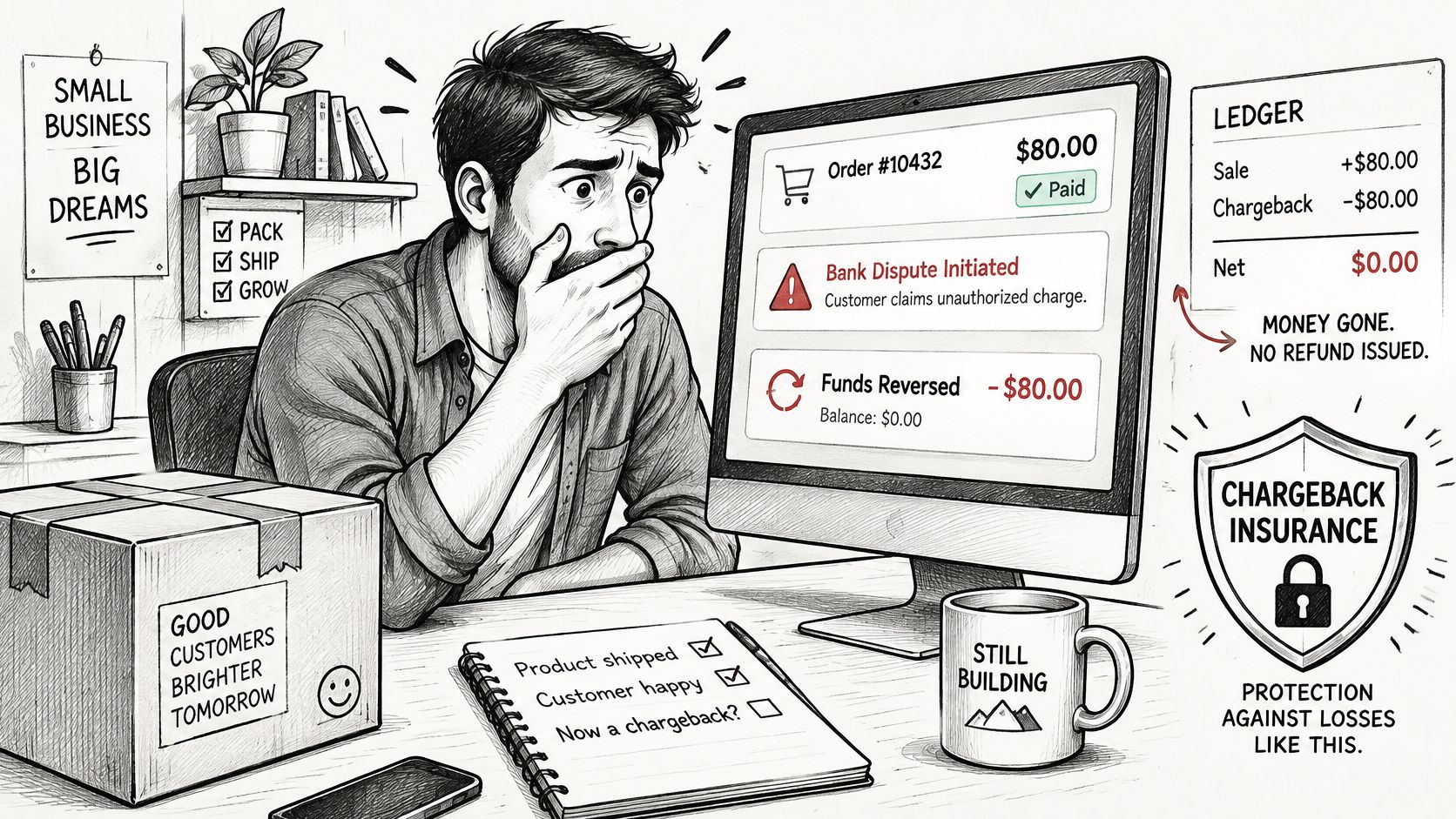
Say you ship an order, the customer disputes the payment with their bank, and your processor pulls the sale proceeds back. You never issued a refund, yet you no longer have the money. The customer may still have the goods.
Chargeback insurance is coverage that reimburses defined losses after a card issuer or payment processor reverses a sale. Think of it as a spare tire: it helps after the flat, but it doesn't stop the nail.
How the money moves
A chargeback is a payment reversal initiated through the cardholder's bank, rather than a refund issued by the merchant. The basic sequence is:
- The customer contacts the bank. They report an unauthorized purchase, missing delivery, cancellation problem, or another dispute.
- The bank initiates the reversal. Your processor debits the disputed amount under its procedures and may charge a separate dispute fee.
- You can contest the claim. You submit transaction-linked evidence through a process called representment, asking for the payment to be restored.
Insurance enters according to its contract's claim conditions. A reversal alone doesn't establish that the loss is covered.
Why your sales channel matters
The Kansas City Fed analysis found substantially higher chargeback exposure for card-not-present transactions, purchases made without presenting the physical card, than for card-present sales. That distinction matters to online retailers, subscription businesses, and software sellers: a blended payment-industry average isn't a reliable forecast for their own checkout.
Your dispute mix matters just as much. Unauthorized purchases, failed deliveries, and cancellation complaints can create similar debits on your statement while receiving different treatment under a policy.
Practical rule: Buy coverage for the losses your business actually experiences, not for the word “chargeback” printed on a brochure.
The useful role of insurance is narrow but important: funding eligible losses that remain after you've worked to prevent disputes and preserve evidence.
What Chargeback Insurance Costs and Which Losses It Repays
There's no standard premium you can safely apply to every merchant. Request quotes using your monthly card volume, average order value, card-not-present share, dispute history, and preferred deductible, the portion of an eligible loss you must absorb.
First establish what the quote buys. The reversed payment is only one possible cost, and naming “chargeback protection” doesn't tell you which other expenses qualify.
Cost components a chargeback insurance policy may or may not repay
| Cost component | What it includes | How policies often treat it |
|---|---|---|
| Transaction value | The original sale amount reversed by the issuer | The core amount to confirm when the dispute is a covered event |
| Chargeback fee | Processor or bank fee charged per dispute | Must be expressly included in coverage |
| Replacement goods and shipping | Product resent or shipped after the dispute | Check exclusions and any separate cap |
| Investigation and evidence costs | Staff time, tools, and outside help for responding | Don't assume reimbursement without an expense clause |
| Processor reserves | Cash the processor holds back during risk review | Establish whether held funds qualify, rather than just reversed sales |
| Network fines and monitoring fees | Charges associated with card-network dispute programs | Require explicit wording for each charge |
| Premium and deductible | Coverage cost plus the merchant's first-loss responsibility | Quote-specific; confirm the pricing basis and deductible calculation |
A chargeback fee is separate from the money returned to the cardholder. Our explanation of what a chargeback fee is helps distinguish those statement entries; recurring-billing teams can also use NoChurn's guide to chargeback fees for subscriptions when mapping subscription-related costs.
A hypothetical loss calculation
For illustration, suppose a shop processes 200 orders at $80, and 1% become disputes. Those assumed inputs produce two disputes, reversing $160 in sales; if the processor also charges an assumed $20 per dispute, the immediate debit totals $200.
Those are illustrative assumptions, not market rates. They exclude investigation time, held funds, penalties, and any additional fulfillment expense.
Now test the policy against that loss. A per-event cap limits an individual claim; an annual aggregate limits total payments over the policy year. A waiting period may delay eligibility or payment, while the deductible reduces the amount recoverable under the applicable wording.
Compare the same disputed sale under every quote. A lower premium is less useful if the policy excludes the costs you're trying to transfer.
Ask each insurer to state the premium's billing basis, its equivalent against monthly card volume, caps, waiting periods, and deductible in writing. Mark each cost line as covered, limited, or excluded, then estimate your remaining annual exposure.
How a Claim Moves From Dispute to Payout
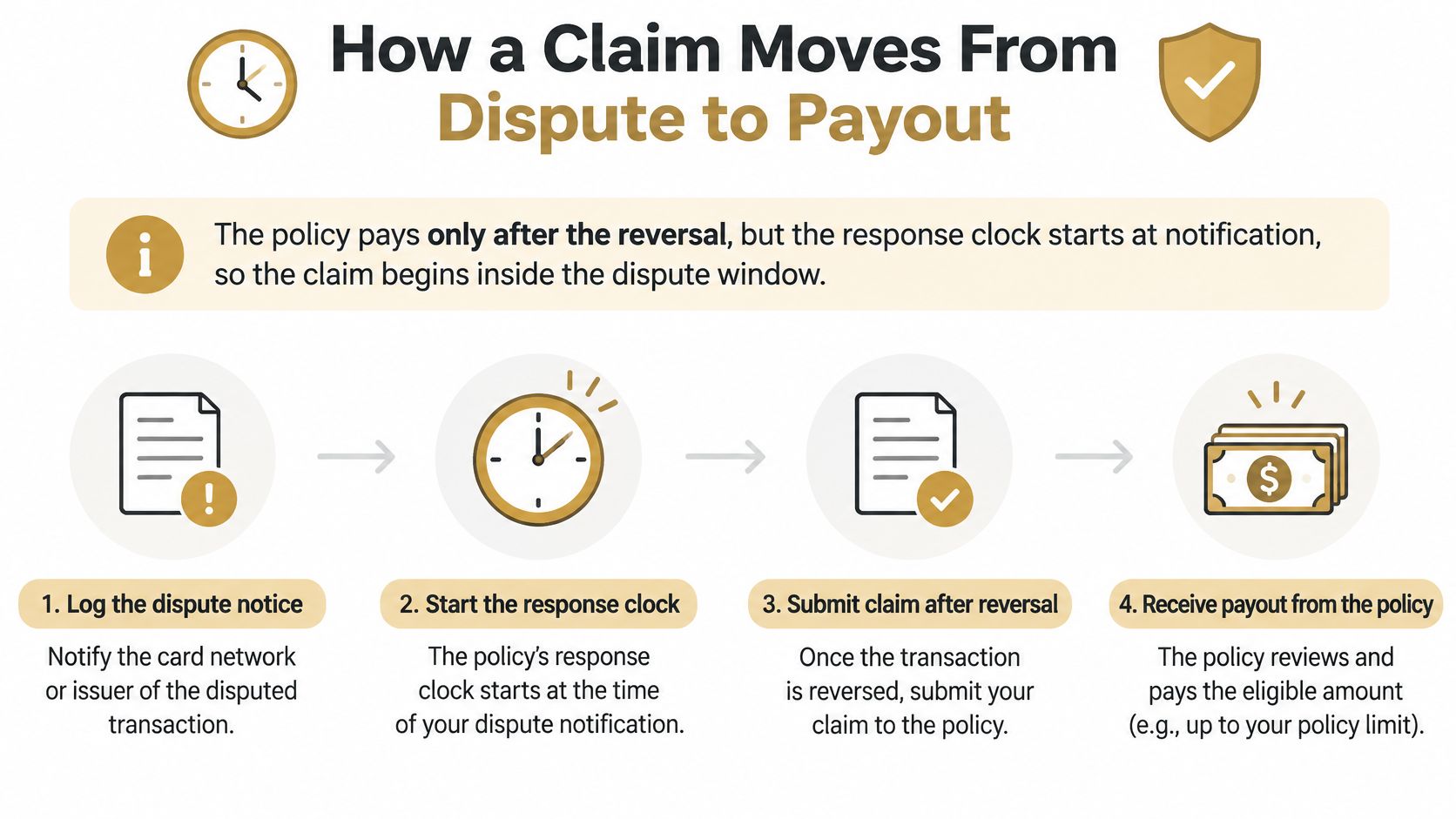
The timing problem starts immediately: reimbursement follows an eligible loss, but your obligation to respond begins when the dispute notice arrives. You need to manage the payment dispute and the insurance claim in parallel.
This diagram separates notification from eventual payment.
Keep both response tracks moving
Log the dispute when it arrives. Record the transaction identifier, amount, notification date, response deadline, and reason code, the network's category for the complaint. Assign a named owner rather than leaving the notice in a shared inbox.
Check the insurance notification requirement. Notify the insurer within the contract's deadline, even if the dispute remains unresolved. Ask which documents can follow later and retain proof of submission.
Build the evidence file. Pull delivery confirmation, customer messages, authentication records, and the AVS result, which records the payment address-verification outcome. For subscriptions, preserve prior payments, login history, renewal notices, and cancellation timestamps.
Respond through your processor before its stated cutoff. The deadline shown in your actual notice governs your workflow. Don't assume the insurer's claim deadline also gives you time to contest the bank's reversal.
Submit the eligible claim. Include the reversal record, dispute response, transaction documents, and any final decision the insurer requires. Our guide to the chargeback dispute process explains the payment-side workflow separately from insurance.
Track the insurer's assessment. Answer follow-up requests promptly and record which policy clause supports each requested payment. Keep the claim open in your tracking system until payment or a documented denial arrives.
Reconcile the recovery. Check the payment against deductibles, caps, and approved expenses. Separately confirm the dispute's status with your processor rather than assuming reimbursement changed it.
Confirm that the policy covers reversals
General cyber insurance isn't enough evidence of coverage. The Victor cyber-policy form illustrates how a policy can broadly exclude chargebacks unless they're expressly covered.
Look for an insuring clause, the provision describing the loss the insurer promises to cover. Match that clause to the actual dispute, not merely to the fact that money left your account.
For a visual explanation of the dispute workflow, watch:
Waiting for the insurer before answering your processor is a costly mistake. A missed response deadline can undermine your opportunity to contest the reversal and may also compromise recovery under the policy.
Disputes Chargeback Insurance Usually Refuses
Not every chargeback is an insurable fraud event. A stolen-card purchase, an overlooked subscription renewal, and an undelivered package may all reverse revenue, but they don't establish the same cause of loss.
Treat the following as a coverage-testing checklist, not a universal description of every policy. In particular, an issuer's responsibility under network rules is different from an insurer's promise to reimburse you.
Dispute types and how coverage usually treats them
| Dispute type | Typical coverage | What decides it |
|---|---|---|
| Unauthorized card-not-present fraud | Potentially covered under a named fraud clause | Fraud definition, authentication status, transaction linkage |
| Card-present fraud | Confirm residual merchant loss; issuer liability isn't insurance coverage | Chip or terminal data and applicable liability rules |
| Friendly fraud, where a customer retains goods or services and disputes anyway | May be excluded or closely scrutinized | Policy definition and required proof of delivery or use |
| Subscription cancellation disputes | May fall outside fraud-only coverage | Cancellation timestamps, renewal notices, prior payments |
| Item not received | Requires wording that includes non-delivery losses | Carrier delivery evidence and shipping-address match |
| Dissatisfaction or not as described | May be excluded as a service or quality dispute | Definition of customer dissatisfaction |
| Processing or authorization errors | Requires express inclusion | Whether the policy names the error |
| Household-member purchase or unrecognized descriptor | Classification requires careful review | Billing descriptor and account-linkage evidence |
Friendly fraud describes customer misuse of the dispute process, although a merchant shouldn't assume every mistaken complaint is deliberate. A customer may forget a purchase, fail to recognize the billing name, or discover that someone in their household used the card.
A Checkout.com article describing a 2025 survey of consumers in the United States and United Kingdom reported that 13% believed they could initiate a chargeback or refund to obtain goods or services for free, while 25% had requested funds back on at least two occasions despite the merchant fulfilling the order.
Intent isn't the same as evidence
Delivery tracking can establish arrival without proving who authorized the purchase. A login record can show service use without resolving whether a cancellation request was honored.
Automatically refunding every alert may avoid escalation, but can reward repeat abuse. Contesting every complaint can recover legitimate revenue, but adds response costs and customer friction.
Before buying, get written answers to these questions:
- Definition: What exactly does the policy classify as friendly fraud?
- Proof: Which records establish an eligible claim?
- Repeat behavior: Can recurring abuse affect coverage eligibility or premiums?
Prevention Options That Work Before a Chargeback Exists
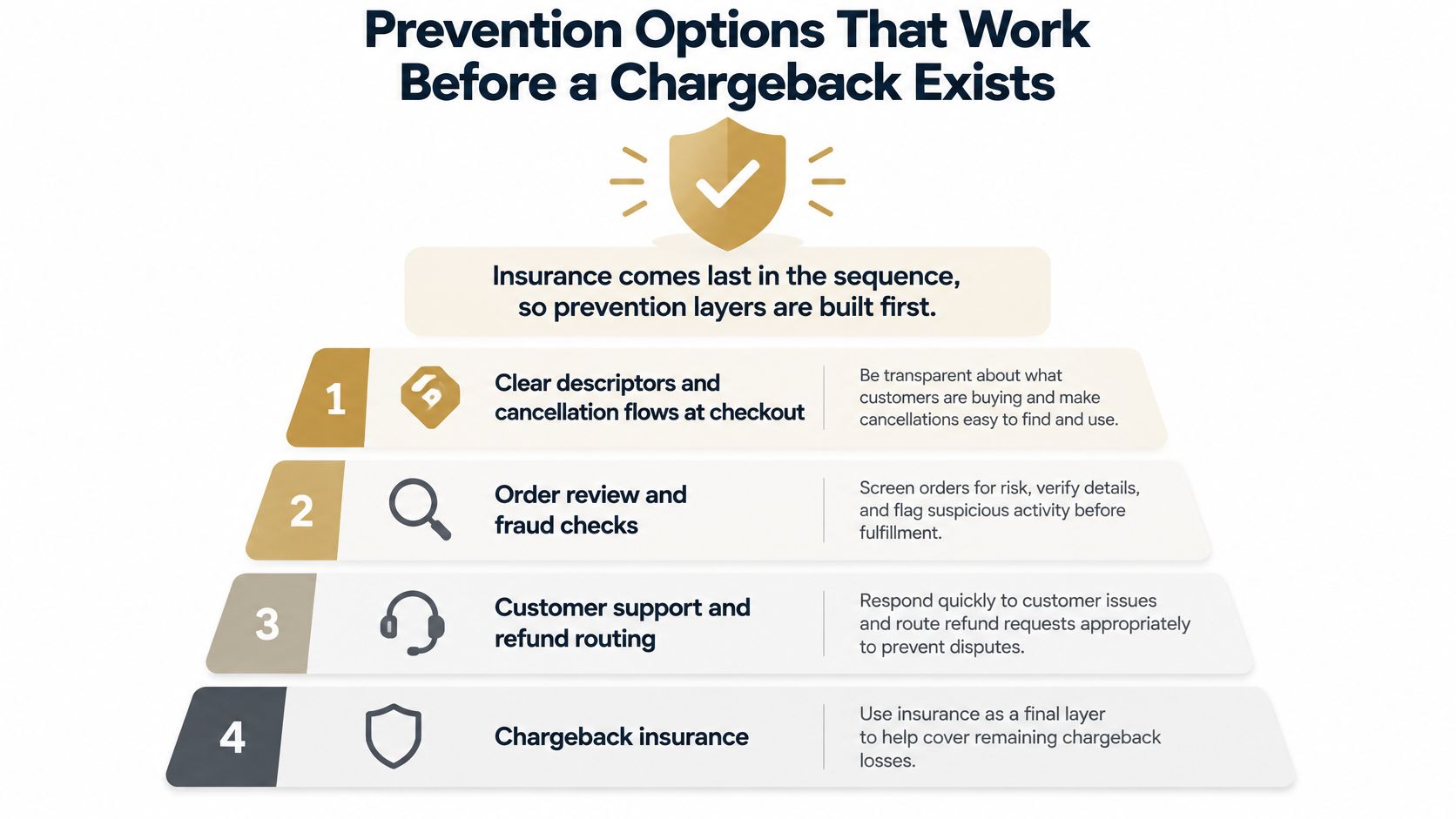
Insurance belongs at the end of the protection sequence. Start by reducing preventable complaints, then address fraud liability, fulfillment evidence, and early dispute intervention.
The hierarchy below shows why a reimbursement policy can't perform every job.
Prevention layers compared with chargeback insurance
| Option | Stage it acts on | What it protects | Main limit |
|---|---|---|---|
| Clear descriptors and cancellation flow | Checkout and each renewal | Reduces unrecognized-charge and subscription complaints | Doesn't stop stolen-card purchases |
| 3-D Secure with qualifying authentication | Checkout | Can shift certain fraud liability away from the merchant | Doesn't resolve non-delivery or service complaints |
| Fulfillment and delivery tracking | After shipment | Supplies evidence for item-not-received disputes | Requires carrier records and retention |
| Network alerts with rapid refund | Early dispute notification | Can prevent escalation into a chargeback | Refund cost; prevention isn't guaranteed |
| Evidence compilation | After filing | Supports representment | Staff or tool cost; no guaranteed outcome |
| Chargeback insurance | After an eligible reversal | Reimburses covered losses | Exclusions and deadlines; no automatic account protection |
3-D Secure is a card-payment authentication framework that helps an issuer verify a shopper. Mastercard's merchant guidance explains that merchants are generally liable for card-not-present fraud, while qualifying authentication can shift certain fraud liability.
That's liability transfer, not an insurance payout. You must still establish that the transaction and authentication result qualify.
Match the intervention to the cause
Visa's merchant dispute-management guidelines distinguish dispute conditions and the transaction evidence needed to address them. Authentication doesn't establish that a parcel arrived or that your team honored a cancellation.
At Disputely, when we detect a chargeback threat, we automatically process a refund to prevent the chargeback. That trades the refund cost against the potential dispute fee and processing consequences; it doesn't preserve the sale proceeds.
We don't guarantee dispute prevention, chargeback reduction, processor approval, account standing, or avoidance of reserves, monitoring programs, or termination. Measure results against your own alert volume and refund costs, using a broader set of chargeback prevention strategies.
Assign each problem to an operational owner: authentication for unauthorized fraud, refund rules and recognizable descriptors for customer misuse, cancellation flows for subscriptions, and tracking for delivery complaints.
Retain evidence even when prevention is working. Some disputes will require a response rather than an early refund.
Pros, Cons and Which Option to Choose
Chargeback insurance is most worth evaluating when an individual loss would materially hurt your business, eligible fraud disputes are relatively infrequent, and you can fund the deductible and reimbursement delay. It's less compelling when frequent disputes fall outside the proposed coverage.
The choice isn't insurance versus no insurance. It's whether the policy offers useful protection after you account for the operational fixes available to you.
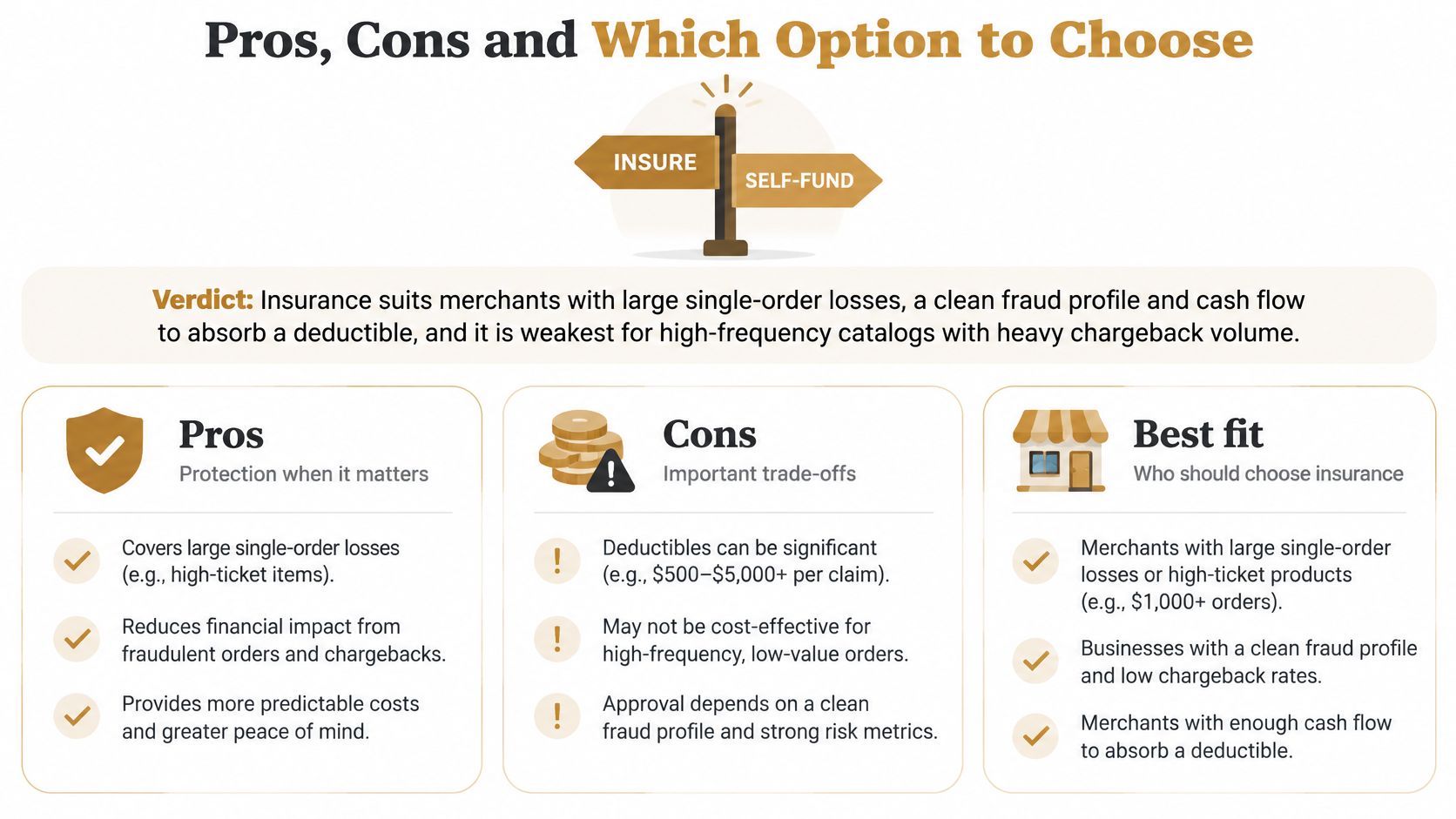
Benefits and drawbacks
Potential benefits
- Large-loss protection: An eligible payout can reduce the financial impact of a concentrated loss.
- Cash recovery: Reimbursement restores funds after a covered reversal, subject to settlement timing.
- Defined risk transfer: Clear wording establishes which fraud losses the insurer accepts.
- Additional expense coverage: Explicitly included fees can make the policy more useful than transaction-only protection.
Limitations
- Ongoing premium expense: You pay for coverage even when you make no claim; deductibles apply according to the contract when eligible losses occur.
- Coverage gaps: Your most frequent dispute reason may be excluded.
- Administration: Someone must preserve records, submit claims, and resolve questions.
- Unchanged dispute records: Financial recovery doesn't itself remove a chargeback from processor reporting.
Choose around your actual dispute mix
Evaluate insurance for residual exposure when order values are high, disputes are uncommon and predominantly eligible fraud, and authentication controls are already functioning.
Prioritize prevention spending when unclear billing names, cancellation problems, or repeat customer misuse drive complaints. Insuring an unrelated fraud category won't fix those losses.
Consider both when substantial online-payment exposure combines with limited cash flexibility. Separately model what happens if your processor holds funds in a reserve, money withheld to cover potential payment liabilities.
Check processing risk separately
A 2023 Federal Trade Commission complaint described Visa's then-applicable excessive-chargeback threshold as 100 or more chargebacks in a month combined with a ratio of at least 0.9%. That historical threshold illustrates why both count and ratio matter, but it isn't a substitute for checking current requirements with your processor.
A dispute ratio expresses chargebacks relative to the relevant transaction population under the applicable program. Don't assume every network or processor calculates it identically.
Run a break-even test
- Estimate loss without the policy. Categorize expected disputes by cause and total the costs your business would retain after other recoveries.
- Estimate cost with the policy. Add the premium, applicable deductibles, excluded losses, amounts above caps, and claim-administration time.
- Compare the totals and the timing. Then test prevention economics against your own alert history, including refunds and service charges.
For our prevention service, you only pay when Disputely prevents a chargeback from hitting your account. Keep that billing model distinct from an insurance premium when comparing proposals.
This week, export your dispute history, classify each reason, and send prospective insurers the same loss schedule. Require a written coverage decision for each category before choosing a policy.
Every Disputely plan includes automatic refund processing to act on chargeback threats, a prevention layer rather than insurance reimbursement. Visit Disputely to evaluate that approach against your alert history and identify which remaining losses might justify separate coverage.


