
Credit Card Refund Rules: Deadlines and Rights Explained
You sold a subscription box, the customer's card was charged on the first of the month, and now she's emailing to say she cancelled in writing three weeks ago. Or you run a small shop and a customer wants his money back on a jacket he bought eleven days ago and doesn't like. Both feel like the same request. They aren't.
Refund rules are split across at least three systems that never talk to each other: the law of the customer's country, the operating rules of the card network, and your own published policy. Each one runs its own clock, starts it at a different moment, and ends it with a different obligation. Get the timing wrong and a routine refund turns into a formal dispute that costs you the sale, the fee, and a mark against your merchant account.
Refund Deadlines Across Card Rule Sets
A customer paid on a Visa card in March. The charge hit the April statement. She emailed for a refund, and you credited the card that afternoon. You treated that as one deadline. It was not. A country rule, a network refund rule, and a network dispute rule can each be counting from a different event.
Five rule sets set the clocks that matter, and none of them starts at the same moment.
| Rule set | Clock starts when | Key deadline | What must follow |
|---|---|---|---|
| US billing error (Fair Credit Billing Act, Regulation Z) | Charge appears on the statement | Cardholder sends written notice after the statement | Issuer acknowledges, then resolves across billing cycles after notice |
| EU consumer withdrawal (Consumer Rights Directive) | Delivery of goods, or conclusion of contract for services | Consumer may withdraw after that start | Trader reimburses after withdrawal notice; may hold funds until return or proof of return |
| Mastercard refund record | Refund transaction receipt date | Submit to acquirer within 15 days | Reversal only for purchase amount or clerical error, within one calendar day |
| Mastercard chargeback | Cardholder dispute notification | Issuer submits within 60 calendar days | Shorter legal or regulatory periods can apply |
| Visa refund credential | Merchant issues refund | No fixed clock | Credit original card where possible; alternate method only for closed or unavailable account or declined authorization |
The Mastercard transaction processing and dispute rules require a merchant to submit each refund record to its acquirer within 15 days of the refund receipt date, and they let an issuer submit a chargeback within 60 calendar days of the cardholder's dispute notification, subject to shorter legal or regulatory periods.
Read the rows in the order a claim moves. These clocks work like separate kitchen timers. One starts when the statement shows the charge. Another starts at delivery for goods, or when the service contract is concluded. The network starts its own when the refund record exists, and a different one when the cardholder notifies the issuer.
The US billing-error path is built around the statement. Written notice comes after that date, the issuer acknowledges, and only then does the investigation run, which is why that path is counted in billing cycles as well as days. The EU withdrawal path is counted in days from its own start, and the trader's reimbursement duty begins at the withdrawal notice, with room to hold the money until the goods come back or the consumer proves they were sent. Those two structures do not map onto each other. A shop selling into both markets has to run both.
A voluntary refund and a regulated dispute are not the same timer. On Mastercard, your 15-day job is to get the refund record to the acquirer. The issuer's 60-day job starts only if the cardholder notifies the bank of a dispute. A credit that reaches the original card and is matched before that submission is what keeps the case from being filed as a chargeback. Miss the refund record, and the dispute clock can still be open even though you already "refunded" in your own system.
The Visa row has no deadline at all. It only says where the money should go: the original card where possible, and another method only if that account is closed, unavailable, or the authorization is declined. A credit sent to a different card may be harder for an issuer to match to the original purchase if a dispute arrives later. That matching point does not set, shorten, or govern the US billing-error path or the EU withdrawal path. Those still start and end on their own terms.
There is no single universal deadline, despite how often one number gets repeated. The starting event, the length, and the party who must act all change with the country and the network.
Find the row that matches your customer's country and the network printed on the card. The same complaint can sit inside one clock and outside another, and a timely refund stops a chargeback only when it lands before that separate dispute clock is used.
Refunds and Chargebacks Are Different Processes
Think about a shop counter. A customer brings back a shirt with the tags on, and the person on the till hands over cash. No one calls the bank. The shopkeeper decided, using the shop's own returns policy, and the money moved because the shopkeeper said so.
A chargeback is a different animal. Nobody at the counter decides anything. The cardholder calls the number on the back of the card, the issuing bank opens a case, and the bank pulls the money back under rules the card networks wrote. The merchant doesn't get a vote, only a response.
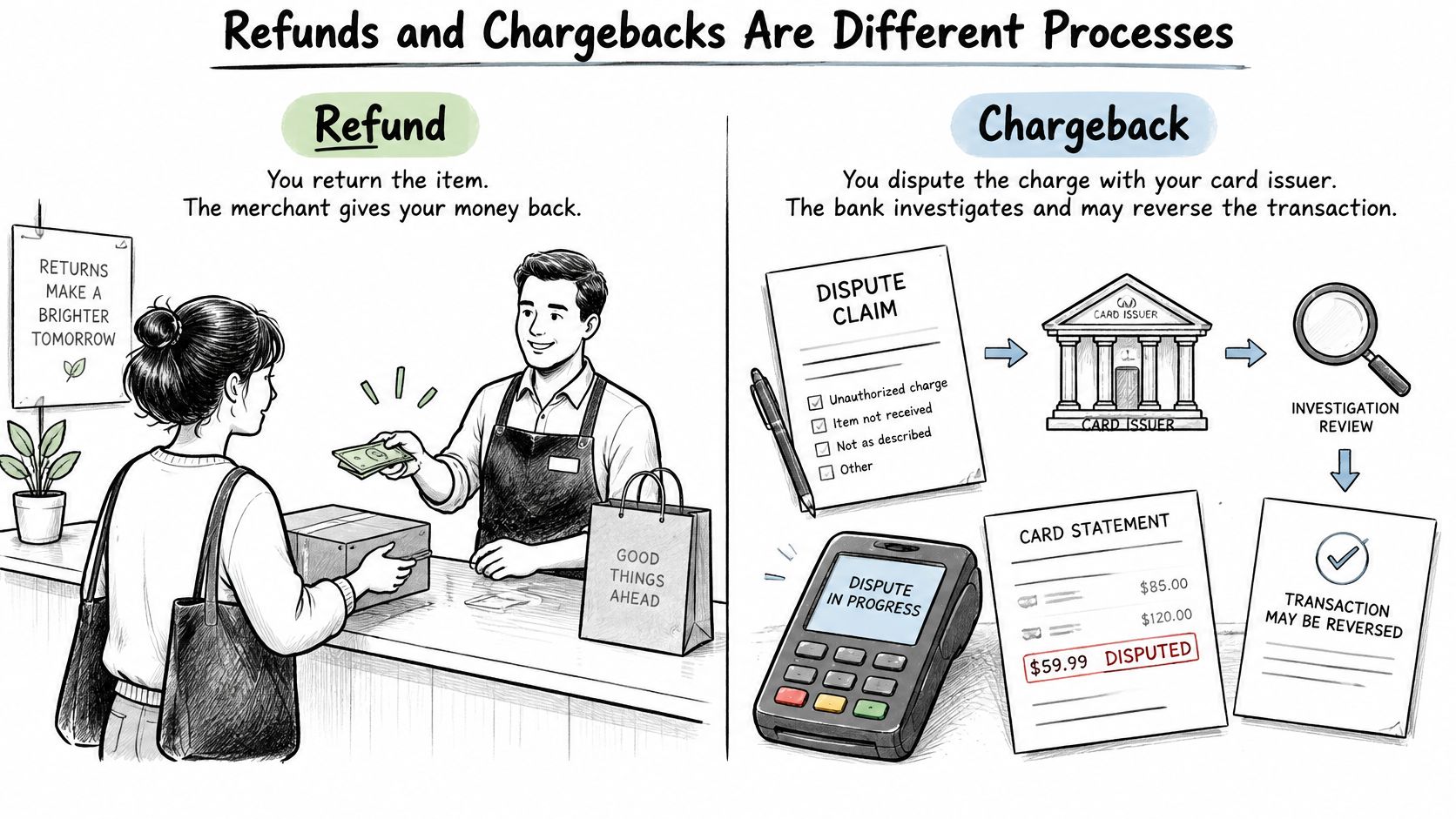
That difference in who decides is the whole story, and everything else follows from it.
Who starts it and who decides
| Factor | Merchant refund | Chargeback |
|---|---|---|
| Who starts it | Merchant decides to refund | Cardholder asks the bank to dispute the charge |
| Who decides | Merchant, under its own written policy | Issuer, under card network rules |
| How money moves | Merchant sends a credit to the card | Bank reverses the original charge |
| Network record | Refund transaction record | Chargeback record |
| Effect on dispute ratio | Refund issued before a dispute is filed usually prevents a chargeback | Counts toward the merchant's dispute ratio and monitoring |
The operational consequence is worth stating plainly. A refund issued before a dispute is filed usually settles the matter without a chargeback ever existing. A refund issued after a dispute is filed, or issued against the wrong transaction so the issuer can't match it, may leave the case open anyway. The customer has the money and the bank still has an open case.
The one-line version: a refund is a merchant decision, and a chargeback is a bank decision made under network rules.
There's a practical detail underneath this that trips up a lot of stores: the refund has to be executable. If your payment setup routes refunds through a processor that can't reach the original transaction, or you're running a gateway that doesn't pass the original transaction identifier through, your policy is only as good as your plumbing. This comparison of choosing a payment setup for stores is worth reading before you promise same-day refunds you can't technically deliver.
Here's the process from the bank's side, which makes the sequencing clear.
One more distinction matters before the legal detail. A customer asking you for a refund is making a request. A cardholder filing a billing-error claim with the issuer is invoking a statutory procedure with its own deadlines and its own evidence standard. The first is governed by your policy and your goodwill. The second is governed by law, and it starts the moment the cardholder escalates, not the moment you first said no. If you want the merchant-side view of how those two tracks interact in practice, this breakdown of chargeback versus refund covers the mechanics of each.
How to Process a Refund That Holds Up
Start with the policy, because everything downstream depends on it. Visa requires merchants to disclose return, refund, and cancellation policies to cardholders, and the same Visa rules require a refund to go, where possible, to the same payment credential used for the original transaction. An alternate credential or a non-card method is permitted only in specified exception cases, such as a closed or unavailable account or a declined authorization.
That means the policy the customer reads on your site has to be the policy your team applies in step two below. If the published version says 30 days and the person on support is granting 45, you've created two policies and no record of which one applied.
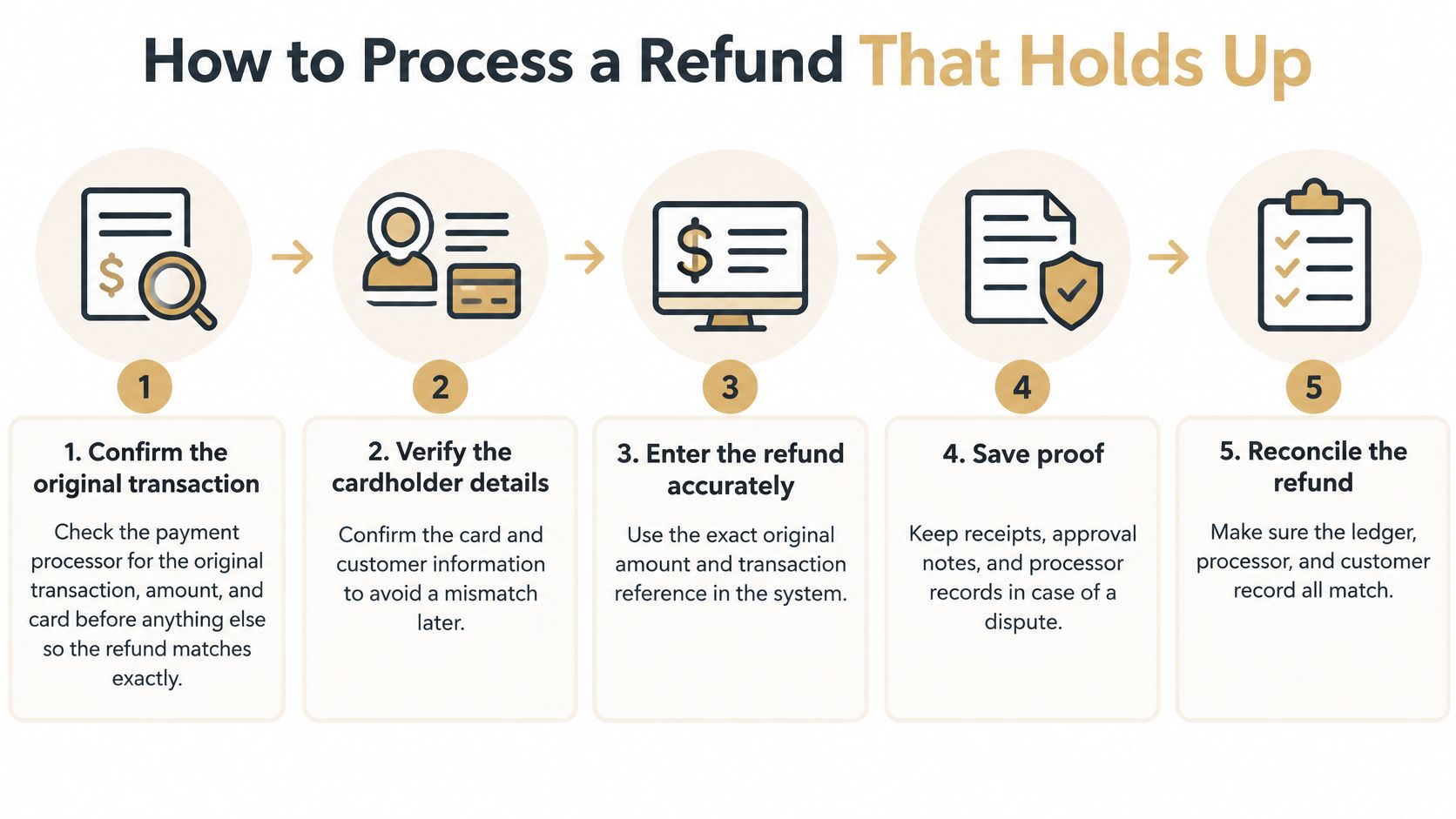
Confirm the original transaction. Pull it up in your payment processor and check the amount, the date, and the card. A mismatch here is the single most common reason a later dispute becomes impossible to resolve, because the issuer can't tie your credit to the charge the cardholder is disputing.
Check the request against the written policy and record the decision. Note whether it's a voluntary goodwill refund, a statutory withdrawal, or a billing-error response. The label determines which clock you're on, and you'll want it later when the case is reviewed.
Send the credit to the original card. Reach for another method only when the account is closed or unavailable or the authorization was declined. Arbitrary card substitution creates reconciliation ambiguity that works against you.
Store the identifiers with the refund. Keep the original transaction ID, the payment credential token, the amount, and the policy outcome together. If a transaction was processed incorrectly, for example as a duplicate or for the wrong amount, use a reversal or adjustment where your processor supports one rather than waiting for the customer to dispute.
Make sure the refund record reaches your acquirer. A refund that exists in your dashboard but never transmits is not a refund as far as the network is concerned. Timestamp it, link it to the original purchase, and monitor the submission status.
Tell the customer when to expect the funds. Bank posting times vary, and a customer who knows the expected date is far less likely to call the issuer on day three.
Keep the evidence. Cancellation records, delivery confirmation, and return proof are what an issuer examines when a billing-error claim arrives.
All refund decisions remain your responsibility, and the funds move through your processor or acquiring bank. The test at the end of every refund is simple: can you trace it from the customer's first message to the posted credit, with a document at every step?
US Cardholder Rights and the Billing Error Process
In the United States, a credit-card refund dispute runs through the Fair Credit Billing Act and Regulation Z's billing-error procedures. The Consumer Financial Protection Bureau's guidance on credit card refunds sets out both the qualifying problems and the timetable.
What counts as a billing error
Regulation Z covers unauthorized charges, charges for goods or services the cardholder didn't accept or that weren't delivered as agreed, and mathematical or statement errors. Notice what's on that list and what isn't. A change of mind isn't a billing error. A late delivery that the merchant is actively resolving usually isn't either, at least not yet.
The timeline a cardholder walks through
The cardholder generally must send the issuer a written billing-error notice within 60 days after the charge appears on the statement. Once the issuer receives that notice, it must acknowledge it within 30 days unless it has already completed the required resolution steps. The issuer then investigates and completes the resolution procedure within two complete billing cycles, but never later than 90 days after receiving the notice.
If the issuer determines a billing error occurred, the consumer's account must generally be credited for the disputed amount and related finance charges.
Worked example: a customer pays for a bundle in early March and nothing arrives. She emails you twice, gets one holding reply, and six weeks later writes to her issuer instead. Her 60-day window still runs from the statement date, not from your last reply, and your earlier offer to refund doesn't pause the statutory clock.
Two things follow for merchants. First, the cardholder's escalation starts a regulated investigation timetable whether or not you think the complaint is fair. Second, accurate transaction records, cancellation evidence, delivery confirmation, and clear refund policies determine whether the issuer treats the claim as a valid billing error or rejects it after investigation.
If a refund you promised hasn't posted, the cardholder can still send a written billing-error notice, but only inside that 60-day window from the statement. That's a narrow gap, and it's why a refund you've approved but not transmitted is more dangerous than one you've declined outright.
Cardholders who want the wider picture of what issuers must disclose and when can read up on the Credit Card Accountability and Disclosure Act, which sits alongside Regulation Z in shaping what appears on a statement.
EU Withdrawal Rights for Online Purchases
European Union consumer law runs a separate and far more standardized refund framework for distance sales, and a merchant's internal policy can't replace it. The EU consumer rights guidance on returns and withdrawal sets the structure.
Under the Consumer Rights Directive, consumers generally have 14 days to withdraw from an online, telephone, or doorstep contract without giving a reason. For goods, the period normally runs from delivery. For services, it generally begins when the contract is concluded. That difference in the starting event matters more than the number, because a merchant shipping slowly gives the customer a longer window without meaning to.
After a valid withdrawal, the trader reimburses the consumer, normally using the same payment method, within 14 days of the consumer communicating the withdrawal. The trader may usually withhold reimbursement until the goods are returned or the consumer provides evidence of return.
The exceptions that catch merchants out
Not everything is withdrawable. The rules carve out certain personalized goods, sealed goods unsuitable for return after opening, and digital content whose performance began with the consumer's express consent and acknowledgement of losing the withdrawal right. A subscription that starts streaming immediately and a made-to-order item sit in very different places.
Then there's the penalty for silence. If a trader fails to inform the consumer about the withdrawal right, the withdrawal period can be extended by up to 12 months. That's the expensive version of a missing checkbox on a checkout page.
Worked example: a clothing webshop in France accepts a return on day 20 and refunds it. The statutory withdrawal period closed on day 14, so that refund is goodwill, and the store's own terms govern it. A return that arrives on day 12 is a legal withdrawal, and the store must follow statutory timing and can hold the refund until it has the item back or proof of return.
The practical instruction is to label the two in your records. Voluntary goodwill refunds and legally required withdrawals have different timing obligations, different evidence needs, and different implications when a customer later disputes the charge. Businesses selling subscriptions, services, or physical products across Europe need to retain evidence of cancellation, delivery, return, and reimbursement timing for both categories.
Refund Timing for Subscriptions and Delayed Orders
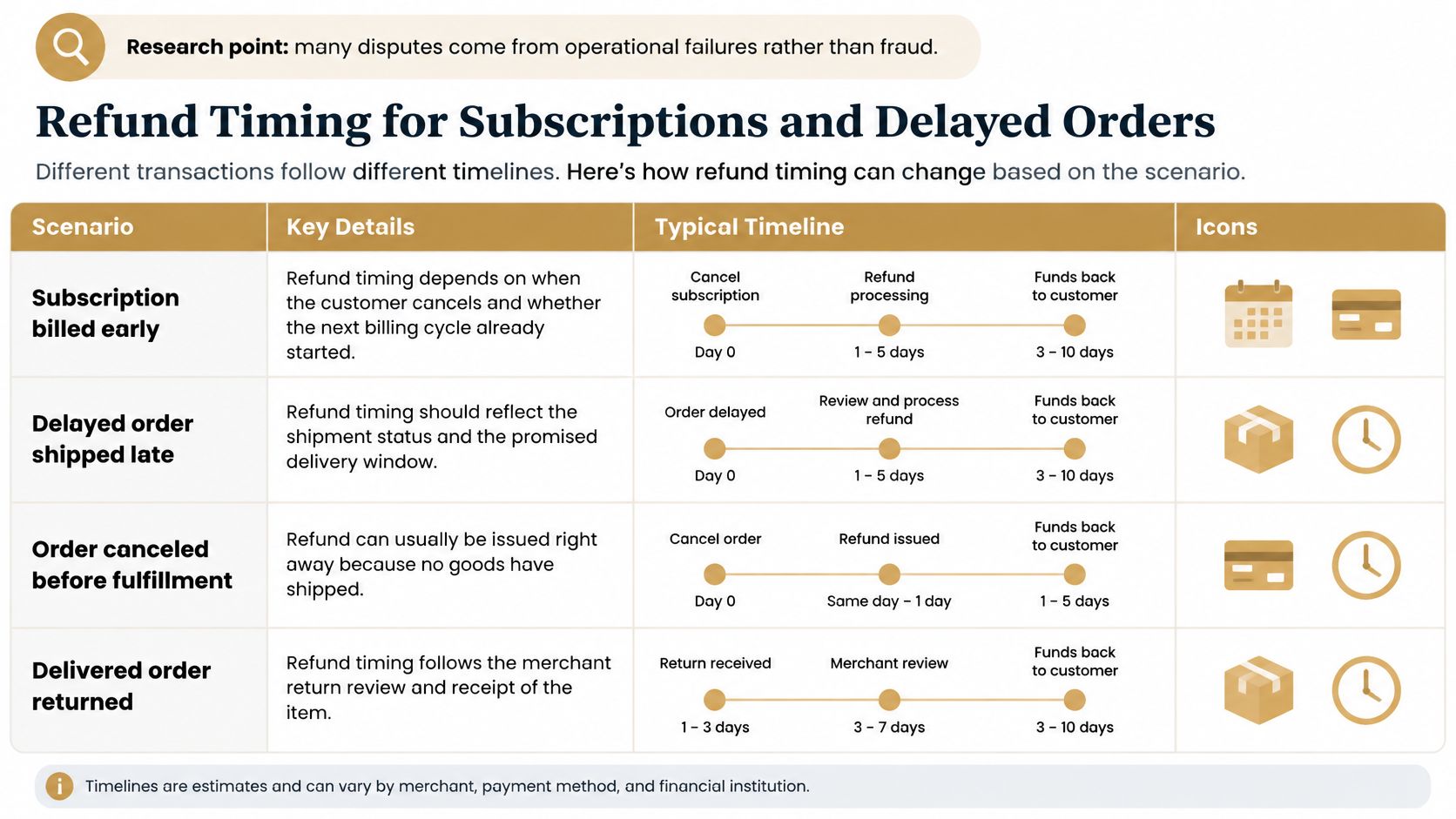
Disputes increasingly come from operational failures rather than fraud, which shifts the problem from your fraud rules to your refund operations. 18% of consumers in Sift's Q4 2025 index associated disputes with delayed refunds and 17% with missing or late deliveries, as collected in Mastercard's 2025 state of chargebacks report. The same report notes that issuers increasingly let cardholders initiate disputes directly through mobile or online banking, which shortens the distance between a bad experience and a formal case.
Why one deadline misses the point
A standard purchase has one window and one fulfilment event. A subscription has a billing cycle, a cancellation date, and a period of service already consumed. A delayed order has a promised date that keeps moving. Future-delivery and travel transactions can carry substantially longer practical exposure than a standard purchase, because the customer is waiting months for something they've already paid for.
| Scenario | Refund action | Dispute risk to watch |
|---|---|---|
| Subscription cancelled mid-cycle | Stop the next charge and refund the unused period per policy | Charges continuing after cancellation are a common billing-error claim |
| Delayed fulfilment | Refund or confirm a new delivery date promptly | Delayed refunds and late deliveries drive disputes for many consumers |
| Partial refund | Refund only the affected item amount, matched to the original transaction | A refund against the wrong transaction may not resolve the dispute |
| Cancelled service | Refund in full or pro rata, with cancellation recorded | Cancellation evidence decides whether the issuer sees a valid billing error |
| Future delivery or travel | Refund according to the stated cancellation terms | Practical exposure can run longer than for a standard purchase |
Two failure modes sit inside that table. A promised refund leaves the customer waiting with nothing but an email, and a refund sent against the wrong transaction leaves the dispute open even though money moved. Both look like resolution from the merchant's side and like nothing from the customer's.
A decision rule that scales
Don't refund every alert automatically. Prioritize the cases where the complaint is operationally valid, where the refund can be clearly matched to the original payment, and where contesting the case would cost more than the transaction is worth. That last test does most of the work at low order values.
At the same time, distinguish legitimate refund prevention from obstruction. Unclear policies and slow replies redirect avoidable service failures into issuer disputes, and once that happens the merchant has traded a small refund for a chargeback and a ratio hit.
For stores that bill on a cycle, the timing mechanics of recurring payments deserve their own attention, and this guide to payments and subscriptions covers the places where billing and cancellation records diverge.
Audit Your Refund Rules Before the Next Dispute
Pull the last 90 days of refunds and disputes and test every row against the deadline table at the top of this guide. That single exercise finds more problems than any policy rewrite, because it compares what you promised with what posted.
The 90-day audit
Map each refund to its original transaction. Open your processor and confirm the credit points to the same card and transaction ID as the charge. Any row that fails is a dispute waiting to be filed.
Check the submission status of every refund record. A refund that never reached the acquirer, or reached it late, is the gap that produces "I never got my money" emails followed by a bank call.
Match dispute dates against refund dates. For every chargeback, note whether a refund was issued before or after the cardholder filed. Refunds issued before the dispute are the ones that prevented a case. Refunds issued after are the ones that didn't.
Verify that cancelled subscriptions stopped billing. Look for any account that cancelled and was charged again. That pattern is a billing-error claim under US rules and a straightforward complaint anywhere else.
Confirm your published policy matches the applied policy. Read your own checkout page and compare it with what support granted over the same 90 days.
Check regional coverage. If you sell into the EU, verify that your policy states the statutory withdrawal right rather than replacing it, and that your records distinguish goodwill refunds from legal withdrawals.
Score the evidence trail. For each case, ask whether you hold the order record, the cancellation record, the delivery confirmation, and the return proof. Missing evidence is what turns a winnable case into a loss.
For stores that want the refund decision handled at the alert stage rather than after the case is filed, alerts from Visa RDR, Verifi CDRN and Ethoca are matched to the order and refunded by the merchant's rules, so the dispute never posts or counts against the ratio. That automation doesn't change who owns the decision: eligibility, account actions, and processor outcomes stay with the merchant and the processor. Rules you write, executed fast, are the whole mechanism.
The audit is the part most merchants skip, and it's the only part that shows you where your refund rules and your dispute rules disagree. Fix the failing rows before the next customer calls the number on the back of her card.
Disputely sits between a cardholder's dispute and your merchant account, catching Visa RDR, Verifi CDRN and Ethoca alerts the moment they're raised and applying your refund rules to decide what happens next. You keep control of the policy; the platform handles matching, timing, and the response before the case ever posts. Connect your processor and run your last 90 days through it at Disputely.


