
How to Dispute Credit Card Charges in 2026
The most repeated advice on a credit card dispute is simple, and it's wrong. Refund every alert, or tell the cardholder to call the bank and let the issuer sort it out. That shortcut treats every unfamiliar line on a statement as theft. Plenty of those lines are real purchases the buyer forgot, a family member charged, or a renewal whose descriptor doesn't match the brand.
A refund is a conversation with the store. Asking a bank to dispute credit card charges is a formal request that pulls the issuer, the processor, and the card network into the sale. Pick the wrong path and you either hand back a legitimate order or spend weeks fighting a claim you cannot prove.
Say a shopper sees "ACME*DIGITAL 4821" and assumes fraud. The charge was a software renewal they approved months ago. The useful choice is recognition, a fast refund, or representment, not a blanket refund on every alert.
What a Credit Card Dispute Actually Means
Picture a bakery counter. You hand the loaf back to the clerk and ask for your money. That's a merchant refund: customer service, no bank involved, and the sale never leaves the store's books. A credit card dispute is different. You ask your card issuer to reopen the sale on the payment rails and reverse the charge through the card network.
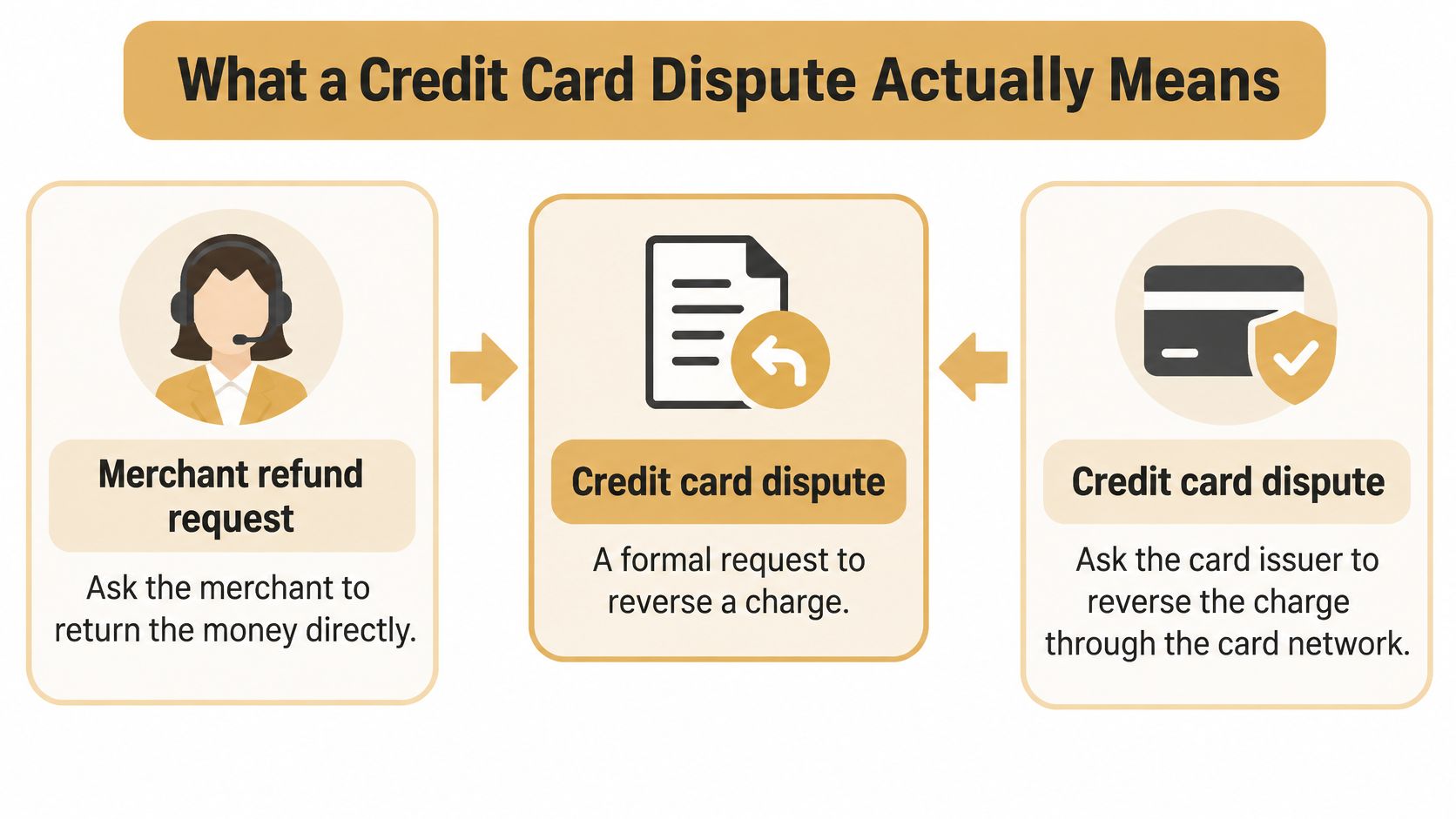
A credit card dispute is the cardholder's request that the issuer reverse a purchase. A chargeback is what happens if the issuer accepts that request and starts the reversal. Four parties share the case: the cardholder, the issuer (the bank that issued the card), the acquirer (the merchant's processor), and the merchant. Once the issuer files, this is no longer a complaint email. It's a payment-system case.
Why the cost is larger than the refund
The Federal Reserve's 2023 interchange report treats chargebacks as reversals that may result from customer disputes, fraud, processing errors, authorization problems, or merchants failing to provide requested transaction documentation. Any one of those can start the same machinery.
A chargeback is an issuer-initiated reversal of a purchase transaction that transfers value from the acquirer back to the card issuer.
On covered debit-card transactions in 2023, fraud losses reached 17.6 basis points of transaction value, or $17.63 per $10,000 processed, up from 7.8 basis points in 2011. Merchants absorbed 49.9% of those reported fraudulent-transaction losses, cardholders 21.8%, and issuers 28.3%. Those figures cover large covered debit issuers, not every U.S. payment. They still show the bill isn't only the refunded sale. Review time, representment work, and fraud losses sit on top of it. Stopping an avoidable dispute before a chargeback is filed is cheaper than winning one later.
How a Credit Card Dispute Moves Through the System
The path is the same whether the claim is fraud, a processing error, a failed authorization, or missing paperwork. What changes is who holds the case, and how expensive the next step is.
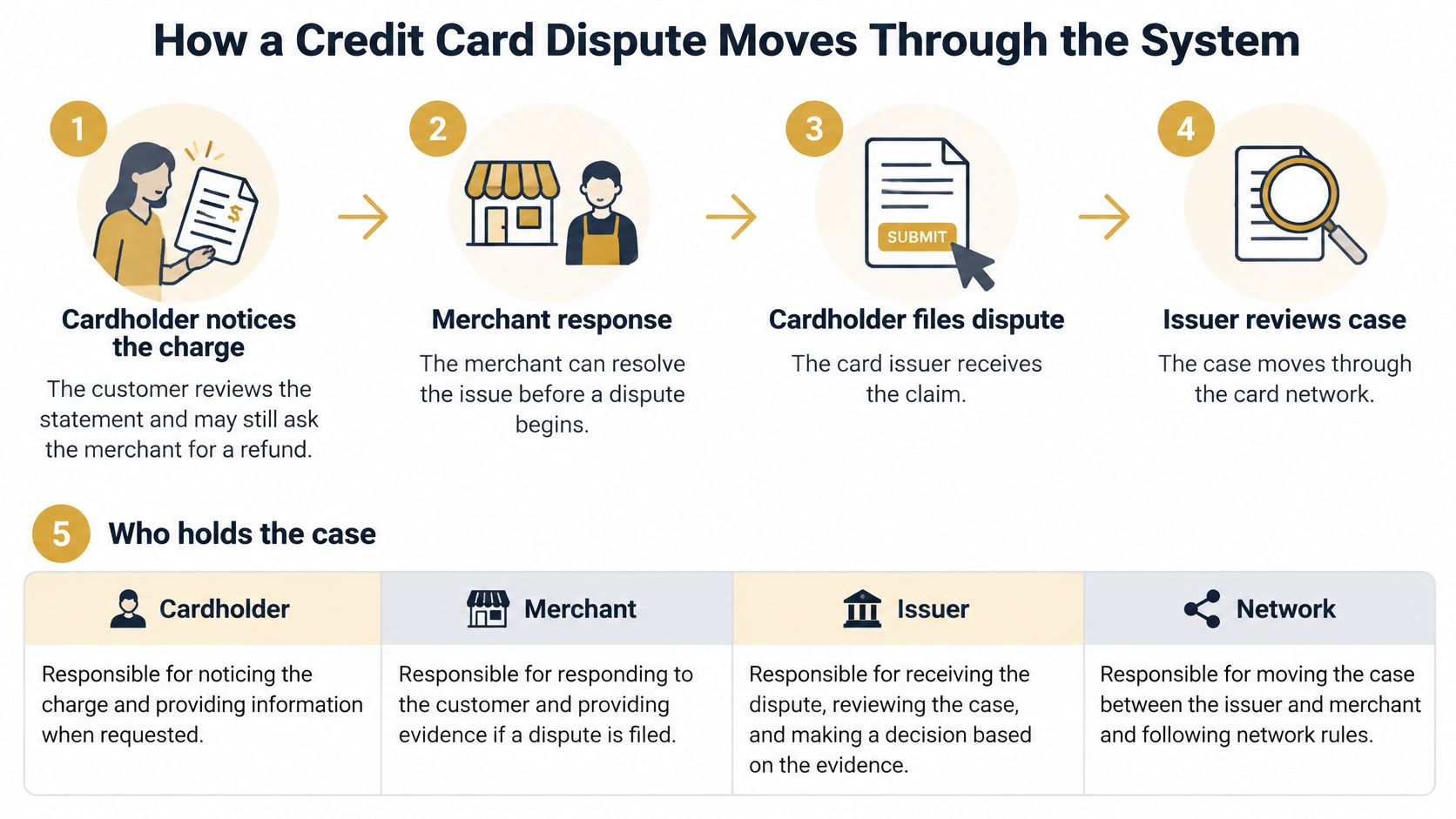
- The cardholder notices the charge. They can still ask the merchant for a refund, a replacement, or a plain explanation. That conversation is customer service. It is not yet a network dispute, and the sale stays with the merchant.
- The complaint becomes formal. If the store can't fix it, or the cardholder skips the store, they contact the issuer. An ordinary complaint is now a credit card dispute.
- The issuer reviews the claim. It checks the story against the transaction and may post a provisional credit while it decides. The cardholder often sees money back before anyone has proved the claim.
- The issuer files a chargeback. If it accepts the claim, value moves back toward the issuer. The merchant receives a reason code and loses the sale pending a response.
- The merchant represents or accepts. Through the acquirer, the merchant either accepts the reversal or submits representment evidence aimed at that reason code.
- The issuer decides. The chargeback stands, is reversed, or may move toward pre-arbitration. That last stage is slower and more expensive than anything that happened at the counter.
Who holds the case
| Stage | Who acts | What changes | Status of the sale |
|---|---|---|---|
| Customer asks the merchant | Cardholder and merchant | Refund, replacement, or explanation with no network case | Sale still with the merchant |
| Customer files with the issuer | Cardholder and issuer | Ordinary complaint becomes a formal dispute | Provisional credit may be posted |
| Issuer files a chargeback | Issuer, acquirer, and merchant | Reason code assigned and value reversed toward the issuer | Merchant loses the sale pending a response |
| Merchant represents or accepts | Merchant and acquirer | Evidence submitted or the reversal accepted | Sale returns if the evidence is accepted; the reversal stands if the merchant accepts |
| Issuer decides | Issuer | Chargeback stands, is reversed, or may move toward pre-arbitration | Final network outcome |
The only inexpensive window is before the chargeback is filed. After that, the merchant can lose the sale, pay dispute handling costs, and spend staff time on representment.
If you're the cardholder, gather the statement line, receipts, order emails, and any merchant replies before you call the issuer. Note the date the charge appeared so the claim is easy to file. If you don't recognize the line, compare the billing descriptor with the merchant name, then check whether a family member or a subscription made the purchase. Many cases close at that step with no chargeback at all.
A short walkthrough of the same path, from the statement line to the network decision, is here:
Match the response to the kind of claim. Treating every stage the same is how legitimate orders get refunded and weak claims get fought.
When to Refund and When to Fight
Don't refund every alert, and don't fight every claim. Mastercard reports that 73.6% of disputes become chargebacks, while only 26.4% are resolved before chargeback completion. Most of the money and the ratio damage happens after the claim leaves customer service.
The same Mastercard and Javelin research found that 48% of consumers had disputed at least one charge they later realized was legitimate. Merchants and issuers estimated that first-party or "friendly" fraud represented about 20% of disputes in 2025. A dispute is often an unrecognized legitimate purchase, not account takeover.
The middle ground shows up in ordinary orders. A billing descriptor the customer doesn't know. A spouse's purchase on a shared card. Digital goods that were downloaded the same night. A parcel the carrier already marked delivered. A subscription the buyer forgot after a free trial. None of those is stolen-card fraud, and none of them deserves the same reply.
Refund, clarify, or represent
| Dispute type | What it usually is | Merchant move |
|---|---|---|
| Unauthorized fraud | Stolen card or account takeover | Accept or refund when authentication is weak and tighten fraud checks |
| Cardholder does not recognize | Confusing descriptor, family purchase, or digital goods | Clarify with descriptor and order proof before refunding automatically |
| Friendly or first-party fraud | A real purchase the customer later denies | Represent when delivery, usage, and consent are documented |
| Subscription confusion | A renewal the customer forgot or could not cancel | Refund quickly if cancellation was hard; otherwise show consent and reminders |
| Processing or duplicate error | A merchant or processor mistake | Refund immediately and fix the billing error |
| Not delivered or not as described | A fulfillment or product gap | Refund if proof is weak; represent with tracking and usage logs if proof is strong |
True unauthorized use with weak authentication is a poor fight. Refund it and tighten the checks. An unrecognized but legitimate order is often fixed by showing the descriptor, the order email, and who placed it. Friendly fraud with delivery and consent is a representment candidate. A subscription the customer couldn't cancel is usually a fast refund. A duplicate or a processing error should be refunded and corrected in the billing system the same day. Non-delivery with no tracking is a refund. Strong carrier proof and usage logs can be fought.
Sometimes the fair answer isn't the full amount. A damaged item or a partial shipment is a case for giving back only what failed, and the ServeApps guide to partial refunds walks through how that credit should be recorded so the rest of the order stays intact.
Practical rule: Refund when you can't prove the claim is wrong, or when the service failed. Investigate or represent when the transaction context shows a legitimate purchase the issuer would accept.
Evidence That Answers the Reason Code
A thick file is not a strong file. Mastercard's chargeback guide starts with the reason code and asks for "compelling evidence" aimed at that code. Extra pages about a different question slow the reviewer and don't change the decision.
Take reason code 4863, Cardholder Does Not Recognize. On a first chargeback, the rules may require a cardholder letter, email, message, or completed dispute-resolution form stating that the transaction was unauthorized. A stack of shipping labels doesn't answer that question. A note from the cardholder that they don't know the charge does.
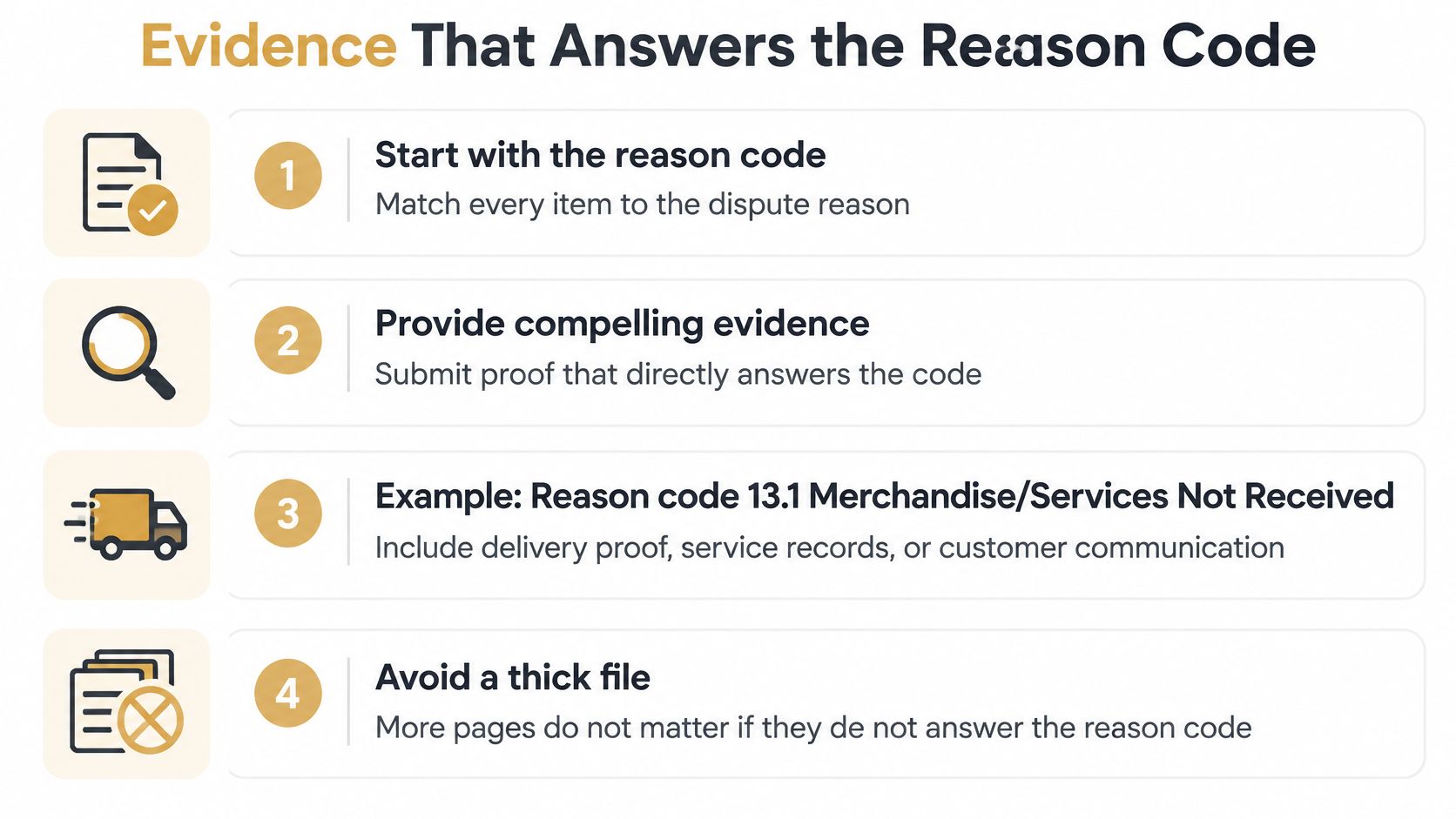
Think of the issuer as a skeptical clerk who asked one question. Receipts about a different question only hold up the line. Our chargeback reason codes guide is the place to match each code to the proof it asks for.
Map proof to the allegation
Unauthorized use. Keep authorization and authentication records: AVS and CVV results, 3-D Secure outcomes, device data, and the IP used at checkout. If those checks were weak or missing, the file won't carry the claim.
Goods or services. Keep the delivery address, carrier tracking, delivery confirmation, and usage logs. A login the same day, a download, or a signature at the door answers "I never got it" better than an invoice.
Recurring billing. Keep the cancellation terms, renewal notices, the original consent, and a history of earlier successful payments on the same card. One prior undisputed renewal is often more persuasive than a long policy PDF.
Don't edit records after the transaction. Change a descriptor, rewrite a timestamp, or tidy a support chat and the file looks manufactured. Store immutable timestamps and the original customer messages.
Sort incoming disputes by reason code and leave out attachments that don't answer the issuer's question. Automation should suppress the irrelevant pages, not dump the whole order folder into the response. This package matters only after you've already decided the case is worth representing. If the proof doesn't exist, refund and move on.
Why Subscription Renewals Turn into Disputes
A customer opens a banking app on a Tuesday and sees a charge from a string of letters they don't remember. The brand was a skincare box or a project tool they tried during a launch week. The cancel link sits three menus deep. They tap dispute instead of hunting for the merchant. The renewal was legitimate. The dispute still looks like fraud from their side of the screen.
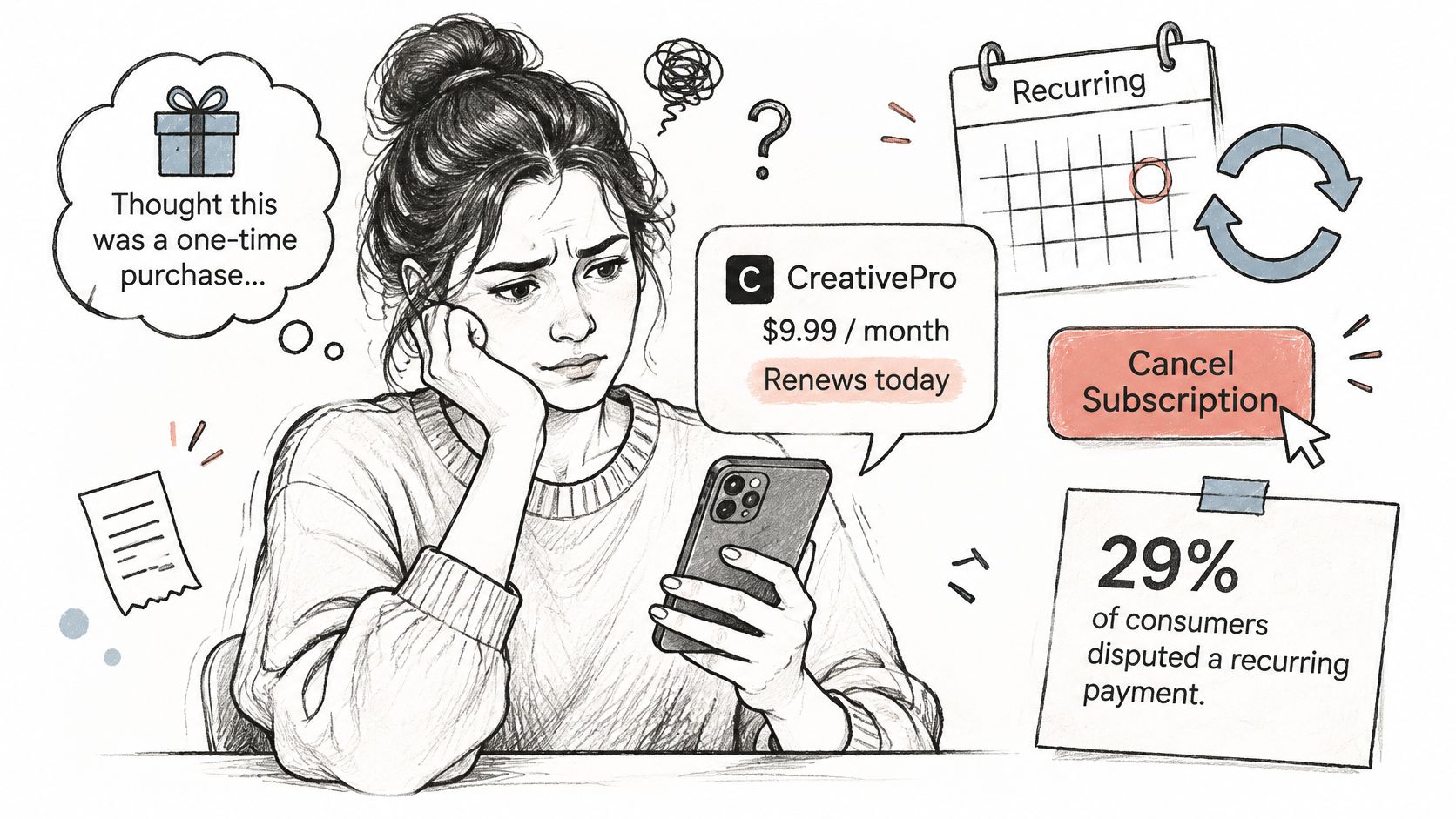
That gap between a real charge and an unrecognized one is where most subscription disputes are born. Mastercard's subscription research reports that 29% of consumers have disputed a recurring payment because they believed it was fraudulent, and 25% have blocked a payment for the same reason. 85% want their bank to cancel subscriptions for them. Younger buyers often skip the merchant entirely: 83% of people aged 18 to 44 prefer to resolve the problem through their bank.
Chargeback volume is expected to keep climbing as subscription billing grows, which is why renewal clarity matters more each year. A cardholder who recognizes the charge rarely disputes it, and a cardholder who could have cancelled easily usually does that instead.
Fixes that belong before anyone files
Treat this as a recognition and cancellation problem that lives in the product, because a buried cancel button produces disputes no evidence package can prevent. The useful work happens weeks before the statement posts.
- Descriptor: Make the statement name match the brand the customer remembers, not a parent company or a payment facilitator string.
- Renewal reminder: Send it before the charge, with the amount and the date, not after the statement posts.
- Account page: Show the plan, the next bill date, and the last four digits of the card in one place.
- Pause option: A pause keeps the customer and stops the "I couldn't cancel" dispute.
- Cancel path: Let them cancel without a phone call. If cancellation was confusing, a fast refund still beats a chargeback.
A merchant with clear consent and a reminder history can represent a renewal dispute and win. That decision comes later, and it only works for the cases worth fighting; the prevention fixes above shrink how many cases reach that point at all. For how renewals, descriptors, and dunning fit together, see our notes on payments and subscriptions.
Visa Monitoring Limits Merchants Can Cross
Individual disputes add up to a ratio the card network watches. Visa's Visa Acquirer Monitoring Program (VAMP) measures a combined fraud-and-dispute ratio, so friendly fraud and true fraud share one tolerance. A clean fraud rate won't save you if unrecognized renewals fill the same bucket.
| Region | VAMP ratio | Minimum activity |
|---|---|---|
| Asia-Pacific, Canada, European Union, United States, Latin America and Caribbean | At least 220 basis points (2.20%) | At least 1,500 monthly fraud-and-dispute occurrences |
| CEMEA | At least 220 basis points (2.20%) | At least 150 occurrences and USD 75,000 associated volume |
Visa's 2025 VAMP fact sheet sets those excessive-merchant thresholds, and the updated thresholds became effective June 1, 2025. A dashboard built on an older fraud-only program can understate current exposure.
Why one monthly percentage hides the risk
A merchant can sit under 2.20% while volume is low, then cross the count line as sales grow. The ratio and the occurrence floor both have to be watched. Fraud and non-fraud disputes consume the same tolerance, so a wave of "I don't recognize this" renewals moves you toward the line just as stolen-card cases do.
Track the numerator, not a single monthly percentage. Split it by dispute type, card network, product, billing descriptor, subscription cohort, and fulfillment status. Set an internal alert as the rolling ratio approaches the line that applies to your region.
Separate three streams that get mixed in one chart:
- Recurring billing, where recognition and cancellation drive the count.
- Card-not-present sales, where delivery and usage proof decide whether you fight.
- Suspected card testing, small repeated auths that should be blocked before they become disputes.
Stopping avoidable disputes before they're filed protects the sale and your standing with the acquirer. How those program lines work in practice is covered in our chargeback threshold breakdown.
Keep the Dispute from Becoming a Chargeback
Start with last month, not with a new tool.
- Audit disputes by reason code. Separate unrecognized legitimate orders, service failures, duplicates, and true unauthorized use. A single "fraud" bucket hides the cases you could have clarified.
- Refund the ones you would lose. Service failures and processing errors belong here. Fighting them spends the sale twice.
- Route the rest before the ratio nears the Visa line. Alerts and representment belong on claims where the order, the consent, or the delivery proof would hold up.
We act as a limited agent for the window before a chargeback hits the merchant account. We're notified of a dispute in the alert flow, and our Verifi by Visa (RDR) product auto-decides qualifying Visa transactions so those disputes resolve instantly. Our chargeback prevention rate is 91%, and you only pay when we prevent a chargeback from hitting your account.
That rate is not a guarantee. Issuer behavior, processor risk models, and card network rules still decide outcomes, and no tool removes every dispute. High-volume ecommerce, subscription, and DTC teams should connect the processor they already use and set refund rules from the refund-versus-fight split, not a rule that refunds every alert.
Disputely notifies you when a customer disputes a charge and gives you a chance to refund or resolve it before the chargeback reaches your merchant account. If you want that pre-chargeback window on the Visa, Mastercard, and other network alerts you already see in your processor, connect your account and set the rules yourself. Visit Disputely to see how the alert flow fits the way you already decide refunds.


