
Dispute Management: A Merchant's Guide to Chargebacks
A customer doesn't recognize your charge, calls their bank, and asks for their money back. Your team sees a payment reversal, an unfamiliar reason code, and a response deadline, even though the order left your warehouse days ago. Should you refund, send evidence, or contact the customer?
Good dispute management makes that decision deliberate. You're managing a portfolio of payment risks, customer relationships, and recoverable revenue, not trying to win every case.
What Dispute Management Covers and Why It Matters
From the customer's perspective, the bank is investigating an unfamiliar purchase. From your perspective, money has moved out of the business before anyone has asked your fulfillment team what happened. Both sides may hold useful evidence, but neither has the complete picture.
A chargeback is a payment reversal initiated through the card issuer that transfers transaction value from the merchant side back to the cardholder. A refund is a credit the merchant initiates voluntarily. They may produce a similar customer outcome, but they follow different processes and require different operational decisions.
The historical scale helps explain why this matters. A Federal Reserve analysis of U.S. debit-card transactions reported that chargebacks represented 0.02% of transactions in 2015, while returns represented approximately 0.79%; together, they totaled about 0.5 billion transactions worth roughly $30 billion.
Think claims desk, not refund queue
Dispute management resembles an insurance claims process more than an ordinary return. Different participants hold different records:
- The cardholder and issuer provide the claim and banking relationship.
- The merchant and acquirer provide transaction, fulfillment, and payment-processing records.
- The card network supplies the rules under which participants exchange and assess the claim.
Your support team may know the customer requested cancellation. Your warehouse may have delivery confirmation. Your payments team may see a processing error neither team noticed.
Managing disputes means bringing those records together, deciding which response is justified, and completing it before the applicable deadline. It also means changing the practices that caused preventable claims.
Practical rule: Treat every dispute as a case with an owner, a deadline, a reason, and a documented decision.
A low incidence doesn't make disputes harmless at scale. The merchant's advantage is operational discipline: identify the claim early, preserve relevant records, and choose the response that protects the business rather than merely improving a win-rate dashboard.
The Dispute Lifecycle from Customer Claim to Final Outcome
A typical dispute follows the stages below, although customers can bypass merchant support and go directly to their bank. The deadline on the notice is your operational deadline, not a generic response window found online.
| Stage | What Happens | Who Acts | Merchant Action |
|---|---|---|---|
| 1. Customer contact | Customer complains or asks for a refund; no bank claim yet | Customer, merchant support | Respond quickly and offer a refund or fix |
| 2. Dispute filed | Cardholder contacts the issuing bank, which files the claim through the card network | Issuing bank, card network | Watch alerts and note the response deadline on the notice |
| 3. Provisional credit | Issuer may return funds to the cardholder while it investigates | Issuing bank, acquirer | Check the amount and reason code |
| 4. Merchant response | Merchant submits evidence, called representment, or accepts the loss | Merchant, acquirer | Compile tracking, receipts, and logs before the deadline |
| 5. Review and decision | Issuer assesses the evidence under applicable network rules; further network procedures may apply | Issuer, card network | Monitor status and answer follow-up requests |
| 6. Final outcome | Funds are restored to the merchant or the chargeback stands | All parties | Record the result and update dispute-reason analysis |
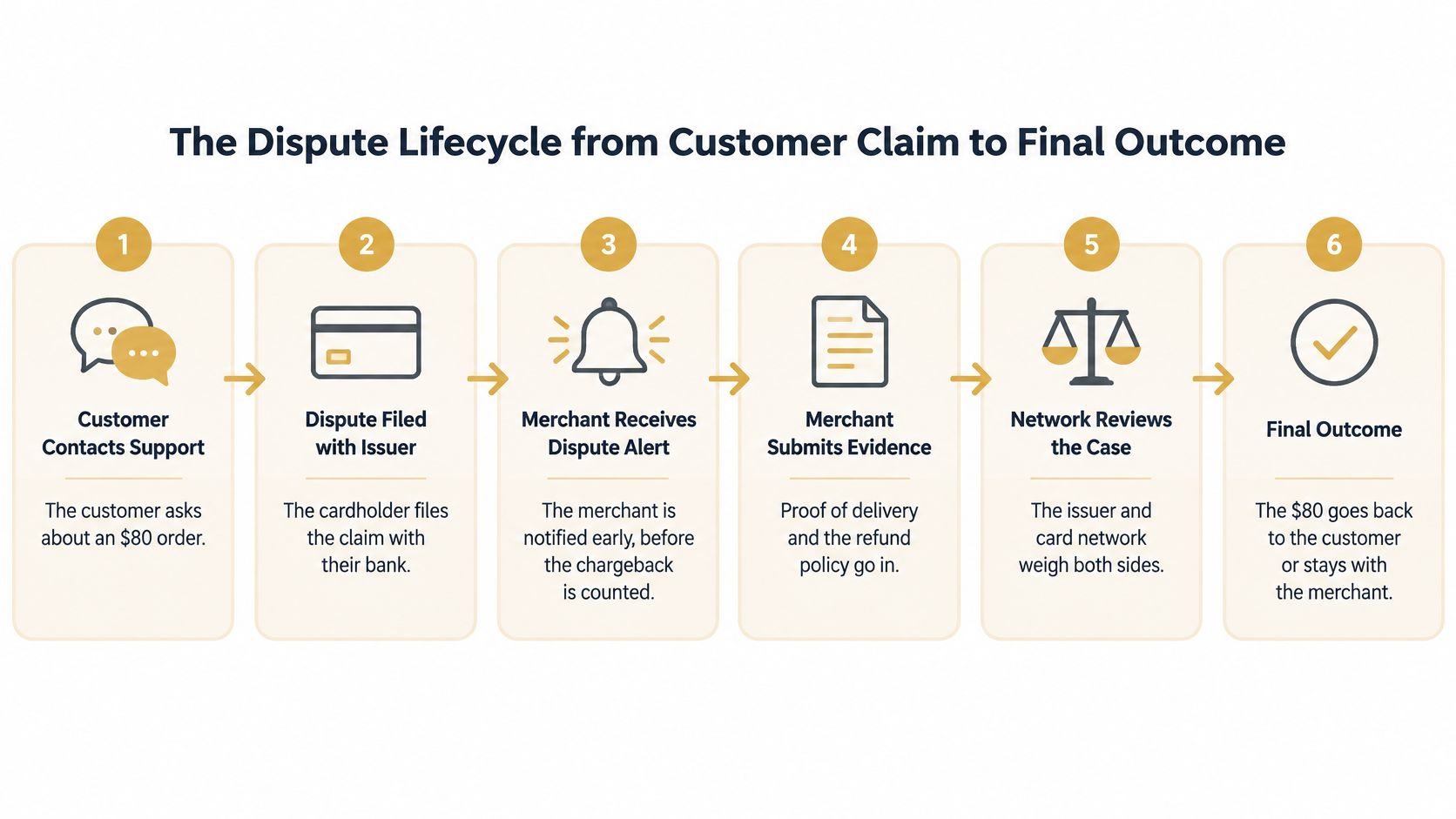
The flow below illustrates the handoffs. Alert availability and timing aren't identical for every payment.
Follow an order through the handoffs
Say a customer disputes a hypothetical $80 order as not received. Support should first check whether the parcel is delayed, incorrectly addressed, or already refunded. If the customer contacts their issuer instead, your payments team needs to identify the order and read the notice before choosing a response.
The issuer may provide provisional credit during the investigation. That isn't necessarily a final decision, and a merchant-account debit shouldn't be mistaken for proof that the customer's allegation has been established.
At Disputely, we're notified within seconds after a customer creates a dispute, and then offer a resolution. Earlier notice gives the team more time to identify the transaction and assess available options.
Build the response around the allegation
The reason code identifies what the customer is disputing. For nonreceipt, provide tracking, the delivery address, and relevant delivery confirmation. A checkout receipt alone doesn't answer whether the parcel arrived.
Record the submission cutoff, time zone, required format, and any earlier processor deadline. Submit early enough to verify acceptance, and retain the submission confirmation.
Missed deadlines and irrelevant evidence are avoidable ways to lose a defensible case. After the decision, reconcile the funds and record why the case succeeded or failed. Map these handoffs to your own operation and assign a named owner, including a backup for absences.
Common Causes Behind Disputes and Chargebacks
First-party misuse deserves attention, but it isn't the explanation for every disputed purchase. A Federal Reserve Bank of Atlanta review of the Merchant Risk Council's 2023 global survey of more than 1,000 ecommerce merchants reported that first-party misuse accounted for 34% of merchants' reported fraud problems, and merchants reported a 62% increase in first-party disputes compared with 2021.
Start with a distinction: was the purchase unauthorized, or did something go wrong after an authorized purchase? That separates conventional fraud investigation from fulfillment, billing, and customer-service work.
| Cause | Typical Example | Category | Controllable by Merchant |
|---|---|---|---|
| Card-not-present fraud | Stolen card used at checkout | Fraud | Partly, through screening and authorization rules |
| Friendly fraud | Customer buys, receives the goods, then disputes the charge | First-party misuse | Partly, through clear records and communication |
| Item not received | Parcel lost or delivered to the wrong address | Fulfillment | Partly, through delivery controls, tracking, and prompt remedies |
| Forgotten subscription | Renewal charge the customer doesn't recognize | Billing confusion | Yes, through reminders and clear cancellation |
| Unclear descriptor | Charge appears under a parent company or legal name | Billing confusion | Yes, through a recognizable descriptor |
| Duplicate or processing error | Same order charged twice after a retry | Merchant error | Yes, through checkout and retry fixes |
| Not as described | Product differs from the listing | Merchant error | Yes, through accurate product content |
Don't confuse misuse with misunderstanding
Unauthorized fraud means the cardholder didn't authorize the purchase. First-party misuse, often called friendly fraud, involves a dispute over a purchase that may have been authorized or fulfilled. The word friendly doesn't establish intent, and an unfamiliar charge isn't evidence of dishonesty.
A subscriber might recognize your product but not your legal business name. Another customer might dispute an order a household member placed. Those situations need clarification before an accusation or an automatic fraud label.
Your investigation should also separate customer allegations from confirmed causes. A not-received claim might reflect a carrier failure, an incorrect address, or misuse. A delivery scan helps investigate the distinction, but it doesn't explain every case by itself.
Use the common reasons to dispute a charge as a classification aid, then categorize a recent sample of cases. Record both the stated reason and the underlying cause your team established. That distinction tells you whether to improve screening, shipping, billing, or support.
Prevention Tactics That Cut Disputes at the Source
Subscription confusion is a product-design problem as well as a payment problem. Mastercard's 2025 subscription research found that 25% of consumers had blocked a payment because they thought it might be fraudulent, while 29% had disputed a recurring payment for the same reason.
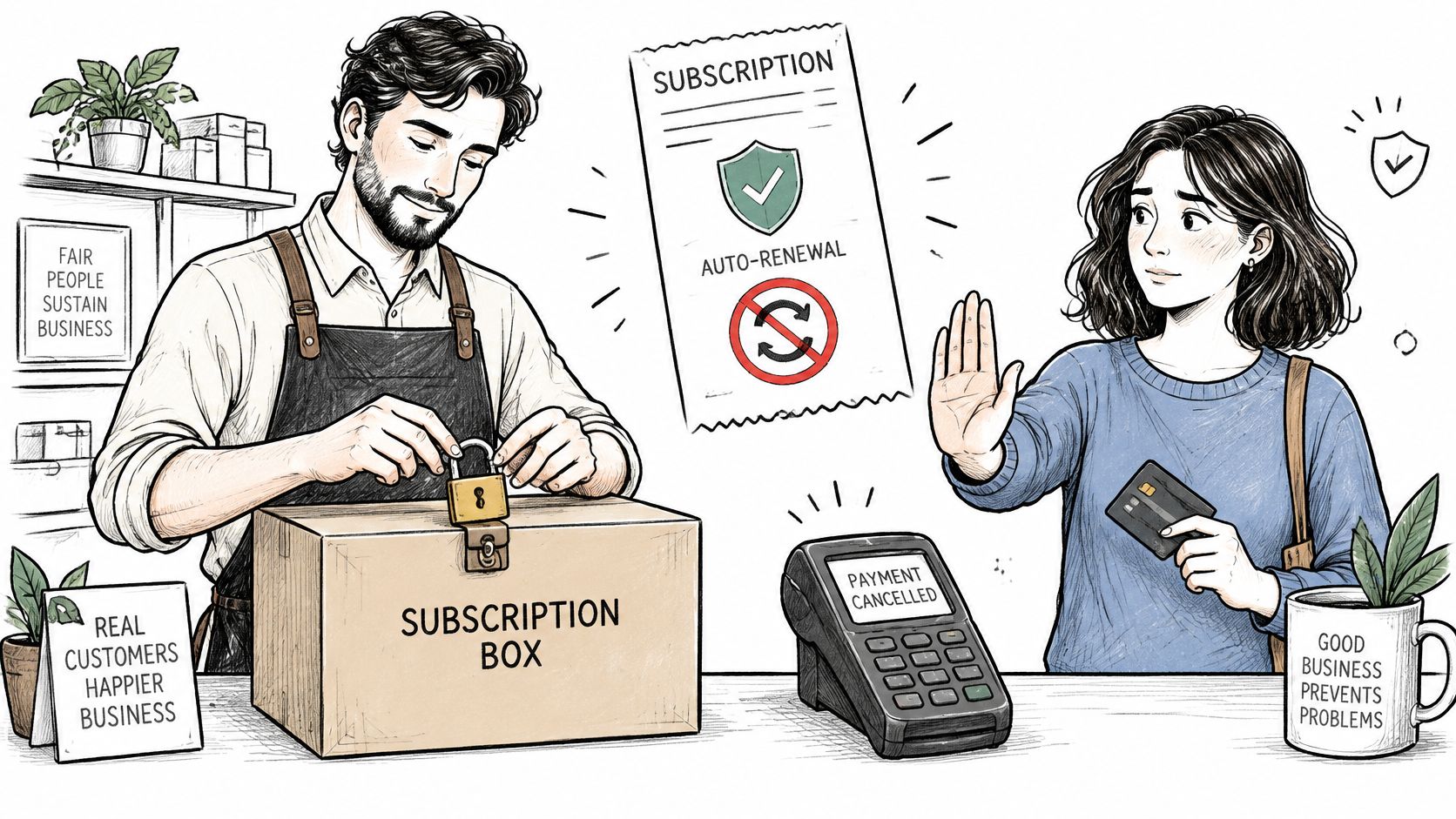
Give customers visible control over the relationship before they need their bank's help.
Before and during the charge
Start with the information a customer sees when deciding whether a payment looks legitimate:
- Make the descriptor recognizable. Use the brand customers remember within your processor's permitted format. Include an accessible support contact where supported, and inspect how the descriptor appears.
- Explain the renewal. Send a reminder showing the product, amount, billing date, and account-management route. Make the difference between a trial ending and an ordinary renewal explicit.
- Provide self-service controls. Let customers pause, cancel, change plans, and update billing without searching through support articles.
- Show the refund policy at checkout. Explain eligibility, the request process, and any product-specific conditions before payment.
Say a subscriber wants to skip a shipment rather than leave permanently. A visible pause option addresses that need directly; forcing them to contact support creates an unnecessary opportunity for a bank dispute.
After payment or a failed attempt
A failed-payment message should explain what happened without implying that every decline means fraud. Provide a secure account link for updating payment details and, where appropriate, a grace period before access ends. Don't make account recovery harder than contacting the issuer.
For physical goods, send tracking at dispatch and communicate delays before the customer has to ask. Keep the delivery address and carrier events attached to the order so support can answer accurately.
Stronger fraud screening won't explain an unfamiliar renewal to a legitimate subscriber.
Evaluate prevention changes with dispute rate by renewal cohort, involuntary churn, refund rate, and authorization rate. Include customer retention after resolution so a lower dispute rate doesn't hide unnecessary cancellations or refunds.
Start this month by reviewing an actual statement descriptor and completing your own cancellation journey. Fix whichever makes it harder for a customer to recognize or control the next payment.
Refund, Respond or Represent
Refund when the expected cost of contesting exceeds likely recovery. Respond when clarification can resolve uncertainty. Represent when relevant evidence justifies a formal challenge. These are different tools, not different levels of commitment to defending revenue.
Visa's friendly-fraud analysis reports that friendly fraud represents about 20% of fraudulent disputes globally, rising to up to 30% for high-volume online merchants. Those figures concern fraudulent disputes, not all customer complaints, which is why blanket assumptions are a poor decision rule.
| Situation | Recommended Response | Why |
|---|---|---|
| Low-value customer-service dispute with weak evidence | Refund promptly when the payment stage permits it | Representment cost exceeds likely recovery |
| High-value order with proof of delivery | Review and respond with relevant evidence | Potential recovery may justify the effort |
| Recurring charge with login and usage logs | Respond with usage and consent evidence | Records can support the customer's relationship with the service |
| Confirmed account takeover | Accept liability where appropriate and block repeat fraud | Fulfillment alone doesn't establish cardholder authorization |
| Duplicate charge found internally | Refund through the appropriate channel and fix the cause | Clear merchant error doesn't justify representment |
| Billing confusion from a repeat customer | Message the customer before refunding | Clarification may preserve the relationship and resolve uncertainty |
Assess evidence before committing effort
Use an internal calculation: probability of recovery multiplied by recoverable value, less handling costs and applicable fees. Treat that as a decision aid, not an exact prediction. Also consider customer impact and whether the same problem affects other orders.
Evidence must answer the allegation. Delivery records address fulfillment; login and usage logs address access; the accepted subscription terms and cancellation history address recurring-billing questions. Prior orders, refund history, and consistent device information can provide context, but none automatically proves authorization.
For a defensible case, prepare a short chronology with clearly labeled supporting records. Don't bury the relevant delivery event inside an export of unrelated transactions.
Avoid paying twice
Once a formal chargeback exists, don't issue a separate refund without checking the processor's case workflow. The customer may already have received credit, and an ordinary refund can create duplicate reimbursement.
Similarly, a customer's promise to withdraw a dispute doesn't replace the merchant response deadline. Preserve the conversation and continue following the notice unless the processor confirms the case is closed.
Decision standard: Write down the order-value bands, required evidence, escalation owner, and permitted payment action for each category.
That gives the team consistent rules while preserving human review for valuable, ambiguous, or sensitive cases.
Dispute Ratio Thresholds to Monitor Each Month
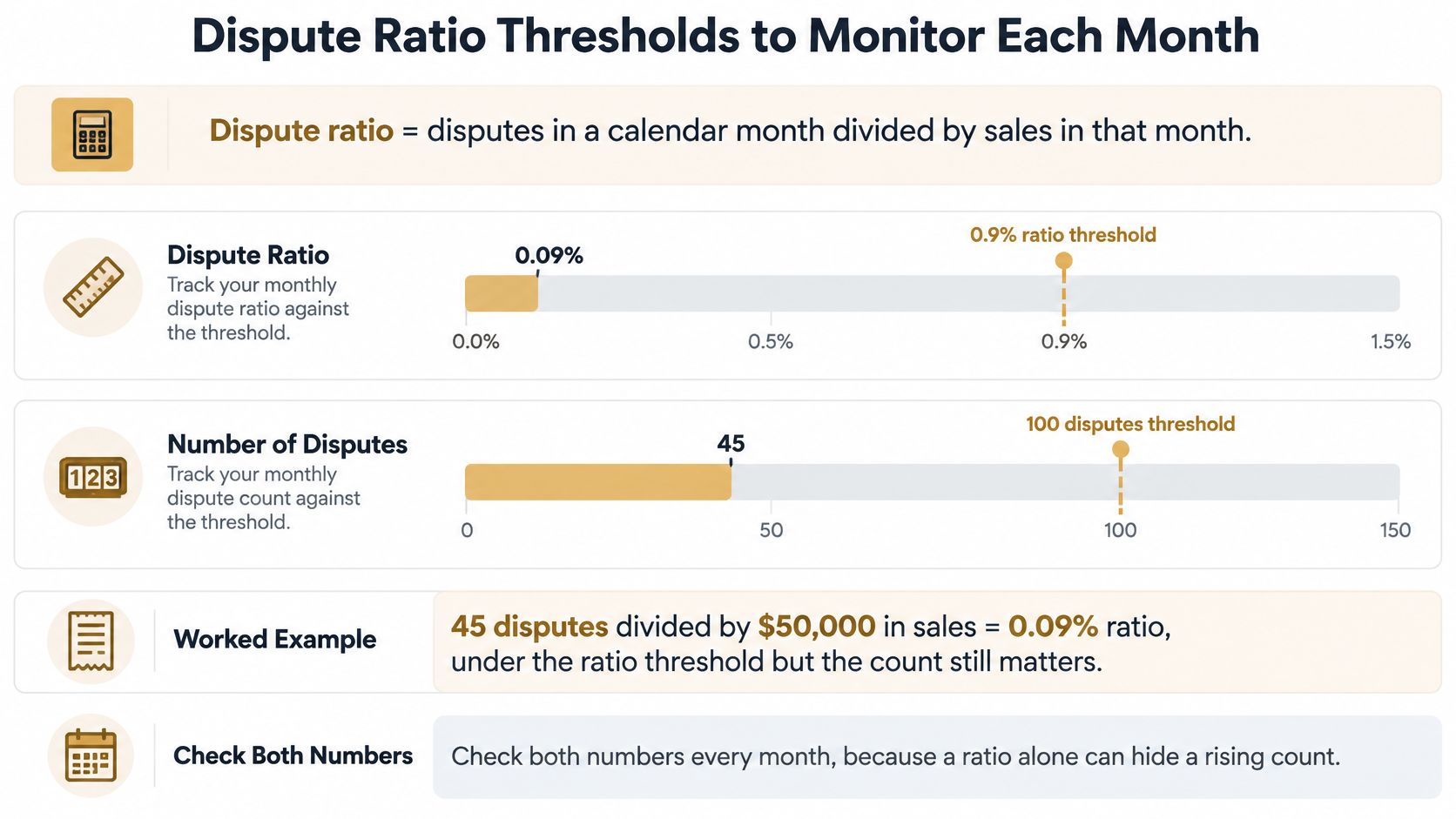
Monitor both dispute count and dispute ratio. The Visa monitoring program guide published by J.P. Morgan lists the historical standard and excessive thresholds below, with both count and ratio conditions applying at each level.
| Level | Monthly Dispute Count | Dispute-to-Sales Ratio |
|---|---|---|
| Standard | More than 100 | Above 0.90% |
| Excessive | More than 1,000 | Above 1.80% |
| Internal early warning | Merchant-set count below the applicable trigger | Merchant-set ratio below the applicable trigger |
These are the cited guide's thresholds, not a claim that they're the current requirements for every merchant. Confirm the applicable program, region, calculation, and processor conditions before using them as operating limits.
The visual illustrates the need to track both measures. Its dollar-denominated worked example should not be used to calculate a transaction-count dispute ratio.
Keep the denominator consistent
For a count-based dispute ratio, divide disputes by sales transactions, not sales dollars. A large revenue total doesn't establish a low dispute ratio, and exceeding a count condition alone doesn't establish that both monitoring conditions have been met.
For example, a merchant can have enough disputes to exceed the count trigger while remaining below the ratio trigger because it processes many sales transactions. A smaller merchant can show the opposite pattern.
Build your monitoring view around:
- Calendar-month and rolling counts, separated by merchant account and processor.
- Program-aligned ratios, using the correct eligible transactions and reporting periods.
- Reason-code and product concentrations, including subscription renewal cohorts.
- Forecast threshold distance, incorporating unresolved alerts and expected sales activity.
Use the chargeback threshold guide to frame the questions your payments team needs to resolve. Set internal warnings before the applicable triggers, then review the count, ratio, and leading reason code together. Don't wait for a formal monitoring notice to investigate a deteriorating trend.
How Dispute Alerts Help Merchants Avoid Chargebacks
An alert can create an intervention point between a cardholder raising a claim and a chargeback reaching the merchant account. It isn't the same thing as receiving a formal chargeback notice with a representment deadline.
A useful dashboard connects the notification to an order and a recorded action, rather than leaving the team to investigate an isolated bank reference.
Act on the alert's actual requirements
Network routes include Visa Rapid Dispute Resolution, Verifi CDRN, and Ethoca alerts. Their mechanics aren't interchangeable: some support configured decisioning, while others require action within the notification's resolution window.
The operational sequence is straightforward:
- Match the transaction. Verify the payment reference, amount, customer, and any existing refund or dispute.
- Apply the response rule. Decide whether the case qualifies for resolution or needs review.
- Complete the permitted action. Use the correct payment channel and meet the alert's stated cutoff.
- Confirm the result. Record whether resolution succeeded and reconcile any credit.
A successfully prevented chargeback can avoid adding a chargeback to the relevant monitoring count. Don't assume every alert or refund qualifies for that treatment; confirm the resulting status and applicable program treatment.
Our order-pattern analysis helps identify potential disputes and chargebacks. Combine that context with evidence history so a strong case isn't refunded because a notification arrived.
The video below provides another view of the alert workflow.
Verify coverage and measure outcomes
Check which payment processors and merchant accounts are connected, which alert routes cover their transactions, and who receives notifications when the primary owner is unavailable. Test whether order matching and refund permissions work before relying on automation.
Our role includes initiating refunds and managing disputes on the merchant's behalf. Outcomes still depend on merchant practices, issuer behavior, processor risk models, and card network rules, so no alert tool can guarantee every result.
Use this explanation of how chargeback alerts work when documenting your team's response procedure. Each month, reconcile alerts received, actions taken, confirmed resolutions, and cases that became chargebacks. Investigate unmatched and expired alerts separately, because they point to different operational failures.
Confirm Your Dispute Process Before the Next Alert
Mastercard projects global chargeback volume to increase 24% from 2025 to 2028, reaching 324 million transactions annually. That's a projection, not a reason to contest every claim. It's a reason to make your response process repeatable before the next notification arrives.
Start with a documented operational check:
- Map the handoffs. Name an owner and backup for customer contact, notice review, evidence submission, and reconciliation.
- Inspect the descriptor. Compare what appears on the customer's statement with the brand they purchased from.
- Write response rules. Define order-value bands, relevant reason codes, evidence requirements, and refund authority.
- Validate monitoring. Confirm your monthly count, ratio denominator, applicable thresholds, and internal warning points.
- Connect and test alerts. Verify processor coverage, notification recipients, order matching, and action permissions.
Choose the stage that needs help first
Our products cover the lifecycle: Resolve works before a dispute is filed, Alerts acts when it's filed, and Recover addresses the stage after a chargeback. Choose according to the gap you've identified, not the part of the process that generates the most visible notifications.
We initiate refunds and manage payment disputes on merchants' behalf. Merchants must obtain proper customer consent for the related data processing and inform customers about data sharing with Disputely.
Start the checklist this week with your support, payments, and fulfillment owners. Leave the review with a concrete decision: fix the customer-facing cause, improve the response workflow, or add support at the stage your team can't reliably manage today.
Disputely offers prevention, dispute alerts, and post-chargeback recovery to support the decisions your team makes throughout the payment lifecycle. Visit Disputely to identify which stage fits your operation and where rule-based resolution or evidence support could help.


