
Dispute Prevention Resolution Hawaii: A Business Guide
85% of mediated rent-arrears cases reached agreement without litigation in Hawaii's early landlord-tenant mediation program, according to legislative testimony on Act 57, which describes 1,660 mediated cases. That's housing evidence, not a chargeback success rate. But it challenges a costly business habit: waiting for someone else to formalize a dispute before offering a workable remedy.
For a Hawaii business, the useful question isn't whether you can win. It's which channel can solve the problem at the lowest total cost, while leaving you with records strong enough for whatever happens next.
Why Hawaii Businesses Win by Resolving Disputes Early
Say a Honolulu subscription customer emails because a renewal surprised them. Support can verify the account, stop future billing, and authorize an appropriate refund. If nobody takes ownership, the customer may contact their bank while your team continues sending automated reminders.
The underlying transaction hasn't changed. Your workload has.
A direct resolution requires a decision and follow-through. A formal payment dispute can require processor correspondence, evidence preparation, deadline tracking, and reconciliation. Even a defensible sale can become an expensive distraction when staff must reconstruct what happened.
Separate prevention from resolution
Prevention removes the causes that turn an ordinary problem into a formal dispute. Resolution selects a channel capable of delivering the remedy someone needs.
Hawaii businesses encounter both across several kinds of conflict:
- Customer complaints about service quality, deliveries, returns, and refunds.
- Unpaid invoices where the disagreement concerns scope, acceptance, or payment.
- Contract disagreements involving vendors, customers, or business partners.
- Recurring-billing disputes involving renewals and cancellation.
- Card chargebacks that already require a processor-facing response.
The housing program's relevance is narrow but useful: early notice, structured communication, and access to a meaningful remedy can help parties reach agreement. It doesn't establish how frequently ecommerce customers will accept refunds or how card networks will decide claims.
Practical rule: Don't escalate a problem just to prove that your original position was reasonable.
A business owner needs authority as much as empathy. Give support a clear route to approve remedies, identify matters that require management, and confirm when an agreement has been completed.
Effective dispute prevention and resolution in Hawaii means connecting customer service, finance, and operations before a complaint becomes everyone's emergency. The outcome should be concrete: identify the least expensive workable channel, carry out the remedy, and correct the process that created the disagreement.
Choosing the Right Dispute Path for Each Problem
Dispute resolution paths compared
| Dispute path | Best for | Cost and speed | Outcome | Choose it when |
|---|---|---|---|---|
| Direct refund or make-good | Service failures, duplicate charges, small subscription disputes | Refund or replacement cost plus handling; initiate promptly | Voluntary settlement | The issue is real and fixing it costs less than fighting |
| Community mediation | Ongoing customer or vendor relationships, contract disagreements | Confirm intake charges and scheduling with the center | Negotiated agreement if parties consent | You want a neutral facilitator and a written agreement |
| Arbitration | Contract disputes covered by an arbitration agreement | Administrator, arbitrator, and preparation costs under applicable rules | Generally binding award, subject to applicable law | An enforceable agreement requires it or parties choose it |
| Small claims or District Court | Unpaid invoices, breach of contract, property damage | Filing, service, preparation, and hearing requirements | Judgment, with collection potentially requiring further work | Negotiation has failed and the claim fits the court's jurisdiction |
| Card-network chargeback response | Payment disputes already filed by a cardholder | Processor-specific charges and response deadlines | Decision under payment-network rules | A formal dispute notice requires action |
| Regulator complaint response | Licensing, safety, or unfair-practice allegations | Staff preparation and possible legal costs; agency-controlled timing | Enforcement or other agency action isn't guaranteed | The allegations concern conduct within an agency's authority |
Start with the remedy, not the threat
Before choosing a path, establish dollar value, relationship value, evidence strength, urgency, and counterparty identity. Those inputs prevent a familiar mistake: sending every conflict to the channel that sounds most forceful.
A customer who wants a duplicate charge returned needs a payment correction. A vendor who disputes the scope of completed work needs a contract discussion. An allegation involving unsafe or unlicensed conduct may require regulatory attention even if the parties settle the money.
Hawaii's Regulated Industries Complaints Office covered 52 industries and approximately 170,000 licensees in 2025, while warning that investigation or enforcement isn't guaranteed. A complaint isn't the same as a remedy. Verify jurisdiction rather than treating RICO as the destination for every unhappy customer.
Use these routing distinctions:
- Regulated conduct: Preserve the allegation and supporting records, then identify the agency responsible for the profession, business activity, or financial institution.
- Money recovery: Start with a written demand explaining the obligation, supporting documents, requested remedy, and response date.
- Negotiable disagreement: Consider community mediation before paying to formalize opposing positions.
- Filed card dispute: Follow the processor's instructions and deadline even while discussing settlement.
- Contractual arbitration: Review the clause, applicable rules, and enforceability with counsel before assuming court is available.
For local mediation, possible starting points include the Mediation Center of the Pacific on Oahu, Ku'ikahi Mediation Center in Hilo, West Hawaii Mediation Center in Kona, and Maui Mediation Services. Confirm that the center handles your dispute type and ask about intake, fees, and participation requirements. Don't promise the other party a fixed settlement date.
Resolve the hesitation before it becomes policy
Business owners often resist refunding a transaction they could defend. Compare the refund against the expected cost of the alternative, including staff time, processor charges, customer loss, and payment-account exposure where applicable. Being technically right doesn't make every defense economical.
The opposite mistake is threatening court before making a clear settlement offer. A signed agreement with a payment date, delivery obligation, and completion confirmation may produce more value than a judgment you still need to collect.
For a broader comparison, use this guide to dispute resolution methods. An AI legal assistant such as LegesGPT can help organize questions for a contract review, but don't treat generated analysis as a ruling on jurisdiction or enforceability.
Keep a single case file containing dates, contacts, actions, transaction records, relevant contract terms, and supporting evidence. Use that factual record for settlement, chargeback representment, and any regulator response, tailoring each submission to its audience rather than sending everything indiscriminately.
The Escalation Ladder from Complaint to Chargeback
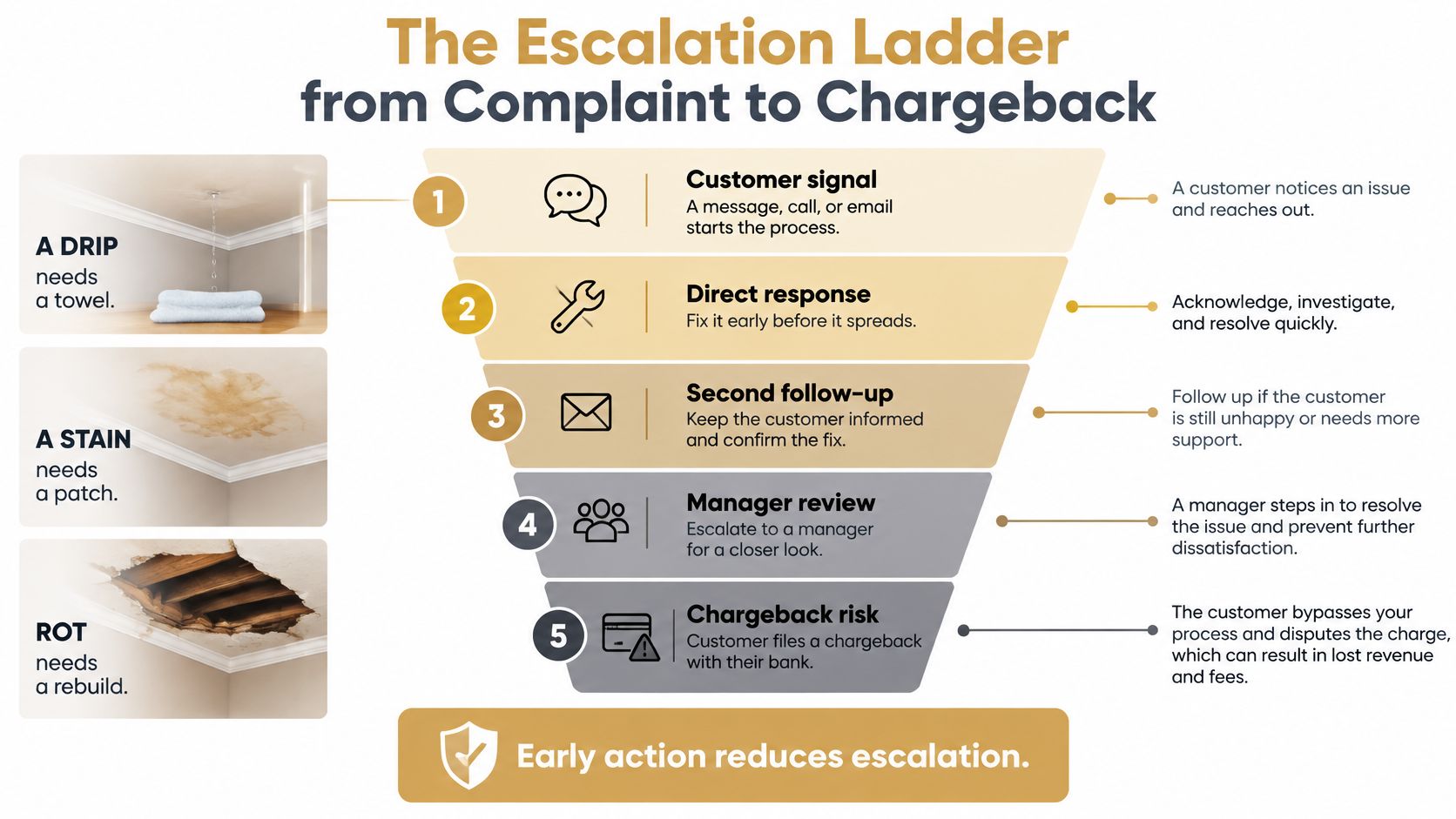
A dispute resembles a roof leak. A drip may need a towel while you locate the source. A stain needs repair. Rotten framing needs a much larger intervention. Treating every stage as the same maintenance job wastes money and lets preventable damage continue.
The operational ladder helps staff recognize when a complaint needs more authority, not merely another acknowledgment.
What each rung adds
A customer signal might be a cancellation email, failed-delivery message, or question about a statement. At this stage, staff need to understand the requested outcome. A defensive reply can turn uncertainty into a disagreement.
Direct communication adds a factual position. Once you tell a customer that a payment is valid or a delivery is complete, you should be able to support that statement. Repeated follow-ups without a decision add delay rather than resolution.
Informal settlement introduces commitments. Someone must authorize the refund, replacement, payment schedule, or revised scope. Record what each party accepted and who will perform it.
Facilitated mediation adds coordination and preparation but gives the parties a neutral setting for negotiation. The business representative needs settlement authority, not just permission to attend.
Arbitration or litigation adds formal procedure, preparation costs, and a greater need for legal advice. Positions become harder to revise once the parties have invested in defending them.
Payment-network enforcement adds a separate decision process tied to the transaction. It isn't necessarily the last chronological rung: a cardholder can contact their bank before you've had a meaningful conversation.
Hawaii has a usable settlement channel
The Hawaii Judiciary's report through fiscal year 2025 records 835 cases entering the Appellate Mediation Program, with an overall 50% settlement or partial-settlement rate, and 4,201 community mediation cases serving 11,083 clients during that fiscal year. These are court and community mediation measures, not merchant payment outcomes.
They support a practical distinction: a contested matter isn't automatically beyond negotiation. A neutral process can still be useful when direct exchanges have become repetitive or personal.
Escalation should purchase something useful, such as settlement authority, neutral facilitation, or an enforceable decision. It shouldn't merely make your response sound tougher.
For staff who hesitate to address disagreement, responding instead of avoiding conflict is an operational skill. Assign the next action, the person responsible, and the point at which a manager takes over. Don't let a complaint climb because nobody wants to own it.
How Chargebacks Work and Where Merchants Lose
A chargeback begins when a cardholder challenges a transaction through their issuing bank. The dispute moves through the payment system to the acquiring side, and the merchant receives instructions through its processor or payment provider. Funds may be debited while the case is handled.
Representment is the merchant's submission of evidence challenging the dispute. It's not a fresh sales pitch, and it isn't decided by how strongly you describe the customer's behavior. Your response must address the stated reason for the dispute.
Follow the notice, not a generic calendar
When a notice arrives, record its deadline, reason, amount, and transaction identifier immediately. Use the actual processor notice to establish the response window and any required evidence. Don't assume a deadline you remember from another provider applies.
Check refund status before taking action. If a refund, alert resolution, and chargeback overlap, reconcile them with the processor so staff don't independently issue conflicting payments. A customer's promise to withdraw a dispute isn't a reason to ignore an open case.
For a fuller operational explanation, review how chargebacks work. The important distinction is between solving the customer's issue and completing the payment system's required process.
Diagnose the cause before choosing a defense
First Hawaiian Bank's merchant guidance identifies forgotten purchases, unrecognized descriptors, delivery problems, and intentional misuse among friendly-fraud issues, alongside merchant-controlled problems such as duplicate billing, processing errors, and fulfillment failures. That makes operational review as important as fraud screening.
Chargeback causes, prevention and response
| Cause | What the customer experiences | Prevention | Response |
|---|---|---|---|
| Unrecognized billing descriptor | A charge they can't match to a purchase | Use a recognizable brand and contact details where supported | Explain the transaction; submit descriptor and purchase evidence if contesting |
| Forgotten subscription renewal | A recurring charge after inactivity | Send clear renewal notices with amount, date, and cancellation access | Review notice and consent records; consider a goodwill refund |
| Duplicate billing | Matching charges for the same order | Use idempotent payment keys and reconcile captures | Verify settled charges, refund the duplicate, and investigate the integration |
| Processing error | Wrong amount, currency, or capture | Test checkout changes and reconcile payment records | Correct the customer's loss and pursue any processor remedy separately |
| Delivery failure or delay | Product late, damaged, or missing | Send tracking and delay updates; use appropriate delivery confirmation | Investigate, reship, or refund; retain relevant delivery evidence |
| Intentional misuse of chargebacks | A genuine purchase the buyer denies | Use appropriate address and security-code checks, delivery records, and clear policies | Contest with evidence that addresses the dispute reason |
Don't retain raw card security codes in the case file. Preserve permitted verification results and processor references instead.
Fight the reason, not the customer
A delivery scan doesn't prove every aspect of a transaction. It may address receipt, but not a claim about cancellation, product condition, or authorization. Likewise, a matching billing address alone doesn't establish that the cardholder approved the purchase.
Where your systems created the problem, correct it and log the root cause. Where the records support a legitimate defense, assemble a focused package: transaction details, relevant consent, fulfillment evidence, customer correspondence, and the applicable policy version.
A successful representment isn't the same as a cost-free transaction. Verify fee treatment and dispute-reporting effects under your processor's rules rather than assuming a win reverses every consequence. The strongest dispute operation prevents avoidable cases and defends the remaining ones selectively.
The Prevention Playbook That Keeps Disputes Off the Ladder
Prevention needs an owner, a trigger, and an artifact that proves the work happened. A policy document without those elements won't help when finance discovers that support and fulfillment each thought the other team had handled the customer.
Use the visual as an operating overview, then assign the detailed controls to named people.
Put controls where customers encounter friction
Recognizable statements
Finance owns the descriptor review whenever a brand, legal entity, or payment configuration changes. Test a purchase on a company-controlled card and compare the statement entry with the name customers see at checkout. Save the result and any processor correspondence as the descriptor verification record.Pre-renewal notices
The subscription manager owns the communication triggered before renewal. Include the amount, expected billing date, and a usable cancellation link. Archive the notice content, delivery status, and applicable account settings so staff can distinguish a sent notice from a failed message.Accessible cancellation
Product owns the cancellation flow and tests it after relevant releases. Don't make a customer explain their decision to several teams before they can stop billing. The artifact is a timestamped cancellation confirmation connected to the subscription's effective end date.Proactive fulfillment
Operations owns order confirmations, tracking, exception alerts, and accurate shipping expectations for interisland and mainland orders. Trigger an exception workflow when the carrier record conflicts with the promised service. Save what the customer was told, not merely the latest tracking page.
Make exceptions deliberate
Triage by remedyability
The support lead owns rules for cases that can be resolved without management. Automatically resolving a low-value, high-friction problem may be sensible, but separate that category from repeated claims, disputed authorization, substantial losses, and contradictory evidence. Record the decision reason so staff can explain why apparently similar cases received different treatment.A complete case file
Finance and operations jointly own the record from the first complaint. Include the customer's stated issue, transaction identifiers, permitted authorization records, fulfillment history, relevant communications, and remedy decision. Restrict access and use an appropriate retention policy rather than copying sensitive payment information into ordinary support notes.
A useful file also distinguishes facts, allegations, and decisions. The customer saying an item never arrived is an allegation; a carrier scan is evidence; approving a replacement is a decision. Mixing them produces confused submissions later.
Don't turn prevention into indiscriminate refunds
The Hawaii Judiciary's fiscal year 2024–25 alternative dispute resolution report records 12 of 32 active appellate mediation cases settling or partially settling, while seven returned to the appellate docket. Those figures concern appellate matters, but they illustrate why settlement processes need an unresolved-case route.
Measure settlement quality and escalation quality, not just how many complaints support closes. A closed ticket with an unprocessed refund isn't a resolution. Neither is a refund issued without checking whether the same transaction was already credited.
Keep manual review for cases where the evidence, amount, pattern, or legal implications justify it. The playbook should make straightforward decisions faster and difficult decisions better documented.
Three Hawaii Dispute Scenarios and How They Play Out
These are hypothetical operating scenarios, not reported cases. Each shows how a different remedy can be appropriate even when the business believes its original policy was defensible.
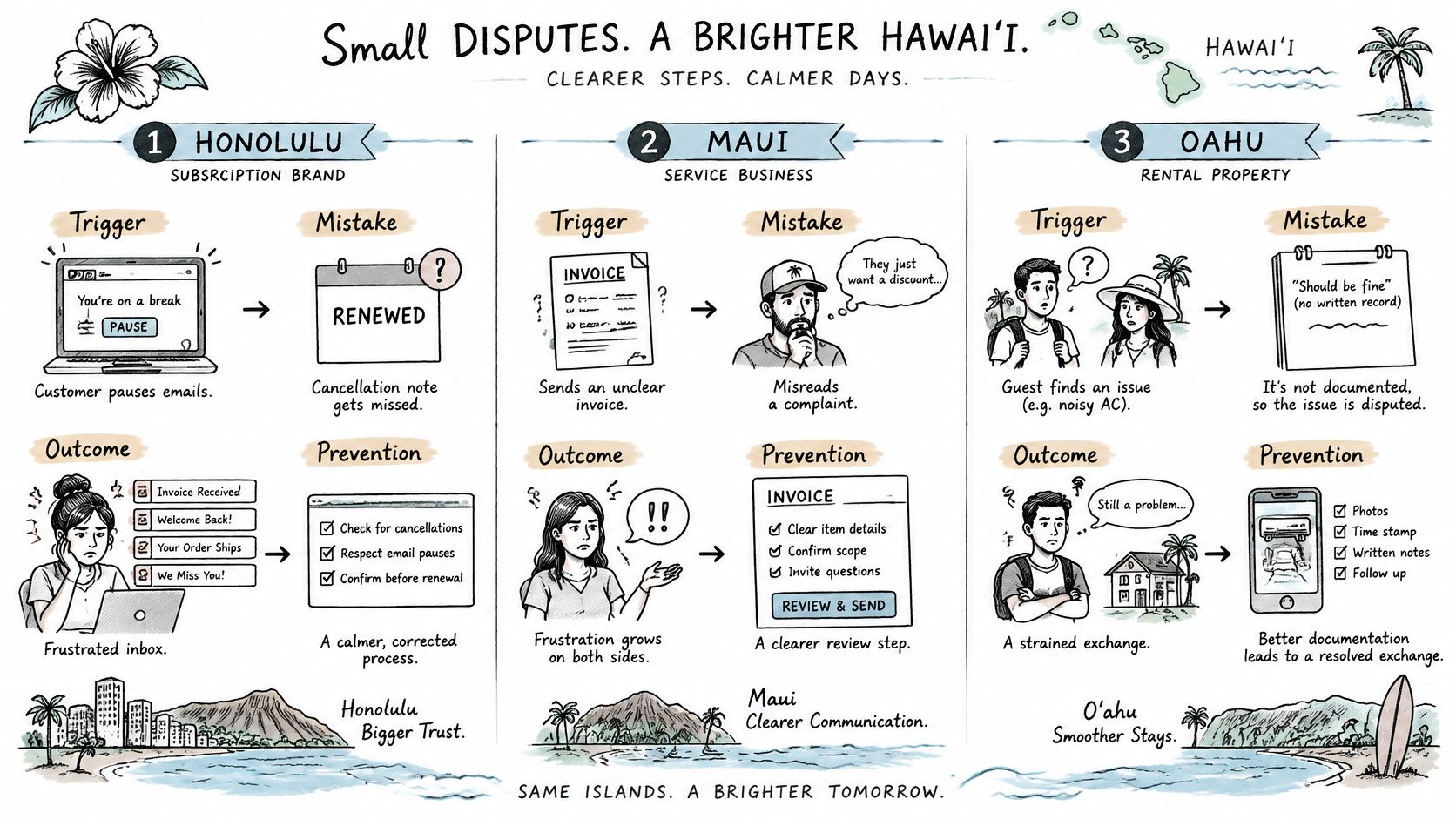
A Honolulu subscription renewal becomes a bank dispute
Trigger: A customer requests cancellation after a renewal has processed. The subscription brand's records show that the charge followed its disclosed terms.
Mistake: Support sends the policy and closes the ticket without checking whether the customer used the renewed service, received the notice, or would accept a practical compromise. The customer contacts their bank.
Possible outcome: The merchant submits its consent and cancellation records, but the decision remains subject to the dispute reason and applicable rules. Even a favorable result doesn't recover the staff time spent preparing the response.
Prevention: Make the account's upcoming billing status visible and cancellation easy to complete. For an unused, modest-value renewal, management might authorize a goodwill refund and immediate cancellation rather than convert a recoverable relationship into a formal contest.
A Hilo roaster's mainland wholesale shipment stalls
Trigger: A wholesale buyer needs coffee for a planned promotion, but the shipment stops progressing. The buyer asks for help and later disputes receipt.
Mistake: The roaster replies only that the carrier has the shipment. Nobody asks when the buyer needs stock or whether a replacement can still save the promotion.
Possible outcome: A later delivery record may support a response to a nonreceipt claim, but it doesn't necessarily settle the commercial disagreement about timing. The roaster could defend the payment and still lose future wholesale orders.
Prevention: Assign an operations owner to stalled shipments. Offer a realistic choice among waiting, replacement, or an agreed adjustment, then document the buyer's acceptance and the treatment of the original parcel.
A payment decision answers a transaction question. It doesn't necessarily repair the business relationship.
A Maui tour refund demand includes a regulator threat
Trigger: A guest demands a refund and threatens a licensing complaint. The operator believes the cancellation policy applies, while the guest says the tour description created different expectations.
Mistake: The owner treats the regulator threat as a bluff and responds aggressively. That leaves the factual disagreement unresolved and creates correspondence that may later need explaining.
Possible outcome: If direct negotiation stalls, the operator could propose mediation through Maui Mediation Services, subject to intake and the guest's participation. A written agreement can specify the financial remedy and performance obligations without assuming that private settlement controls an agency's authority.
Prevention: Preserve the booking-page version, confirmation, policy acceptance, and service records. Separate the refund negotiation from any duty to answer a legitimate agency inquiry.
Across these scenarios, the decision changes with the remedy. A goodwill credit, a replacement shipment, and a mediated agreement aren't interchangeable, even when each can avoid a larger conflict.
Build Your 30-Day Dispute Prevention Plan
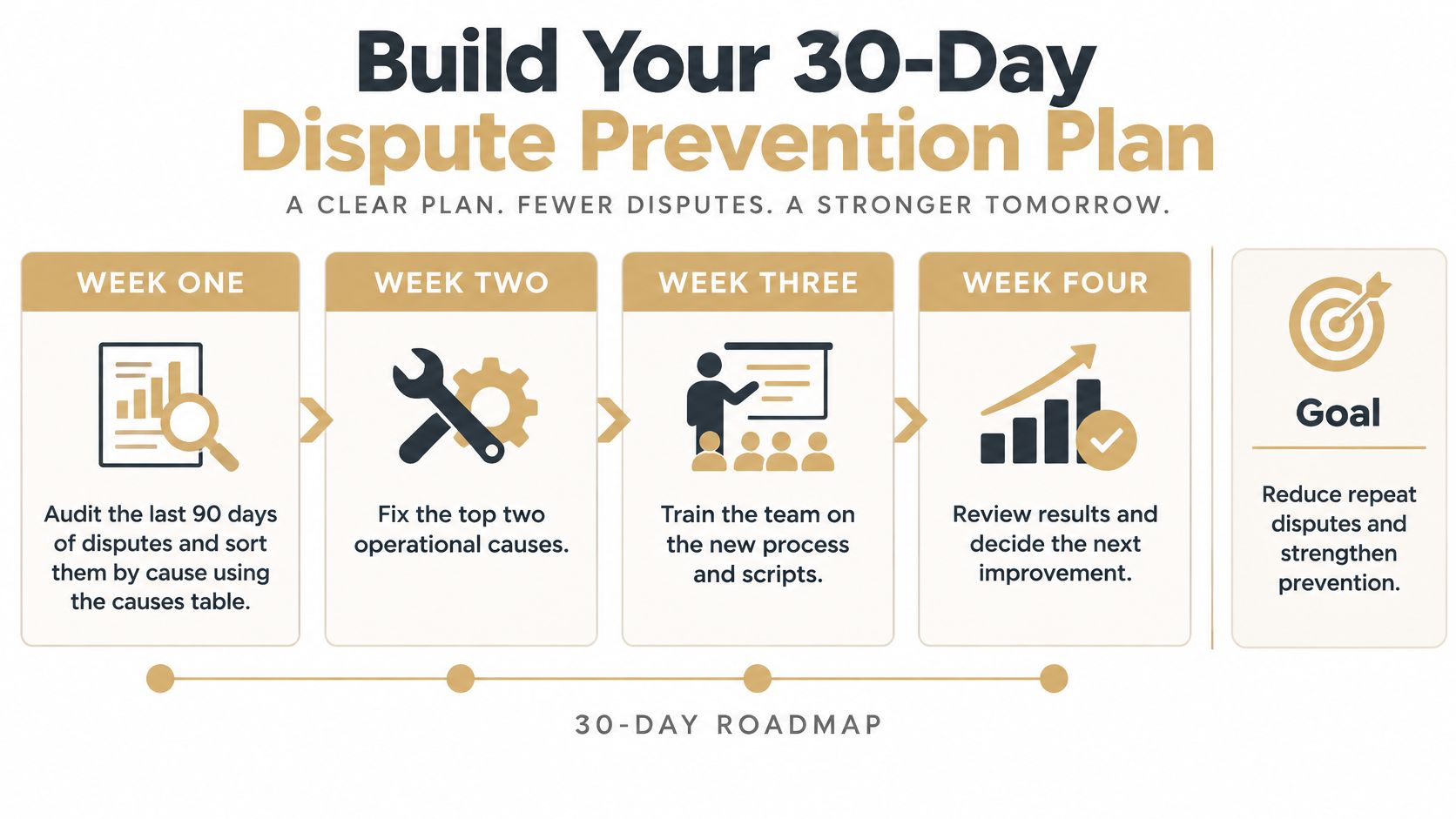
Treat this as a proposed implementation schedule, not a promise of measurable improvement within a month. Assign an accountable manager and protect time for finance, support, and operations to work from the same records.
Audit and correct
Week one's decision is what problem deserves attention first. Choose a recent review period and collect complaints, refunds, chargebacks, and fulfillment exceptions. Group them by cause rather than by which employee handled them.
Separate preventable operational errors from unresolved factual disputes. Record missing evidence as its own finding: you can't reliably assess whether to contest a case when the cancellation log or policy version is unavailable.
Week two's decision is which operational fixes to ship. Choose the leading causes from your own review, not a generic list of fashionable improvements. A descriptor correction won't help a merchant whose actual problem is a broken cancellation integration.
Use a simple acceptance checklist:
- Customer experience: Can someone recognize the charge, understand the promise, and request help?
- System behavior: Does the payment, subscription, or fulfillment system carry out the requested action?
- Evidence: Can staff retrieve proof without rebuilding the timeline from separate inboxes?
Authorize and automate
Week three's decision is who can approve what. Write refund authority, manual-review triggers, and escalation ownership into a short operating guide. Train staff with sample cases, including an overlapping refund and chargeback, rather than relying on a policy acknowledgment.
Week four's decision is where automation belongs. Match any alert and response service to your processors, transaction types, and remedy rules. Establish who handles exceptions and reconciles completed actions.
Our product lineup at Disputely follows the transaction's stage: Resolve before a dispute, Alerts when it's filed, and Recover after the chargeback. We provide real-time alerts within minutes of a dispute being filed, and our alerts automatically trigger a refund to avoid the cost of a chargeback. Our dashboard lets merchants track disputes, monitor their chargeback ratio, and see saved revenue.
Don't judge the process by a dashboard total alone. Compare results against your own baseline and account for refunds, operating effort, repeat complaints, and unresolved cases. No platform guarantees prevention, chargeback reduction, processor approval, or account standing.
Finish the month with an owner for each remaining defect and a scheduled review of the next batch of cases. Use the cheapest channel that produces a real remedy, and use it early.
Disputely offers prevention, real-time alerts, and post-chargeback support to help merchants act at the right stage of a payment dispute. Visit Disputely to evaluate how those tools fit your Hawaii business's refund rules, evidence workflow, and escalation process.


