
Dispute Prevention & Resolution Inc: A Hawaii ADR Profile
Dispute Prevention & Resolution, Inc. is a Honolulu-based alternative dispute resolution firm founded by Keith W. Hunter in 1995, offering mediation and arbitration among other services. Its work concerns disputes between parties, not the card-network chargeback process merchants may associate with the phrase “dispute resolution.”
You may be reviewing a supplier agreement, facing a construction payment disagreement, or searching for help after a customer disputes a purchase. Those situations can sound similar, but choosing the wrong process means preparing the wrong documents and contacting the wrong organization. Understanding DPR starts with separating its documented history, its neutral services, and the business estimates that directories attach to its name.
Company Profile at a Glance
Dispute Prevention & Resolution, Inc. (DPR) is a regional ADR provider rather than a law firm representing one side in a dispute. The Lexinter company profile identifies Keith W. Hunter as its founder and records incorporation on May 24, 1995, business commencement on July 1, 1995, a BBB file opening on July 22, 1996, and BBB accreditation on August 12, 1996.
Dispute Prevention & Resolution Inc at a glance
| Attribute | Detail |
|---|---|
| Legal name | Dispute Prevention & Resolution, Inc. (DPR) |
| Type of firm | Alternative dispute resolution (ADR) provider |
| Principal market | Hawaii |
| Founder | Keith W. Hunter |
| Incorporated | May 24, 1995 |
| Began business | July 1, 1995 |
| BBB file opened | July 22, 1996 |
| BBB accreditation | August 12, 1996 |
| Sectors served | Legal, business, construction, insurance, medical and judicial |
The sequence matters more than a generic claim of experience. Incorporation establishes the legal formation milestone; beginning business marks a separate operational event. The subsequent BBB milestones document an early commercial presence, not a recent specialist appearing under a broad dispute-management label.
What the history establishes
The history supports treating DPR as an established Hawaii institution. It doesn't establish a settlement success rate, the quality of a particular neutral, or the likely outcome of your case. Longevity and case suitability are different questions.
Its described scope also extends beyond conducting hearings. DPR presents itself as a full-service provider with administrative, financial, case-management, and hearing-room support. For a business, that means evaluating not just the mediator or arbitrator, but also who coordinates submissions, communicates procedural instructions, and administers the matter.
Read the table as a record of identity and historical milestones. Read descriptions of service breadth as information from the firm and its listings, not as an independent assessment of performance. BBB accreditation is a business-profile fact, not a substitute for checking qualifications, conflicts, or the agreement governing your dispute.
Contract Disputes Versus Card Chargebacks
DPR's ADR services and merchant chargeback services address different problems. A contractual dispute asks what the parties promised and what remedy follows from an alleged breach. A card chargeback asks whether a transaction should be reversed through the payment system's dispute procedures.
DPR's official service description lists mediation, arbitration, fact-finding, neutral evaluation, facilitation, partnering, and special-master assignments. It doesn't document card-network chargeback processing. That distinction limits what a merchant should infer from the company's name.
Which route fits each dispute type
| Dispute Type | Who Resolves It | Typical Route | DPR Fit |
|---|---|---|---|
| Contract dispute with a supplier or customer | The parties, then a neutral | Negotiation, mediation, then arbitration where agreed | Yes, if the contract provides for ADR or the parties subsequently agree |
| Construction payment dispute | The parties and a project neutral | Partnering, dispute review board or mediation | Yes |
| Insurance claim under motorist coverage | The insurer and a neutral arbitrator | Arbitration under applicable provisions | Yes, as listed in DPR's offerings |
| Card network chargeback | Card issuer under network rules, via the payment processor | Representment under card rules | Not a documented DPR service |
Say a supplier stops delivering after a disagreement about payment. The supply agreement may require mediation or arbitration to determine whether either party breached its obligations. If a retail customer disputes a card purchase, however, the merchant answers through its processor using the applicable chargeback workflow.
Why the distinction affects your response
For card disputes, representment means submitting evidence to challenge the chargeback through the payment system. A merchant should follow the credit card dispute resolution process, rather than assume that hiring an ADR neutral will answer the issuer's request.
The Mastercard chargebacks outlook distinguishes causes including genuine fraud, transaction confusion, dissatisfaction, and misuse of the dispute process. Consequently, merchants shouldn't treat every disputed transaction as either a contractual lawsuit or a claim that automatically deserves a refund.
Practical rule: Identify the authority handling the dispute before choosing the response. A contract clause and a processor notice create different procedural obligations.
A business can face both routes at once. Don't assume that resolving a commercial disagreement automatically closes a related card dispute or suspends the processor's response deadline.
Services Offered and When Each Applies
DPR's services fall into distinct groups: prevention, settlement, neutral assessment, and procedural management. Its BBB business profile supports a broad service offering, including mediation, arbitration, fact-finding, partnering, evaluation, facilitation, master assignments, dispute review boards, and minitrials.
Dispute Prevention & Resolution Inc services by purpose
| Service | What the Neutral Does | Typical Use |
|---|---|---|
| Mediation | Facilitates confidential negotiation between the parties | Settling disputes before adjudication |
| Fact-finding | Investigates disputed facts and reports findings | Narrowing technical or factual disagreements |
| Neutral evaluation | Gives an early assessment of the case | Testing case strength before arbitration or litigation |
| Strategic facilitation | Structures negotiation among the parties | Multi-party business disputes |
| Construction partnering | Sets up a collaborative project framework | Preventing disputes on construction projects |
| Employment partnering | Sets up a collaborative relationship framework | Workplace disputes |
| Special-master services | Takes a defined role appointed to the matter | Complex case management |
| Discovery-master work | Resolves discovery disputes within an assigned mandate | Document-heavy matters |
| Dispute review boards | Standing panel that reviews disputes as they arise | Large construction contracts |
| Minitrial | Presents an abbreviated case to decision-makers who seek settlement | Commercial disputes |
The diagram groups the core services by the neutral's function.
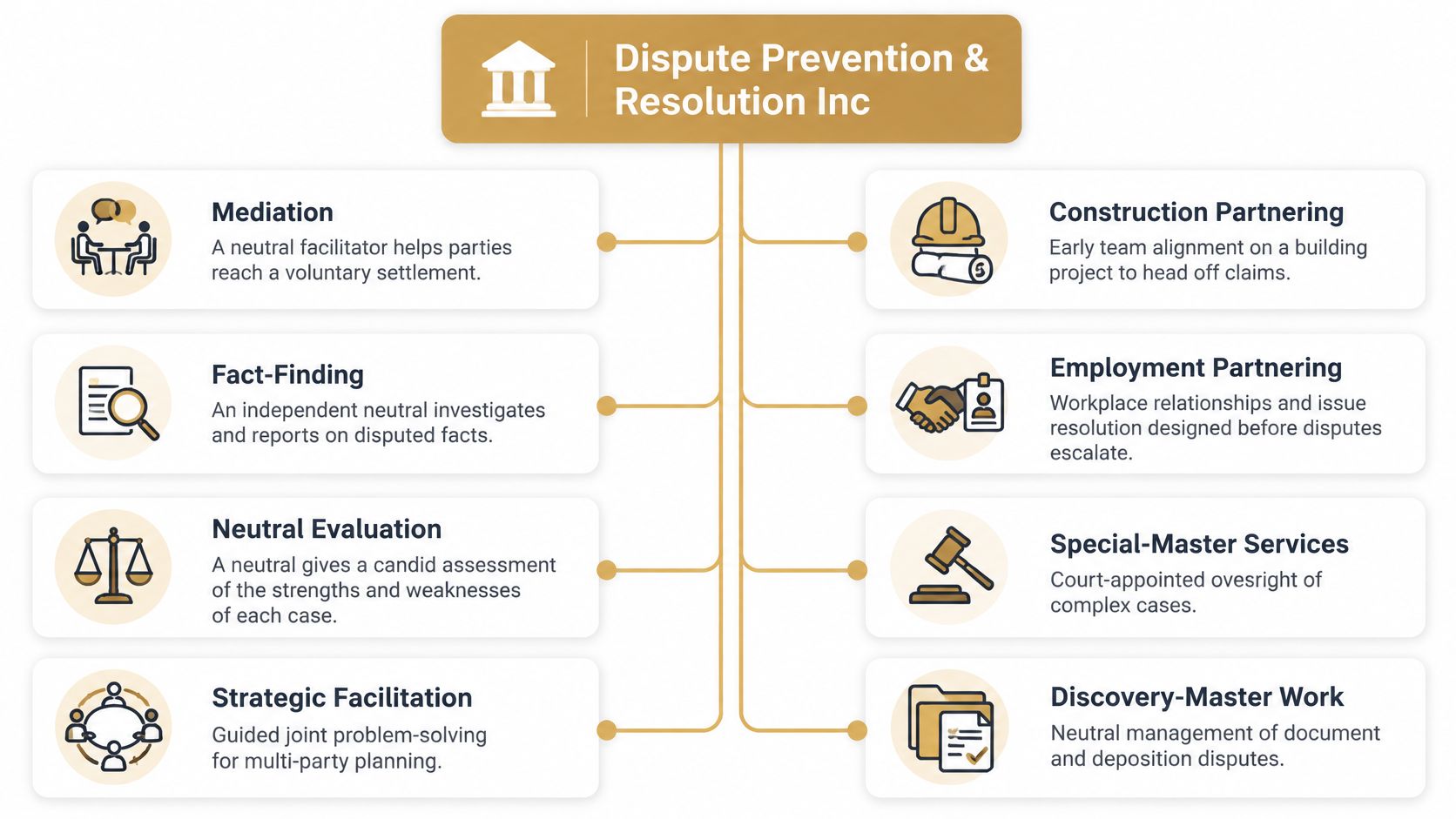
Choose the function before the format
Partnering and facilitation help participants establish working arrangements or address disagreements before positions harden. Mediation asks whether the parties can reach an acceptable settlement. Fact-finding and neutral evaluation address different obstacles: uncertainty about events and uncertainty about the merits.
Master assignments serve another purpose. A discovery master may handle disclosure disagreements within a larger proceeding, while a special master's authority comes from the particular appointment. Neither label should be read as unlimited authority to decide the entire case.
The published offerings also include final-offer, high-low, interest, and uninsured/underinsured-motorist arbitration. Selecting among these requires more than recognizing a service name. The agreement must establish what the neutral may decide and what effect the decision will have.
For a broader comparison, distinguish these neutral roles from merchant-focused dispute resolution services. If your construction issue involves contract interpretation, payment rights, or legal remedies, Olson & Sons' guide can help you find a construction dispute lawyer before selecting a neutral process.
The accompanying video offers another format for considering dispute resolution.
Administrative support matters across these services. Clarify who handles intake, scheduling, document control, fee administration, and procedural communications. Choose the service that addresses the actual obstacle, rather than the most formal option available.
Escalation Stages and Clause Drafting Checklist
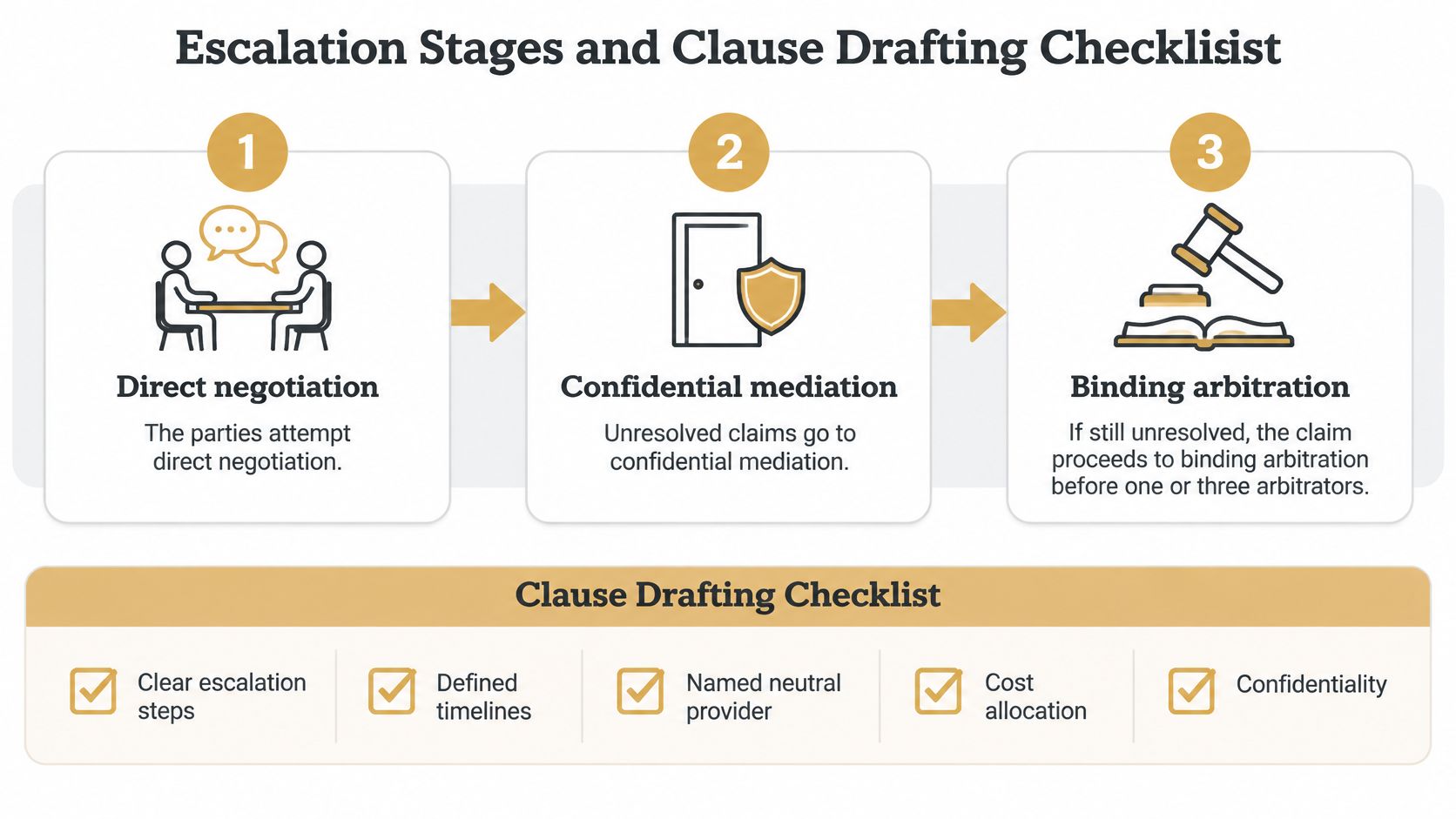
A workable dispute clause tells the parties what happens when ordinary discussions fail. Under DPR's published arbitration framework, unresolved claims proceed through confidential mediation and may then move to binding arbitration before one or three arbitrators, with flexible procedures and alternative arbitration formats.
A practical escalation structure is:
- Direct negotiation. Identify the issue, the requested remedy, and the representatives authorized to settle. State any negotiation prerequisite expressly rather than assuming informal discussions satisfy it.
- Confidential mediation. Specify how mediation begins and when the parties must participate. Confidentiality expectations should be addressed in the governing documents.
- Binding arbitration. If settlement fails and the agreement authorizes arbitration, follow the specified appointment and filing process. The arbitrator's authority must come from the applicable agreement and rules.
The process diagram highlights the escalation sequence and drafting decisions.
Choose the award mechanism deliberately
Arbitration variants offered by DPR
| Variant | How the Award Is Set | When Parties Choose It |
|---|---|---|
| Standard arbitration | Arbitrator or panel issues a binding award under the governing rules | Default binding route after mediation fails |
| Baseball arbitration | Arbitrator selects one party's final figure | Money disputes where parties want disciplined final positions |
| High/low arbitration | Parties agree a floor and a ceiling on the award | Parties want to limit exposure and recovery uncertainty |
| ADR trial procedure | Managed discovery followed by a trial-style hearing | Complex claims needing structured evidence |
These formats change different things. Baseball arbitration constrains the arbitrator's choice; high/low arbitration constrains the financial outcome. Neither automatically eliminates the work needed to establish liability or prepare evidence.
Remove ambiguity before signing
- Prerequisites and timing. Identify required negotiation and mediation steps, including how a party starts each stage.
- Confidentiality. Address mediation communications and arbitration materials separately rather than assuming identical protections.
- Appointments. Specify panel size, selection method, and a mechanism for appointment difficulties.
- Governing rules. Identify the applicable rules and how their version will be determined.
- Discovery. Define disclosure limits or select a managed-discovery procedure.
- Award and variant. State whether the award is binding and identify any agreed award constraints.
- Administration and costs. Name the provider and address responsibility for deposits and fees.
Have counsel turn these decisions into enforceable language. A clause that merely says the parties will use ADR leaves unresolved questions about when participation is required, who decides the dispute, and what authority that decision carries.
Sectors Served and When DPR Fits a Dispute
Industry fit isn't enough; procedural fit matters too. DPR's described audience includes legal, business, construction, insurance, medical, and judicial communities. A business still needs to identify the particular issue a neutral can help resolve.
Consider a contractor and owner who disagree about payment for changed work. The immediate obstacle might be missing project documentation, disagreement over authorization, or a breakdown in communication. A project-level process can address those issues without treating every disagreement as a fully developed arbitration claim.
For a supplier dispute, the question may be different: did the delivered goods meet the agreed specification, and what remedy does the contract permit? Neutral evaluation can help parties assess their positions, while mediation gives them room to negotiate replacement, revised delivery, or another commercial solution.
Match the relationship to the mandate
| Setting | Illustrative disagreement | Main suitability question |
|---|---|---|
| Construction | Owner contests payment for changed work | What project process and contractual authority apply? |
| Business | Customer alleges failure to meet specifications | Can the parties negotiate a practical commercial remedy? |
| Insurance | Coverage-related motorist claim | Does the applicable provision authorize arbitration of this issue? |
| Medical or legal | Parties disagree over professional services or obligations | Is the issue suitable for the proposed process and neutral? |
| Judicial | A complex matter needs defined procedural oversight | What does the appointment authorize the neutral to do? |
Consent and authority require separate attention. An existing clause may supply the agreement to arbitrate; without an applicable clause, a party may need to propose mediation or negotiate a submission agreement. A court-appointed role instead requires attention to the appointment's terms.
A suitable neutral process needs a defined problem, authorized participants, and a clear mandate. A familiar industry label doesn't supply any of those automatically.
DPR's Hawaii base is relevant when considering location, logistics, and the local context of the matter. It isn't proof that a particular neutral has the subject expertise your dispute requires. Ask about conflicts, relevant experience, and availability, then compare the proposed process with the remedy you need.
Cost and Timeline Drivers
No DPR fee schedule is established by the public information supporting this profile. A responsible budget therefore starts with the proposed procedure, not an invented price range or completion promise.
The main cost question is what work the parties are asking the neutral and their representatives to perform. A focused settlement session and a contested evidentiary hearing require different preparation. Even mediation can become expensive if the parties arrive without the records or authority needed to negotiate.
What to include in the budget
| Driver | Practical consequence |
|---|---|
| Scope of the dispute | More issues can require additional submissions and preparation |
| Panel composition | Additional neutrals create additional compensation and scheduling considerations |
| Discovery | Document collection, review, and deposition disputes add work |
| Hearing format | Witnesses, experts, and hearing length affect preparation |
| Administrative arrangements | Filing, scheduling, facilities, and case administration may carry separate charges |
| Settlement readiness | Missing records or absent decision-makers can make sessions less productive |
Arbitration variants aren't interchangeable cost controls. Limiting the award range doesn't necessarily limit discovery, expert work, or hearing time. To control those expenses, parties need procedural limits that address the work itself.
Request an itemized procedural proposal
Ask DPR to identify neutral compensation, administrative charges, deposit requirements, cancellation terms, and how charges are allocated. Also request the anticipated appointment process, submission sequence, and available hearing arrangements. Distinguish a scheduling estimate from a contractual deadline or legal limitation period.
For merchants, the relationship between cost and revenue is useful as a budgeting discipline, but don't substitute payment-dispute economics for an ADR budget. Include internal management time and legal advice, not just the provider's invoice.
Compare the likely value of the remedy with the total process cost. That comparison may support a narrower mediation, an agreed document exchange, or legal advice about another route. It shouldn't be based on an assumed fee or a promised outcome.
Verified Facts and Open Questions
The strongest evidence concerns identity, historical milestones, and documented service categories. Those facts support a regional company profile. They don't support precise conclusions about DPR's current size, financial capacity, case volume, or results.
Public business listings are useful, but their fields don't all have equal evidentiary weight. A dated incorporation milestone is different from an estimated employee count. A provider's service description is different from an independently measured performance finding.
Separate the evidence categories
| Category | What can reasonably be concluded |
|---|---|
| Historical milestones | The listings document formation, business commencement, and BBB milestones |
| Company identity | Public profiles identify the Hawaii business and its leadership |
| Service scope | The firm and its listings describe a multi-method ADR offering |
| Staffing | Directory counts conflict and shouldn't be treated as audited figures |
| Revenue | A directory estimate doesn't establish verified financial results |
| Fees and availability | Current written confirmation is needed |
| Chargeback processing | It isn't documented among DPR's described services |
The conflicting staffing estimates should remain unresolved unless the firm provides reliable clarification. Averaging incompatible directory figures would create a new number without improving its reliability. Employee headcount also wouldn't tell you how many suitable neutrals are available for your particular matter.
What remains decision-critical
The open questions are operational: who would serve, whether that person has a conflict, which rules apply, what authority the process requires, and what the engagement will cost. Published rules exist, but their availability doesn't establish which version governs your agreement.
Evidence standard: Use directory information to identify the business. Use engagement documents to establish the terms on which you'll actually work with it.
Avoid treating BBB accreditation as a finding about legal outcomes or assuming a long operating history guarantees a quick settlement. The useful conclusion is narrower: DPR has a documented institutional history and a described ADR platform, while case-specific suitability still needs verification.
Verify DPR and Choose Your Next Step
Identify the notice or agreement that requires action. Start with the actual document, not the phrase used in a search result. A processor dispute notice calls for a payment-system response; a demand invoking a contractual ADR clause requires analysis of that clause.
Read the whole dispute provision. Check who must receive notice, how notice must be delivered, what issues the clause covers, and whether any prerequisite applies. Don't rely on a heading that says arbitration if the surrounding language limits its scope.
Establish participation authority. If there's no applicable ADR clause, consider proposing mediation through a written agreement. Identify who can approve a settlement and whether insurers, affiliates, or other affected parties need to participate.
Prepare a useful intake package
Provide a concise dispute summary, the relevant agreement, key correspondence, and a clear statement of the remedy sought. Separate undisputed facts from allegations. For a construction matter, organize change documentation and payment records; for a supply dispute, include specifications, delivery records, and rejection communications.
Don't send an uncontrolled archive before receiving submission instructions. Ask how DPR wants confidential materials delivered, who will receive them, and what conflict-check information is required.
Confirm the business and proposed engagement. Match the legal entity and contact details to independent records and current correspondence. Request confirmation of the proposed neutral, relevant experience, availability, and conflict disclosures rather than relying on directory staffing estimates.
Obtain the operative documents. Request the applicable rules, engagement terms, fee schedule, and any proposed arbitration variant in writing. Use the official website to obtain documents, but confirm that they're the documents your contract or submission agreement adopts.
Proceed toward mediation when the parties have authority to participate and a realistic settlement question to resolve. Consult counsel before committing if the clause is unclear, urgent relief may be needed, or the professional expense could outweigh the remedy. Your immediate next step is to assemble the controlling documents and identify the process they require.
At Disputely, we help merchants address payment disputes through prevention, alerts, and chargeback recovery, rather than acting as an ADR neutral for commercial contracts. If your issue is a disputed card transaction, visit Disputely to explore the appropriate prevention or response workflow for your business.


