
eBay Buyer Protection Explained: Rules, Claims and Refunds
The tracking says delivered, but the parcel isn't at your door. Or the parcel arrived, and the phone inside has a cracked screen the listing never showed. If you're the seller, you're looking at the same transaction from the other side, wondering whether to refund, request a return, or challenge the claim.
eBay buyer protection turns on eligibility and records, not who tells the most convincing story. Buyers need to choose the right remedy and preserve evidence. Sellers need to answer the actual allegation before the response window closes, with documents that connect the listing, item, shipment, and payment.
What eBay Buyer Protection Covers by Claim Type
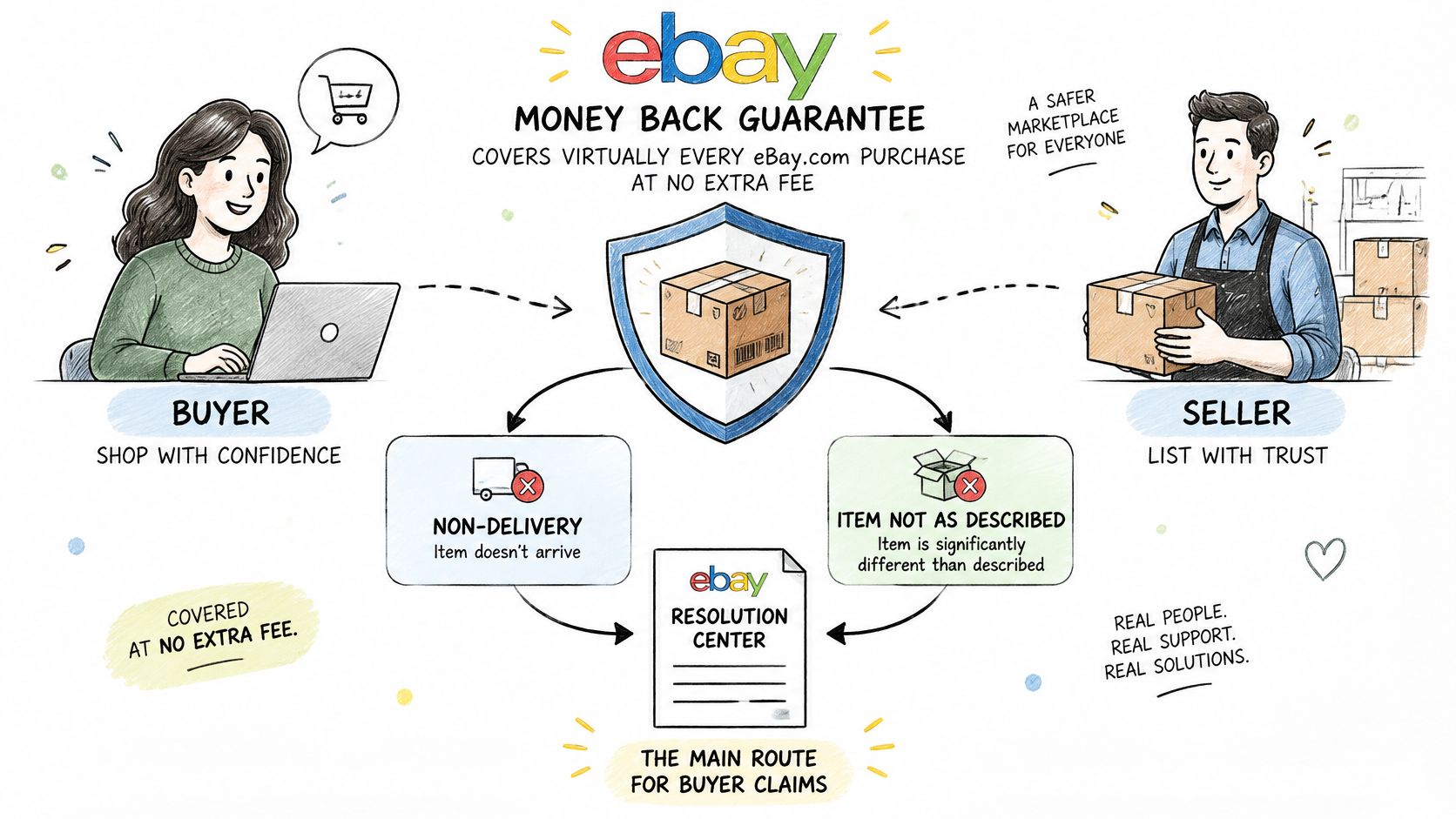
eBay's Money Back Guarantee covers virtually every qualifying eBay.com purchase at no additional fee, generally refunding the purchase price plus original shipping when an item doesn't arrive or is materially different from its description, according to eBay's coverage overview.
That's the core of eBay buyer protection. It isn't permission to return anything you no longer want, and the normal covered remedy isn't store credit. The claim must concern a protected transaction and a problem the guarantee addresses.
The program connects buyer remedies with seller evidence and eBay's resolution process.
Buyer remedies by claim type
| Claim type | Buyer remedy | Key condition |
|---|---|---|
| Item not received | Purchase price plus original shipping | Delivery must match the address on the order |
| Significantly not as described | Purchase price plus original shipping | Item must be materially different from the listing |
| Damaged or faulty on arrival | Return and refund | Applies even if the seller offers no returns |
| Counterfeit or authenticity complaint | Case reviewed under eBay counterfeit rules | Listing and item evidence decide the outcome |
Item Not Received concerns fulfillment. A seller's dispatch receipt helps establish that a parcel entered the carrier's network, but dispatch and delivery aren't interchangeable.
Significantly Not as Described concerns what was promised versus what arrived. A missing advertised component, incorrect model, undisclosed damage, or material functional defect calls for a comparison against the original listing. General disappointment doesn't identify that mismatch.
Authenticity complaints require particular care. A buyer's allegation isn't itself a finding that an item is counterfeit, and a seller's assurance isn't proof of authenticity. Preserve identifying details and supporting documentation rather than arguing from reputation.
Payment protection isn't the same as a chargeback
Qualifying payments include PayPal and most other electronic payment methods. However, the payment method alone doesn't establish coverage, and an excluded purchase doesn't become eligible because checkout succeeded.
An eBay claim and a card-network chargeback are separate procedures. eBay applies its own rules about coverage, evidence, response obligations, and remedies. Start by identifying whether the problem is delivery, description, damage, or authenticity, rather than choosing whichever complaint label sounds strongest.
Which Purchases Fall Outside Buyer Protection
An order confirmation isn't a coverage certificate. Before relying on protection, check the product, checkout route, and applicable marketplace policy. The Australian eBay Money Back Guarantee policy illustrates why category exclusions, accepted payments, deadlines, and competing dispute routes matter.
Eligibility checks before purchase or listing
- Category: Exclusions include motor vehicles, real estate, websites and businesses for sale, classified advertisements, services, digital or intangible goods, travel and event tickets, NFTs, and certain business-equipment listings.
- Payment route: Pay through eBay using an accepted method. Don't treat an off-platform payment as equivalent to marketplace checkout.
- What's being sold: A downloadable file, access right, or service isn't an ordinary physical-goods purchase. Physical goods can also fall into excluded categories.
Policies can differ by marketplace, so use the policy attached to the transaction rather than assuming an overseas policy applies unchanged.
Practical rule: Check eligibility before money changes hands, not after a dispute starts.
A seller's no-returns policy doesn't override protection when an eligible item arrives damaged, faulty, or materially different from its listing. It addresses a different question from whether the seller fulfilled the transaction as described.
Before publishing a listing, identify the actual product category, payment route, and evidence you could produce if the buyer challenged delivery or condition. If coverage is unavailable, describe that accurately rather than presenting the guarantee as a selling point.
How a Buyer Claim Moves Through eBay
A useful way to manage a claim is to treat it as an evidence review with customer communication attached. Under eBay's Money Back Guarantee policy, delivery claims turn on order-address evidence, while description disputes involve listing compliance and return obligations.
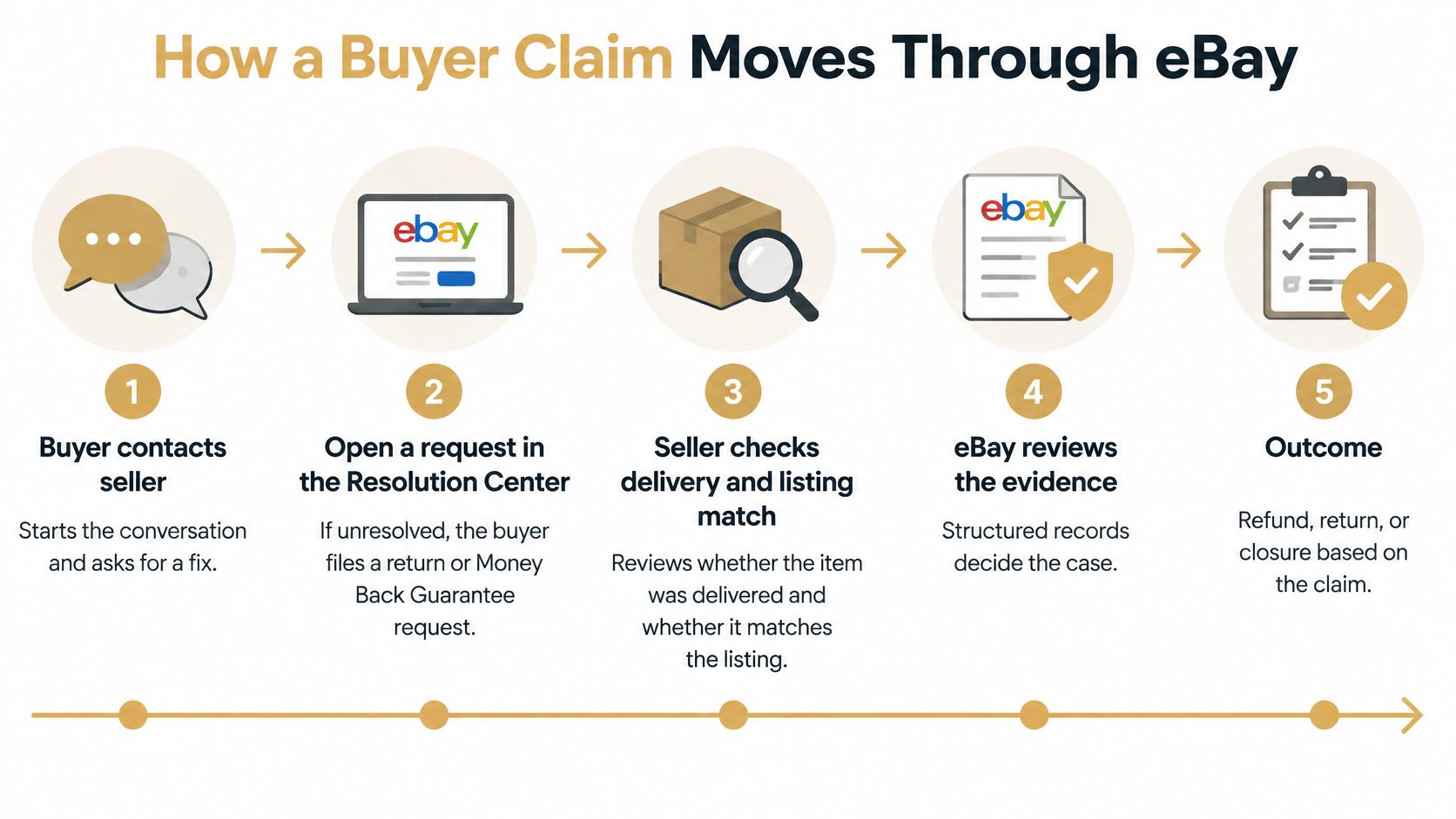
The flow below shows the main stages, although the required actions depend on the claim.
From complaint to decision
The buyer contacts the seller. Describe the specific failure and the requested fix through eBay's messaging tools. A clear initial report gives the seller something actionable rather than a vague expression of dissatisfaction.
The buyer opens the appropriate request if unresolved. Use the return or Money Back Guarantee route available through the order and Resolution Center. A formal request creates a case to manage, rather than leaving the problem buried in messages.
The seller checks delivery, description, and eligibility. Compare tracking with the transaction address, or compare the reported defect with the saved listing. This separates a delivery problem from a product problem before the seller chooses a response.
The seller proposes the appropriate resolution. That might be an agreed refund or a return followed by a refund, according to the case instructions. Keep the offer and acceptance inside the case so neither party has to reconstruct an informal agreement later.
The buyer asks eBay to intervene when appropriate. If the parties disagree or the seller doesn't act, eBay can review the records and procedural compliance. A long message repeating that the seller is trustworthy doesn't replace the missing delivery or listing evidence.
eBay resolves the case. The seller can face a refund, fund reversal, or invoice recovery. A settled payout doesn't necessarily end transaction exposure, so don't discard the order file when the money reaches the bank.
Keep marketplace procedures separate
Teams selling across marketplaces should maintain platform-specific instructions. Reddog Consulting Group's guide to Amazon claim disputes and Buy Box eligibility is a useful comparison, not a substitute for eBay's rules.
Likewise, a chargeback dispute process needs its own workflow. Don't submit a marketplace response and assume you've answered a separate issuer dispute.
For a visual companion to the claim workflow, use the video below.
At intake, retain the allegation and listing. During investigation, attach fulfillment and item records. At closure, save the decision, return status, and refund confirmation together so the next person handling the order can see what happened.
Filing a Claim Without Losing Protection
Buyers should make the problem easy to verify. Say that the advertised charger was missing, show the damaged corner, or identify the tracking discrepancy. Don't make the seller guess what needs fixing.
Use the order's resolution route
- Start with the seller: Send a concise explanation with relevant photos, tracking details, and the listing as it appeared when you purchased.
- Formalize an unresolved problem: Open the appropriate return or Money Back Guarantee request through eBay. Don't assume an ordinary message is the same as a formal case.
- Follow the return instructions: Preserve the item's arrival condition, use the required return method, and retain the shipping receipt.
- Escalate inside the case: When intervention becomes available, ask eBay to step in rather than abandoning the request.
Save the order details, listing screenshot, correspondence, and return tracking somewhere you can retrieve them independently of your inbox.
Choose a remedy deliberately. Opening parallel disputes isn't a way to strengthen the same claim.
A card chargeback or PayPal dispute over the same issue can affect an open eBay case and create duplicate-recovery problems. If you're considering another route, establish the current case status and understand the consequences before proceeding.
Seek recovery for the actual unresolved loss, not another refund for money already returned. Keep refund confirmations so you can distinguish a promised refund from a completed one without creating overlapping requests.
Response Deadlines That Decide Who Wins
The seller windows below distinguish return responses, returned-item refunds, and cancellation actions; eBay's return guidance describes responding within 3 business days, refunding a returned item within 2 business days, deciding a cancellation within 3 days, and refunding an approved paid cancellation within 10 business days.
Seller response windows and what happens if they are missed
| Stage | Seller window | If the window is missed |
|---|---|---|
| Buyer return request | Respond within 3 business days | Buyer can ask eBay to intervene |
| Item returned | Refund within 2 business days | Buyer can request intervention |
| Cancellation request | Approve or decline within 3 days | Check the request status and eBay's available next steps; don't assume approval |
| Approved paid cancellation | Refund within 10 business days | Buyer can file a Money Back Guarantee claim |
Days and business days aren't interchangeable. Record the deadline displayed in the case instead of calculating every request from a generic calendar rule.
A late reply can undermine an otherwise defensible position. But meeting the response deadline isn't the same as resolving the claim: an acknowledgment that provides no required action can still leave the buyer waiting.
A daily routine that keeps cases moving
- Classify incoming events: Separate cancellations, non-receipt reports, returns, and refund tasks.
- Assign an owner: Give each open case a named person and a backup.
- Record the next required action: Use a shared queue with the case identifier, deadline, missing evidence, and proposed decision.
- Reconcile returned parcels: Match warehouse receipts to open returns so refund tasks don't remain invisible to customer support.
- Confirm completion: Save the refund result or submitted response, not merely an internal note saying someone intended to act.
Sort the queue by the next procedural deadline, not only by order value or buyer tone. An inexpensive return awaiting a refund may need attention before an expensive complaint whose evidence review is still underway.
Automation works well for notifications, assignment, and overdue flags. It doesn't determine whether tracking qualifies, whether an exclusion applies, or whether the returned item matches the sold unit. Keep those judgments with someone who can inspect the evidence.
Evidence Checklist for Winning Disputes
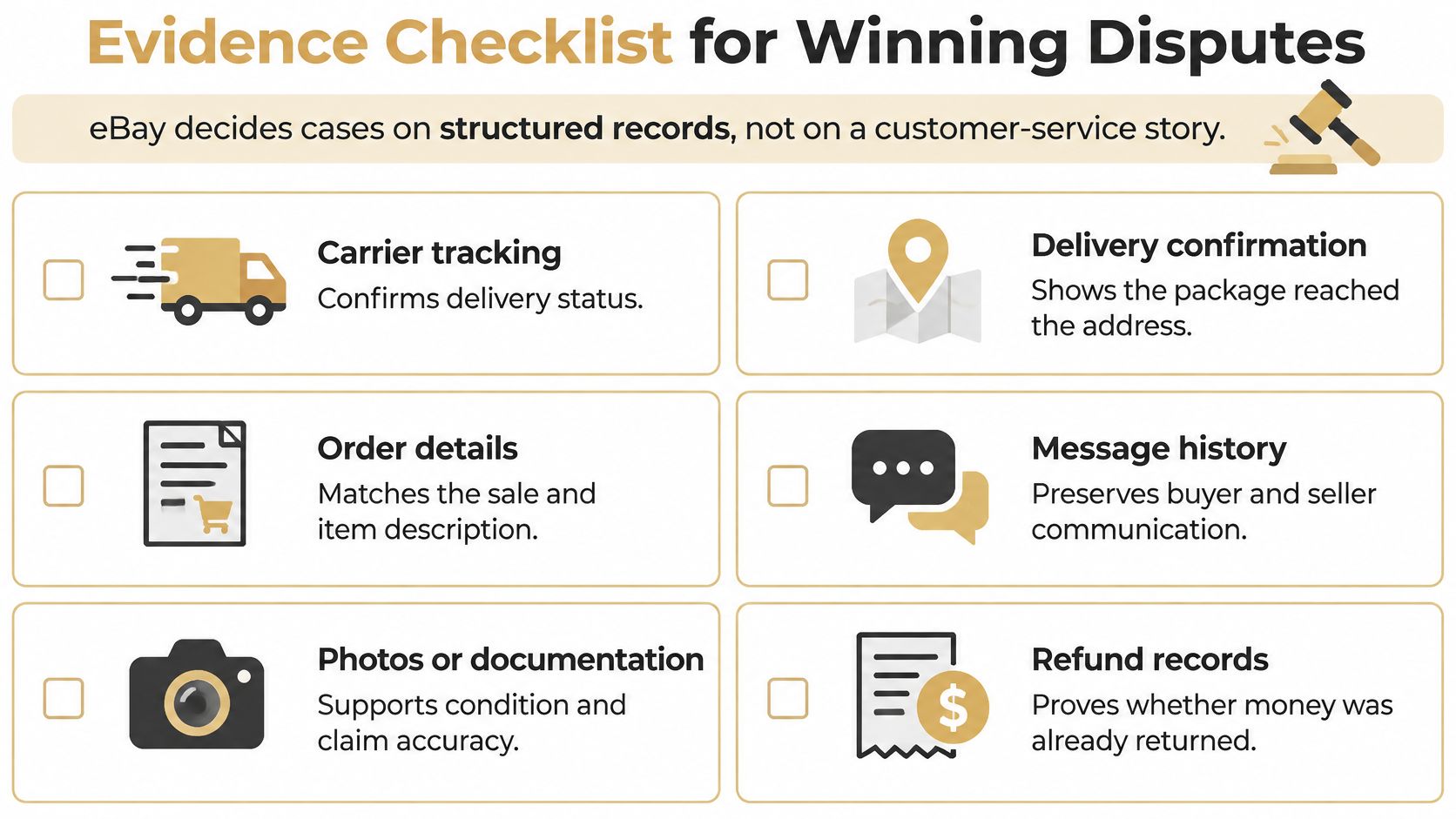
A useful evidence file answers the allegation directly. Tracking doesn't prove an item was authentic, and a packing photograph doesn't prove that the carrier delivered it to the transaction address.
Build the file around the order identifier so support, fulfillment, and finance can retrieve the same records. A defined evidence collection process helps prevent screenshots, warehouse notes, and refund confirmations from sitting in separate systems.
Records worth keeping
- Carrier tracking and delivery confirmation: Retain the carrier record and the information connecting delivery to the order address. A label purchase alone isn't delivery evidence.
- Order details: Preserve the transaction address, purchased item, and payment reference so other records can be matched correctly.
- Listing snapshot: Save the description, condition, item specifics, photographs, and included accessories as sold. A later edited listing may not establish the original promise.
- SKU and serial-number records: Connect the specific dispatched unit to the order, especially when similar inventory is interchangeable at a glance.
- Fulfillment scans: Retain pick, pack, and carrier-handoff records to document how the parcel moved through your operation.
- Condition photographs: Photograph relevant identifying marks and packaging. Keep enough context to connect an image to the item rather than an unidentifiable close-up.
- Messages and resolution records: Preserve timestamped communication, return receipts, refund decisions, and completed refunds.
The checklist below gives teams a compact reference for assembling the file.
Check what your shipping service actually records
For Australian shipments, Aeros Couriers' explanation of signature requirements for Australia Post parcels can help when choosing delivery services. Don't assume that paying for a signature feature automatically satisfies every marketplace evidence requirement.
Keep records through the applicable dispute period and longer where unresolved exposure requires it. Set access permissions so staff can retrieve necessary evidence without circulating unnecessary buyer information.
Retrieval test: Can the case owner produce the file promptly, and can a reviewer connect the records to the item, address, and relevant dates?
Not every document needs to show every field. The complete file should establish the connections without asking the reviewer to infer them.
Handling Ambiguous, Abusive or Counterfeit Claims
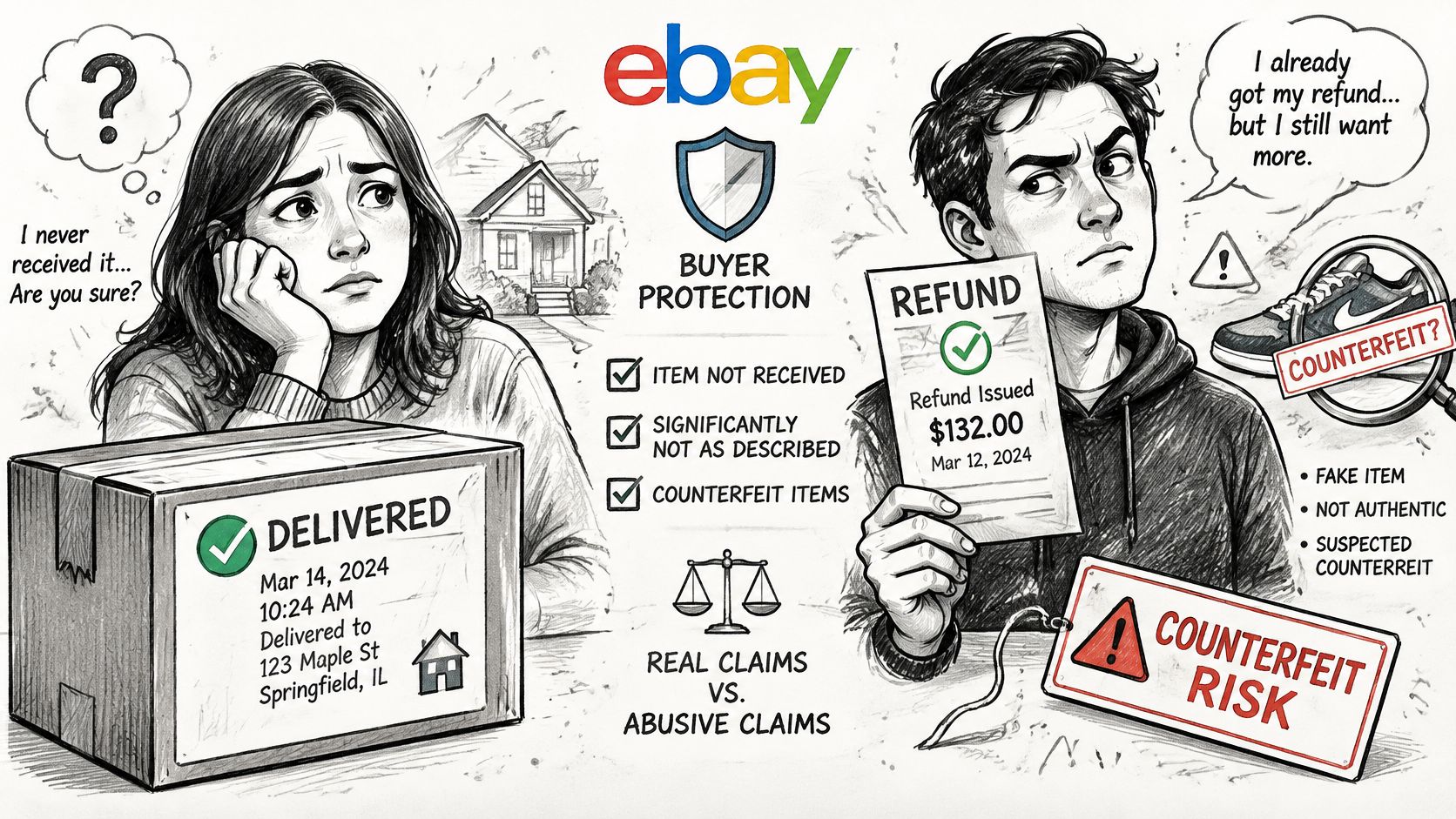
Say a buyer reports non-arrival, but tracking appears to show delivery to the correct address. Separately, another buyer requests a refund that your payment record says has already been completed. Neither situation calls for an accusation, but neither calls for an automatic second payment.
Refunding every suspicious request isn't sound risk management. Ignoring suspicious requests isn't sound risk management either. eBay's seller guidance on handling return requests warns that failing to respond can lead to a buyer refund and seller reimbursement liability without requiring the item's return.
Use the allegation and the records to choose a response, not the buyer's tone.
Match the response to the uncertainty
For a delivery dispute, inspect the address match and carrier information before declaring that delivery settles everything. Submit the relevant record through the case and ask targeted questions about the discrepancy. Don't post the buyer's address publicly or move the argument into feedback.
For a description or damage dispute, compare the allegation with the listing and dispatch records. Ask for photographs that clarify the claimed defect, but don't use repeated information requests to stall a required return decision.
For a potentially mismatched return, document the unpacking, identifiers, accessories, and condition. Describe the specific discrepancy, such as a serial number that doesn't match the dispatched unit, instead of making a broad fraud claim you can't substantiate.
A practical workflow for disputes on eBay should distinguish an evidence-based challenge from a refusal to engage.
Duplicate refunds and authenticity allegations
When a refund appears complete, reconcile the transaction identifier, amount, and status before issuing another. Report suspected duplicate-recovery conduct through eBay's available reporting tools. Prohibited buyer conduct can lead to lost coverage, blocked claims or refunds, or suspension, but the seller shouldn't promise or threaten a particular enforcement outcome.
For authenticity complaints, preserve sourcing documents, identifiers, packaging details, and the exact listing representations. Stop treating an authenticity allegation as a routine preference return, and follow eBay's instructions about what happens to the item.
Public feedback belongs in a separate workflow. Tools such as Bragly review collection tools can be considered for review collection, but reviews aren't delivery evidence or authentication documents. Never condition a required remedy on removing criticism.
A prompt refund is appropriate when the defect is clear and the remedy is due. A documented challenge is appropriate when concrete records contradict the allegation. The skill is making that distinction while the case is still actionable.
Confirm Your Dispute Process Before the Next Claim
Start with active listings, not the dispute inbox. Identify excluded purchases and remove any inaccurate protection promises; an excluded category doesn't necessarily mean the item itself is prohibited, so don't relist it under an inaccurate category to imply coverage.
Then make responsibility visible. A case shouldn't depend on whoever happens to notice an email notification.
Put the process into operation
- Review listing eligibility: Confirm categories, checkout routes, descriptions, and return language.
- Assign case ownership: Give someone responsibility for checking open requests daily, with a backup and a shared deadline calendar.
- Standardize order files: Use consistent folders or case records for listings, fulfillment, communication, returns, and refunds.
- Separate payment channels: Keep eBay requests distinct from issuer disputes involving payments taken through your own store.
For card payments taken outside eBay, an alert service can be another control, not a replacement for marketplace case handling. Our Verifi Network (CDRN) coverage provides direct issuer alerts and 72 hours to refund and stop chargebacks.
That capability has limits. We don't guarantee dispute prevention, chargeback reduction, processor approval, account standing, or avoidance of reserves, monitoring programs, or account termination. It also doesn't establish eligibility for eBay's Money Back Guarantee or decide an eBay case.
Run a mock claim today. Choose a recent order, locate the original listing and delivery records, assign a response owner, and work through a hypothetical return and refund. Fix missing records and unclear handoffs before a real buyer is waiting.
Disputely offers chargeback alerts and automatic refund processing for merchants managing card-payment disputes alongside their marketplace operations. Visit Disputely to assess whether issuer alerts fit your payment workflow, while keeping eBay claims in a separate, evidence-led process.


