
Excessive Chargebacks Explained: Limits, Costs and Fixes

A merchant can have an acceptable-looking chargeback rate and still face higher network risk. Visa's newer framework combines fraud reports and non-fraud disputes, rather than measuring chargebacks alone, according to Adyen's dispute and fraud monitoring documentation, which lists an excessive threshold of 1.50% from April 2026 in major regions. That changes the question from “How many disputes did we lose?” to “Which events did the network count, against which sales, and when?”
For ecommerce and subscription merchants, excessive chargebacks are therefore a timing and counting problem as much as a fraud problem. A useful risk report separates network eligibility, current-month exposure, and the operational causes behind incoming disputes. A single blended percentage can't do all three jobs.
What Makes a Chargeback Count as Excessive
A merchant can cross a count threshold while its dispute ratio remains below a network's limit, or exceed a ratio without meeting the required count. Whether chargebacks count as excessive depends on the network, program, reporting period, and qualifying conditions.
For programs that require both a minimum count and a minimum ratio, crossing only one threshold does not establish eligibility. It still signals which part of the merchant's exposure may need attention.
Excessive chargeback thresholds by card network
This table separates Visa's legacy thresholds from its newer framework. Qualification timing and remediation or enforcement timing are distinct.
| Network | Program tier | Count trigger | Ratio trigger | Timing rule |
|---|---|---|---|---|
| Visa | Standard, legacy Fraud Monitoring Program | 100 disputes | 0.90% | Monthly qualification; four-month remediation window |
| Visa | Excessive, legacy Fraud Monitoring Program | 1,000 disputes | 1.80% | Qualification in a single month; immediate financial consequences at the applicable enforcement stage |
| Visa | VAMP excessive threshold | Fraud reports plus non-fraud disputes; confirm applicable minimum with the acquirer | 2.20% in 2025; 1.50% from April 2026 in major regions | Confirm current regional observation and enforcement rules with the acquirer |
| Mastercard | Excessive Chargeback Merchant, ECM | 100 chargebacks | 1.50% CTR | Two consecutive trigger months |
| Mastercard | High Excessive Chargeback Merchant, HECM | 300 chargebacks | 3.00% CTR | Confirm the current HECM qualification period with the acquirer |
The Visa dispute monitoring thresholds and remediation timing describe the legacy program's monthly count and ratio requirements and its remediation window. The Visa monitoring program thresholds and VAMP framework explain the newer VAMP measures and regional thresholds. These frameworks are not alternative limits a merchant can choose between.
For Mastercard, the Excessive Chargeback Program guide sets ECM at at least 100 chargebacks and a 1.50% chargeback-to-transaction ratio in each of two consecutive trigger months. It lists HECM thresholds of 300 chargebacks and 3.00%.
Why the count changes the diagnosis
A percentage-only dashboard can make different levels of exposure appear alike. A high-volume merchant may need to prevent many disputes to shift its ratio. A smaller merchant may have a volatile percentage while staying below a program's count threshold.
Track count, ratio, and qualifying-period status together for each network. Keep Visa and Mastercard results separate, since each network applies its own program rules.
Practical rule: Check the numerator, denominator, count requirement, observation period, and enforcement status before classifying an account as safe or excessive.
Compare monthly results with the applicable program row. Treat legacy rules as historical, and confirm current conditions with the acquirer before using the table to forecast monitoring exposure.
How the Monthly Ratio Is Calculated
Visa's legacy monitoring calculation compares disputes reported during a calendar month with sales captured during that same month, according to the Visa dispute and fraud monitoring program guide. The disputed purchase's original date doesn't determine that month's denominator.
Expressed as a count-based monthly measure:
Monthly dispute ratio = disputes reported during the month ÷ eligible sales transactions captured during the month × 100
This illustration shows the calculation workflow.

Say a subscription business has unchanged fulfillment and customer support, but customers begin disputing older renewals. Those disputes enter the current reporting period. If current sales have also slowed, the merchant has more reported disputes against a smaller denominator without any deterioration in this month's deliveries.
That's why a calendar-month ratio measures current monitoring exposure, not necessarily the quality of purchases made that month.
Keep the event dates separate
Store these timestamps against a stable transaction identifier:
- Authorization or capture date: Establishes when the payment entered your payment workflow. Keep both when they differ.
- Fulfillment or service-delivery date: Shows when the customer received the goods, access, or scheduled service.
- Dispute-received date: Establishes when the dispute entered your operational queue and reporting period.
Build a network-style monthly view for compliance forecasting and a transaction-cohort view for diagnosis. Segment the latter by transaction age, recurring-billing attempt, issuer region, product, and fulfillment status.
A cohort view can reveal that an older renewal campaign caused today's spike. A monthly view tells the payment team whether that spike requires immediate intervention. Neither replaces the other.
Reconcile events before trusting the percentage
For a VAMP-style dashboard, carry fraud reports and non-fraud disputes separately against eligible settled sales, then reconcile the combined measure to the acquirer's report. Don't assume that an internal sum automatically reproduces all network inclusion and exclusion rules.
Ingest alerts daily, suppress duplicates, and apply deterministic refund instructions. Link every alert to its refund status and eventual network record, including cases where no formal dispute follows.
Your monthly report should show the network-style ratio and cohort ratios side by side. Label provisional events clearly so an unresolved alert isn't mistaken for a confirmed filed chargeback.
How Monitoring Programs Escalate Your Exposure
Monitoring changes the merchant's problem from resolving individual customer complaints to demonstrating control over payment risk. The processor needs a credible explanation of what caused the increase, which controls changed, and whether incoming activity is improving.
Under the historical Visa framework described by Checkout.com's Fraud Monitoring Program guide, standard-stage merchants had four months to reduce disputes, while excessive-stage enforcement included reported fines of $50 per dispute at the applicable stage. The same guide documents the legacy count and ratio conditions shown in the threshold table.
From remediation to processing scrutiny
The escalation ladder is operational as well as financial:
- Initial monitoring: Assign an accountable owner, validate the program calculation, and document the causes.
- Unresolved exposure: Show whether refunds, billing changes, or fulfillment fixes are reducing incoming cases.
- Continued escalation: Prepare for assessments, reporting obligations, closer processor scrutiny, and possible reserves or acceptance restrictions.
A merchant with strong sales can still generate a large dispute workload. A smaller merchant may face sharp ratio volatility. Neither fact alone proves that every qualification condition has been met.
For businesses already managing high-risk merchant processing, the remediation file should connect each action to a measurable cause, rather than promise fewer disputes next month.
A processor can evaluate a documented control. It can't evaluate an unsupported assurance that customer service will improve.
The distinction between prevention and recovery matters here. Recovering revenue from a filed dispute and stopping an eligible dispute before filing are different operational outcomes; report them separately.
The video below provides additional context on chargeback management.
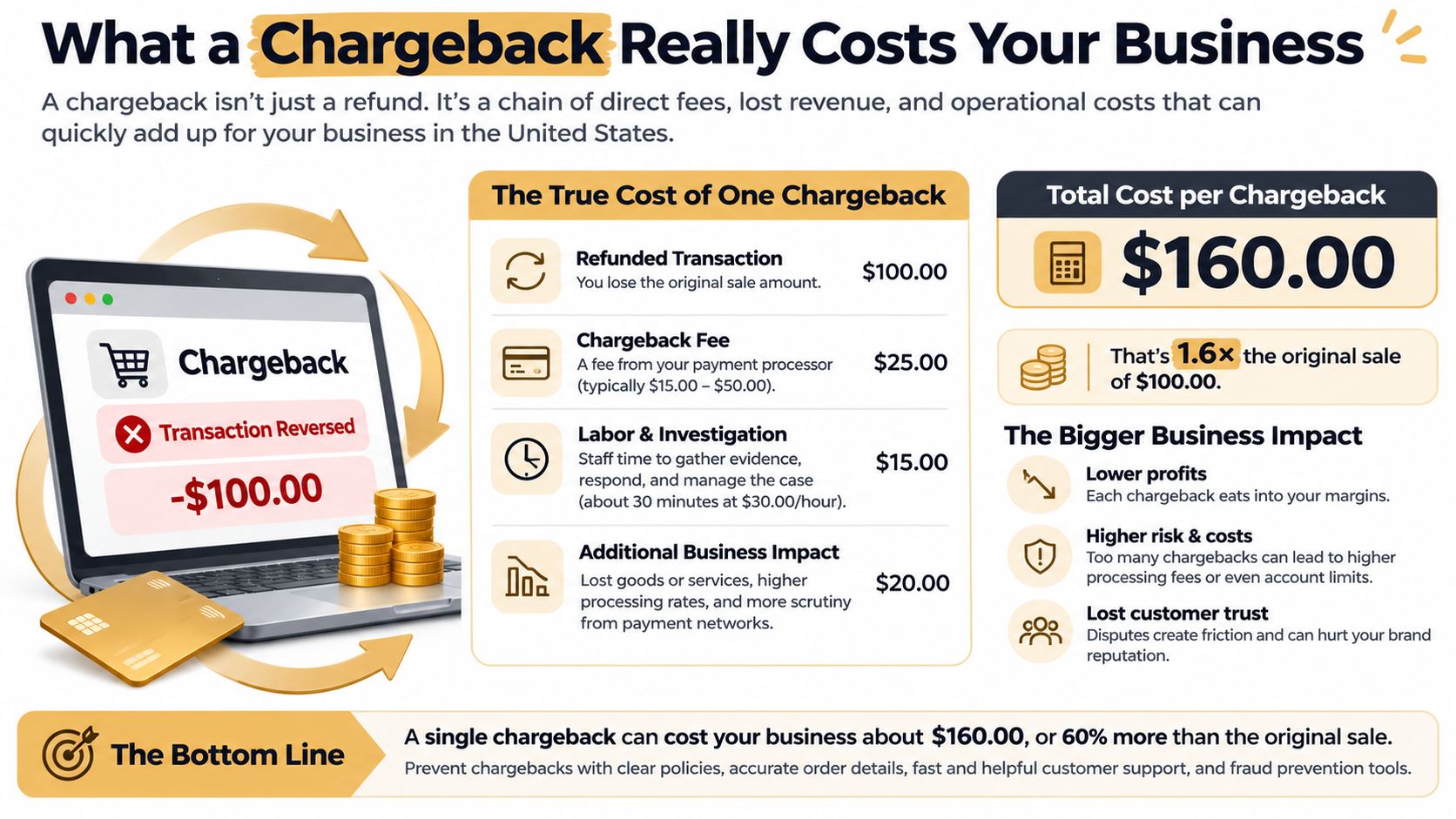
What a Chargeback Really Costs Your Business
A chargeback can resemble a refund with additional processing costs attached. Calling every chargeback a “refund plus a fine,” however, would overstate the case: a dispute fee and a network monitoring assessment aren't the same thing, and not every case results in every possible cost.
The merchant's exposure begins with the reversed payment, but it can extend to merchandise, fulfillment, staff time, and the expense of preparing a response. Those layers explain why the disputed sale value is an incomplete budgeting measure.
A Federal Reserve Bank of Kansas City working paper published in 2016, using processor data covering more than 20% of U.S. signature-based card transactions, found that roughly 70% to 80% of chargebacks were ultimately resolved as merchant liability. It also found significantly higher total and fraud-related chargeback rates for card-not-present transactions than for card-present transactions.
Those are historical findings, not a forecast for an individual store. Their practical significance is that merchants shouldn't build a dispute budget around the assumption that contested payments will usually return.
Separate the cost layers
Use a case-level ledger rather than a single estimated fee:
- Payment reversal: Record the amount removed and any amount subsequently recovered.
- Unrecovered fulfillment: Include goods, shipping, or service-delivery costs that the business can't recover.
- Dispute expenses: Record the actual chargeback fee and any separately charged representment expense.
- Handling effort: Track staff time spent gathering evidence, communicating, and reconciling the result.
The infographic illustrates why these components belong in the same review.
Average chargeback value by sector
The Mastercard and Datos Insights global chargebacks report gives the following approximate 2025 average dispute values. These are disputed amounts, not total merchant losses.
| Sector | Average dispute value |
|---|---|
| Subscription services | $69 |
| Digital goods | $77 |
| Retail | $84 |
| High-risk categories | $99 |
| Travel and hospitality | $120 |
Use those figures only as sector context. Your own sale values, evidence quality, fulfillment costs, and handling effort determine whether a particular response is economically sensible.
For operational planning, calculate:
Gross chargeback exposure = reversed sale value + dispute fees + unrecovered fulfillment cost + handling cost
Subtract recoveries and avoid counting the same expense twice. This is a gross exposure measure relative to the expected completed sale, not a substitute for an accounting profit calculation.
The less visible cost is management attention. If payment staff spend their time rebuilding order histories, they have less capacity to correct the billing or delivery process that generated the disputes.
Choosing the Right Response
Mastercard and Datos Insights estimate that fraudulent chargebacks, combining first-party and third-party fraud, represent about 45% of merchants' global chargeback volume in their global chargebacks report. That doesn't mean every remaining case proves merchant error. It does mean a fraud-only response leaves substantial dispute activity unexplained.
Refund everything and contest everything are both weak policies. The former can surrender recoverable revenue; the latter can spend staff time defending cases where the merchant's own records support the customer.
A better decision starts with the reason code, then tests it against customer history, transaction value, fulfillment evidence, and the cost of resolving the case.
Refund or contest decision by dispute situation
Use the following as triage guidance, not an automatic verdict. “Refund immediately” means refund through the appropriate available workflow after checking whether a formal dispute or earlier refund already exists.
| Dispute situation | Refund immediately when | Contest and preserve evidence when |
|---|---|---|
| Low-value order with no proof of delivery | Handling cost exceeds the recoverable amount and the customer's complaint is credible | Tracking supports delivery to the billing address and addresses the stated claim |
| Subscription charge after a failed cancellation | A cancellation request is documented and customer history doesn't suggest abuse | Records show the disputed charge preceded the effective cancellation date and the terms were clearly disclosed |
| Fraud claim on a signed, high-value delivery | Evidence is incomplete, the deadline is close, and refunding remains available | Delivery signature and order history are complete, with evidence relevant to authorization |
| High-value travel or high-risk sale with full records | Records show a service problem the merchant caused | Booking and access records match customer usage and directly answer the dispute reason |
The subscription distinction is particularly important. A completed cancellation isn't evidence that a later charge was valid. A confirmation may support the customer if the merchant continued billing after cancellation took effect.
Likewise, a delivery signature proves something about receipt, not necessarily who authorized the payment. Match evidence to the actual claim rather than submitting every document attached to the order.
Apply an economic test before spending on evidence
Consider a low-value subscription renewal following a documented failed cancellation. If the merchant's records show that the customer tried to stop billing, refunding through the correct workflow is usually more defensible than paying staff to argue that the renewal technically processed.
Contrast that with a high-value delivery where the merchant has consistent order history, relevant authorization evidence, delivery records, and customer communications. That case may justify a complete evidence pack, provided the recoverable amount warrants the effort.
Before acting, compare:
- Recoverable revenue: What amount could a successful response return?
- Evidence strength: Do the records answer the reason code, or merely show that an order existed?
- Incremental expense: What additional fees and staff time will the response require?
- Customer impact: Is the merchant defending a valid sale or prolonging a documented service failure?
Decision discipline: A strong file answers the customer's allegation. A large file merely contains documents.
Record the decision, the evidence available at that moment, the expected cost, and the eventual outcome. Review repeated mismatches, such as contested delivery claims that consistently fail because the tracking record doesn't identify the recipient.
Don't judge the policy only by recovered revenue. Track unnecessary refunds, missed deadlines, duplicate credits, and preventable customer complaints alongside recoveries. That gives the payment team a basis for changing the rule rather than blaming individual agents.
Cut Your Dispute Rate Before Filing
A useful chargeback reduction plan assigns a control to a specific failure. It also names the evidence that will show whether the control worked.
Group disputes by cause. Export available history by reason code and separate fraud, service, and billing issues. Counting only the total hides whether the fix belongs with fraud operations, fulfillment, or subscription support.
Write consistent refund rules. Set a response for each reason code and value band, with escalation for ambiguous cases. The common mistake is allowing agents to reach different decisions on identical facts.
Process alerts daily and suppress duplicates. Match the alert to the payment, existing credits, and dispute status before taking action. A late alert may require a different workflow from an eligible pre-dispute case.
Reconcile alerts with final network records. Use stable identifiers to verify the refund and filing outcome. Don't treat an alert log as proof that a chargeback was prevented.
Make delivery and cancellation visible. Store tracking events and send clear cancellation confirmations. For teaching businesses, Tutorbase's invoicing connected to lesson scheduling is a relevant resource when reviewing how billed sessions map to scheduled services; maintain the underlying booking and cancellation records too.
The workflow below brings these controls together.
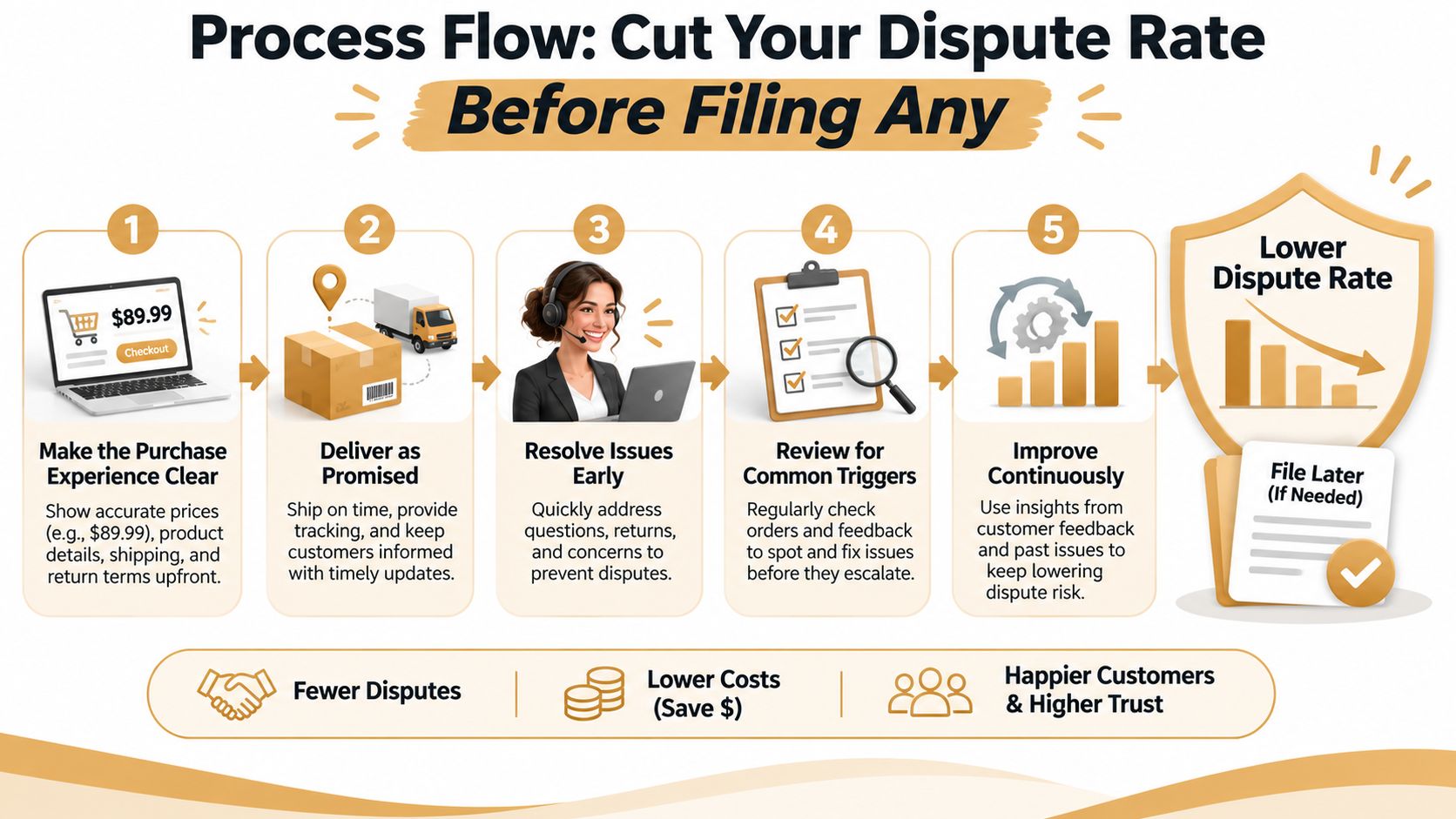
Evaluate changes using event timestamps and transaction cohorts, not just the aggregate outcome. An unmatched alert or ambiguous refund rule can produce an avoidable credit while leaving the original dispute unresolved.
Set Your Dispute Plan Before the Next Monitoring Month
Don't wait for a monitoring notice to decide who owns the problem. Compare the merchant's current count, ratio, and qualifying-period status with the applicable network criteria, then identify which incoming events could still be resolved through an eligible workflow.
If the account has comfortable headroom, prioritize consistent refund decisions and reliable reconciliation. If exposure is approaching a program boundary, shorten the time between receiving an alert and making a documented decision. Don't assume that a refund can erase an already filed dispute or every associated fraud report.
Give automation a defined job
At Disputely, when we detect a chargeback threat, we automatically process a refund to prevent the chargeback. You only pay when we prevent a chargeback from hitting your account. Use that process to act on eligible threats, not as a replacement for checking what the network ultimately counted.
Keep the responsibilities explicit:
- Payments operations owns the daily queue, unresolved matches, and reporting reconciliation.
- Customer support supplies cancellation requests, communications, and service-failure records.
- Finance checks refunds, dispute expenses, and recoveries.
- The risk owner approves rule changes and maintains the remediation record.
Disputely doesn't guarantee dispute prevention, chargeback reduction, processor approval, account standing, or avoidance of reserves, monitoring programs, or account termination. Keep your independent reporting and review exceptions rather than assuming automation establishes compliance.
Make a concrete decision this month: name the daily alert-queue owner and approve the first refund rule for your highest-count dispute reason. Give that owner access to the payment, fulfillment, and cancellation records needed to apply it consistently.
Disputely offers automated refunds when it detects chargeback threats, helping merchants act before eligible cases become chargebacks. Visit Disputely to assess how automated prevention could fit your refund rules and monthly monitoring workflow.


