
What Is a Chargeback Reversal? Who Gets the Money
A chargeback reversal is the financial outcome in which a disputed amount previously debited from a merchant's account is restored after the card issuer or card network accepts the merchant's defense. It isn't the same thing as a refund, because a refund returns money voluntarily while a reversal resolves a formal dispute over who bears financial liability.
You open your processor dashboard on a Tuesday morning, spot a debit pulled from your settlement balance weeks ago, and now see the same dollar figure posted back with a vague status label reading "reversal." Does that mean you won the case, the bank corrected an error, or the customer withdrew the claim? Most explainers blur those answers together and treat a reversal as the simple opposite of a chargeback.
In practice, understanding what is a chargeback reversal means tracking a dispute-processing outcome that runs on multiple card-network clocks at once. Sometimes the money comes back because your evidence convinced the issuing bank. Other times, a "reversal" appears on a statement because a party missed a procedural deadline and forfeited the case by default. Knowing who holds the money at each step keeps you from misreading your cash flow, misstating revenue, or fighting disputes that cost more than the order itself.
What a Chargeback Reversal Means for Your Money
Say a customer buys a $240 piece of gear from your online store, disputes the charge with their bank a month later, and your processor pulls $240 out of your payout right away. You gather the carrier's delivery scan, the checkout authorization log, and your support emails, then submit them through your processor's portal. Three weeks later, $240 reappears in your settlement report labeled "reversal."
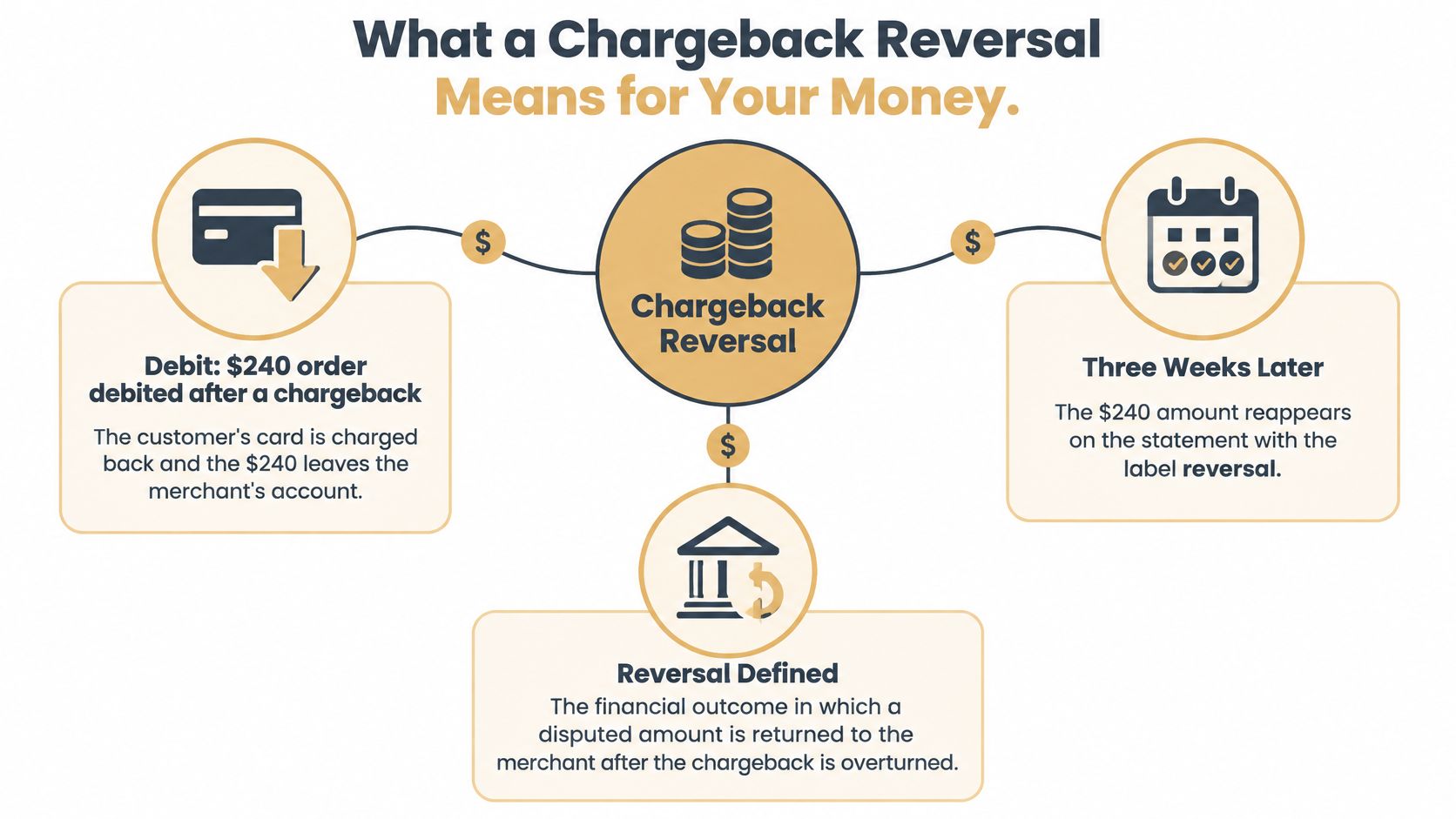
A chargeback reversal is the financial outcome in which a disputed transaction previously debited from your merchant account is credited back after the issuing bank or card network accepts your defense. According to Visa's small-business dispute resolution guide, the operational mechanism that triggers this outcome is representment, a formal request in which you submit transaction-specific proof through your acquirer or payment processor so the issuer can re-evaluate the chargeback.
Representment evidence isn't a general character reference for your store. You're answering a specific reason code with concrete records: authorization logs, carrier delivery confirmation, refund history, customer messages, device or account linkage, and proof that you delivered the service. The issuing bank reviews whether those records directly address the code attached to the dispute. When your evidence holds up, the issuer overturns the provisional debit and sends the disputed amount back through the network to your acquirer, which credits your account.
Don't confuse that credit with a merchant-initiated refund. When you issue a refund, you choose to send settled funds back to a buyer. When a chargeback reversal posts, you've contested the issuer's decision to take your money, and the bank has shifted financial liability back off your balance sheet.
The Four Actors Behind Every Reversal
Money and paperwork move through four separate hands before a reversal ever hits your payout, and each party has a narrow job:
- The cardholder starts the clock: They contact their bank to challenge a line item on their statement, claiming fraud, non-delivery, or a billing error.
- The issuing bank holds the gavel: It posts a temporary credit for the cardholder, files the chargeback against your bank, and later decides whether your evidence satisfies the card network's reason code.
- The acquirer acts as your courier: Your acquiring bank or payment processor receives the debit, pulls funds from your merchant balance, and transmits your representment package back to the issuer.
- You supply the proof: Your team produces the order, fulfillment, and communication records that either rebut the claim or leave the debit standing.
A reversal isn't a reward for running a good business or having polite support reps. It's strictly a liability decision based on whether your transaction records satisfy the rules tied to that dispute code.
Reversal vs Refund vs Alert vs Chargeback Side by Side
Payment dashboards reuse words loosely, and that's where most accounting and operations mistakes start. A processor might label an early canceled authorization or a quick same-day credit as a "reversal," even though neither involves a dispute. Compare the four formal dispute-adjacent events side by side before you record a single entry in your books.
| Event | Who starts it | Money movement | Contestable by merchant | Effect on dispute ratio |
|---|---|---|---|---|
| Refund | Merchant | Leaves merchant, reaches cardholder | Not applicable, voluntary | None |
| Dispute alert (RDR, CDRN, Ethoca) | Card network or issuer | No debit yet | Not applicable until a chargeback posts | None if refunded before the chargeback posts |
| Chargeback | Cardholder with issuer | Debited from merchant provisionally | Yes, through representment | Counts |
| Chargeback reversal | Issuer or card network | Restored to merchant | No, the decision is made | Recorded in history; the original case still exists |
Two Reporting Traps Merchants Hit Most Often
The first trap shows up when teams reconcile a refund that closed a pre-dispute alert alongside a chargeback reversal won through representment. Both cases end with a closed ticket, yet they leave completely different footprints in your payment history. A refund sent on an incoming alert prevents a formal chargeback from ever posting, keeping your monthly dispute ratio clean. A reversal restores the sale amount after a win, yet the original chargeback record stays in your historical file.
The second trap is treating refunds and reversals as interchangeable tools once a customer complains. Sending a discretionary refund is fast, predictable, and avoids formal dispute fees, whereas fighting for a reversal demands staff time to compile evidence, ties up your cash during the review window, and can still leave you paying a non-refundable processor fee. If you're weighing whether to return funds early or let a case play out, reviewing the mechanics of chargeback vs refund helps your finance team separate voluntary credits from formal liability disputes.
Accounting check: Never reconcile a statement entry by its label alone. Always match the credit back to either a refund ID, a pre-capture void, or an open dispute case ID before adjusting revenue.
How the Reversal Process Runs from Dispute to Restored Funds
Seeing the sequence from start to finish shows exactly where you have influence and where control leaves your hands. The diagram below maps the core movement from an initial buyer complaint to restored funds.
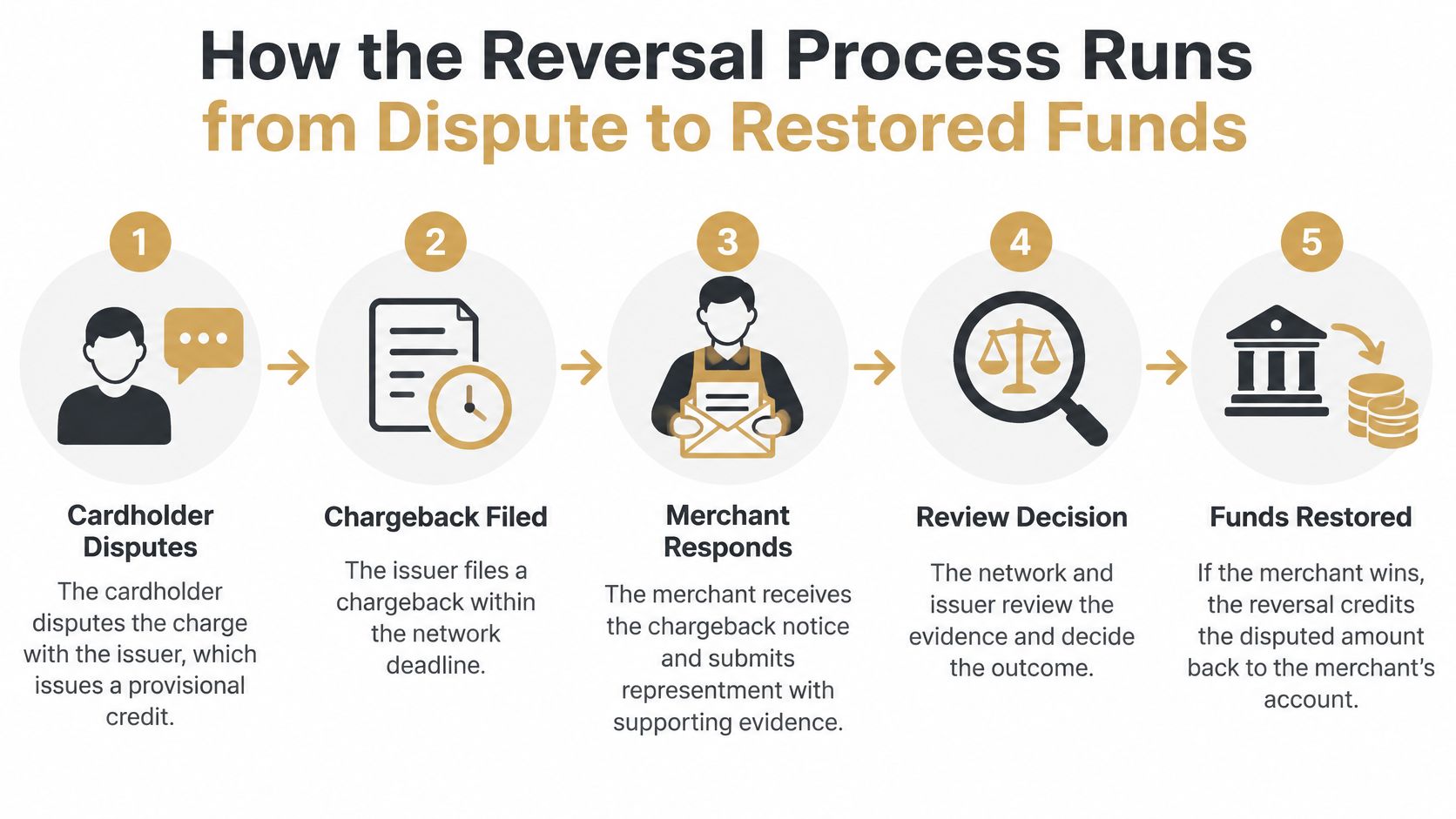
Inside a merchant's day-to-day workflow, that lifecycle breaks down into six distinct stages:
- The cardholder disputes the transaction. The buyer calls or taps inside their banking app to challenge the charge. Their issuing bank typically places a provisional credit on the cardholder's account while it opens an inquiry.
- The issuer files a formal chargeback. Under Mastercard's rules for dual-message workflows, an issuer generally has up to 60 calendar days after receiving a cardholder dispute to submit a chargeback when the applicable conditions are met. At this stage, you have no visibility unless you're enrolled in pre-dispute alerts.
- The acquirer debits your balance and forwards the reason code. Your payment processor receives the claim, deducts the disputed amount from your payout, and surfaces the case with a hard due date in your dashboard.
- You assemble reason-specific evidence. This is your primary window of control. You match the reason code on the notice to transaction-level records rather than dumping every PDF in your order system into one upload.
- Your acquirer submits the second presentment. As outlined in Spreedly's guide to chargeback representment, response windows depend on the network, processor, and dispute category, commonly running roughly 7 to 30 days, though the exact deadline displayed by your processor always controls. Miss that cutoff and you lose by default, even when your order was completely valid. Once submitted, control leaves your hands.
- The issuer accepts or rejects your defense. If the issuer accepts the second presentment, financial liability shifts back to the issuer and the debit is reversed to your account according to card-scheme settlement timing. If the issuer rejects your evidence, the dispute doesn't automatically reverse; it can escalate to pre-arbitration or card-network arbitration, which drives up handling costs and puts pressure on your dispute ratios.
Evidence That Rebuts Common Reason Codes
Upload volume doesn't impress a dispute analyst reviewing dozens of files an hour. Match your documentation directly to what the cardholder alleged.
| Claim | Evidence that rebuts it | Example |
|---|---|---|
| Merchandise not received | Proof of delivery | Carrier delivery confirmation tied to the order |
| Unauthorized use | Authorization and usage trail | Authorization record and account linkage |
| Recurring billing | Cancellation and refund timestamps | Logged cancellation and refund dates |
Many disputes also start because a buyer expected a credit, couldn't spot it on their statement, and called their bank in frustration. Sharing clear refund reference numbers and pointing buyers to practical resources on recovering refunds owed by retailers from Compass+ helps anxious customers trace pending credits through normal channels before they ever trigger a formal chargeback.
If you want a visual walkthrough of how issuers, acquirers, and merchants pass evidence back and forth during representment, watch this short breakdown.
Reversals aren't won by uploading a 40-page evidence packet. They're won on reason-code alignment, clean transaction data, and meeting the processor's exact deadline.
Reversals That Happen Without a Merchant Win
Most merchants assume the word "reversal" always brings good news. Card-network rulebooks tell a sharper story: a reversal can also be an automated penalty triggered when someone misses a procedural step, wiping out a representment even if the underlying sale was legitimate.
Consider a specific rule in Mastercard's Chargeback Guide: when both the issuer and acquirer sit outside Europe, and the acquirer fails to upload supporting documentation through Mastercom within 10 calendar days of the representment settlement date, Mastercard triggers an 11-calendar-day automated reversal. In that scenario, Mastercard credits the issuer and debits the acquirer back. The merchant might have had signed delivery proof sitting in a warehouse inbox, yet the case reverses against them purely on procedure.
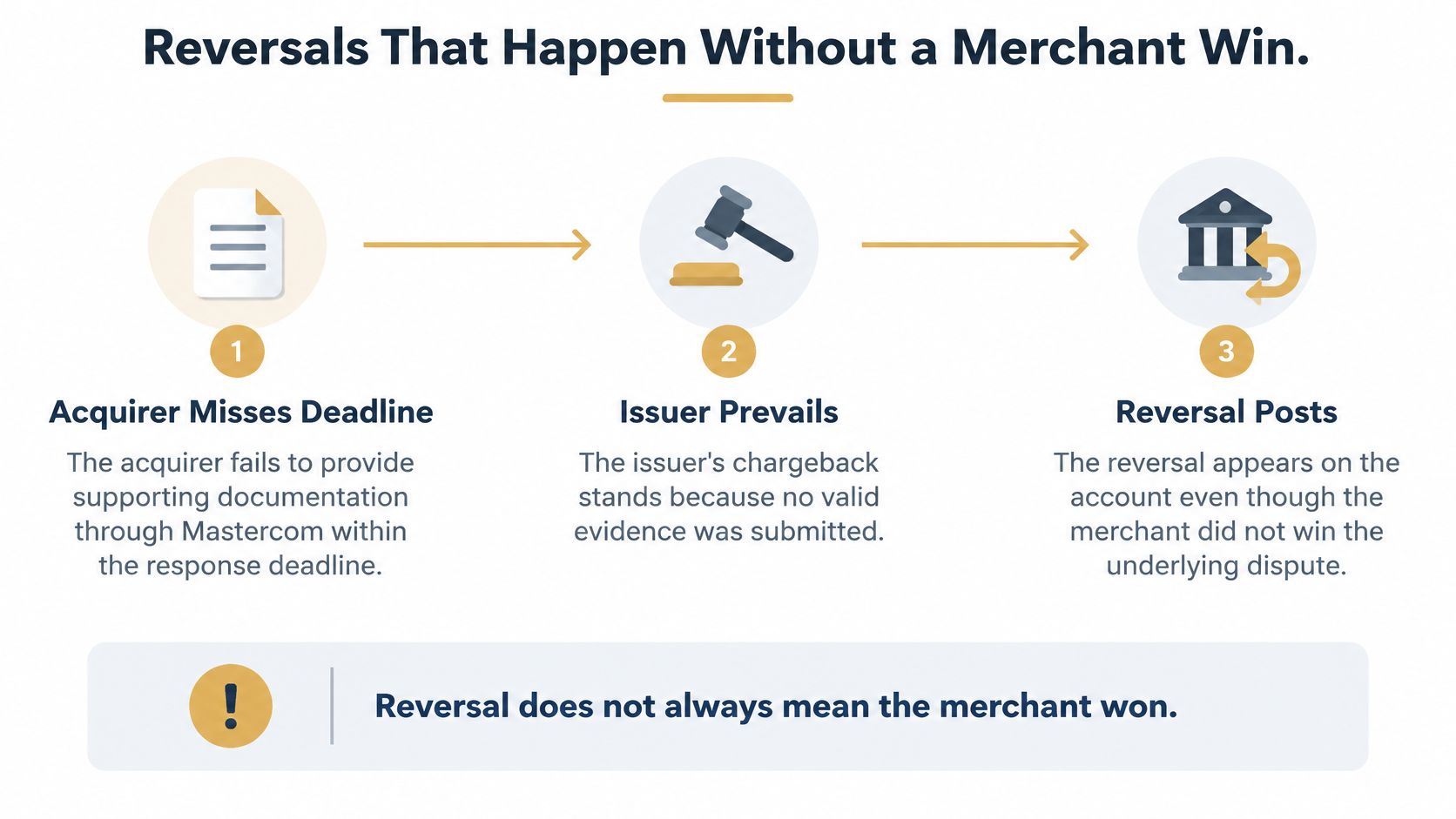
Procedural forfeits aren't the only way a reversal label appears without a classic representment win. Three other everyday events end up looking like reversals on statements or dashboards:
- The cardholder withdraws the dispute early: A customer remembers the purchase, spots a family member's name on the box, and calls their bank to drop the claim before it becomes a finalized chargeback.
- The issuer pulls back a temporary credit: When a cardholder's claim falls apart during review, the bank removes the temporary funds it advanced, a process detailed in how a provisional credit reversal unfolds on card accounts.
- A merchant refund closes an incoming alert: You receive an alert notification, refund the transaction before the bank files the chargeback, and the dispute closes out without ever reaching representment.
Why Three Clocks Control Every Case
Dispute operations trip up growing teams because three separate timers run simultaneously, and missing any one of them changes who keeps the money.
First is the cardholder-dispute window that governs how long an issuer has to file. Mastercard's Chargeback Guide generally requires a chargeback to be submitted within 120 calendar days of the Central Site Processing date unless a specific reason code sets a different limit. Second is your processor's evidence deadline, which shrinks your actual prep time down to a matter of days after the notice hits your dashboard. Third is any network-specific procedural deadline, like the Mastercom documentation window, that can automatically unwind a representment if files arrive late or incomplete.
For ecommerce and subscription businesses, those overlapping clocks lead to one practical takeaway. You can't scramble to rebuild transaction history after a notice arrives. Keeping immutable logs of checkout authorization, fulfillment scans, carrier delivery, subscription cancellations, and customer emails is what keeps an automated procedural reversal from erasing a sale you legitimately earned.
What a Chargeback Reversal Means for Cardholders
A cardholder opens their banking app, spots a charge they don't recognize, and taps the dispute button. Within days, a provisional credit appears on their statement. The balance looks fixed. Many shoppers treat that moment as the end of the story, when in fact the bank has only made a temporary loan against the outcome of an investigation it has barely started.
Consumer resources such as Ireland's Competition and Consumer Protection Commission chargeback guide explain chargebacks as a card provider's power to reverse a transaction and return money, yet they rarely spell out that the provisional credit itself can be undone. Many customer disputes end up filed as formal chargebacks, and in every one of those cases the temporary credit is an opening move rather than a final decision.
Here is what the buyer experiences once the bank opens the case. While the provisional credit sits on their statement, the issuer passes the dispute to your acquirer and waits for your response. If you don't reply, or your records don't match the reason code, the credit becomes permanent and the customer keeps the money. If your evidence persuades the issuer, the bank pulls that provisional credit back off the cardholder's statement and sends a brief letter saying the case was resolved in the merchant's favor.
That pull-back is the reversal from the buyer's side. Exact timing depends on card-network settlement rules rather than any fixed calendar date.
Frustration peaks here because banks rarely share the delivery receipt or login record that swayed the ruling. The cardholder only sees money arrive, then leave again weeks later, with no explanation of which document decided it.
When a Merchant Refund and a Dispute Cross Paths
Timing overlaps create a double-entry headache for buyers and support teams alike. Say a customer emails your support desk asking for a refund on Monday, gets impatient on Tuesday, and files a bank dispute before your credit finishes posting.
By Friday, your refund lands as a separate credit line on their card, while the bank has already opened a formal case. Once you submit the refund confirmation to answer the dispute, the bank reverses the provisional dispute credit so the buyer doesn't collect twice. Anyone scanning a monthly statement without context sees a refund credit followed by a reversal adjustment, and it looks like you clawed their money back unfairly.
One sentence in a shipping confirmation or refund receipt, saved by either side, often decides which version of events the bank believes.
Customer-side reality: When a cardholder loses a reversal on a genuinely failed delivery, it usually means the bank sided with cleaner paperwork rather than fairness. Both buyers and merchants win or lose on saved confirmations, delivery logs, and dated cancellation records.
When Not to Pursue a Reversal
Treating every incoming chargeback as a fight you have to win is one of the fastest ways to bleed margin and trigger card-network monitoring. Chargebacks aren't a fringe edge case anymore. According to Mastercard and Datos Insights' 2025 global chargeback report, global volume is estimated at 261 million chargebacks in 2025, representing about $33.8 billion, with merchants and financial institutions reporting that first-party and third-party fraud together make up roughly 45% of merchant chargeback volume.
The same report cites separate Visa Acceptance research projecting first-party fraud cases at 30.6 million in 2025 and 38.2 million by 2028, accounting for 21% of merchants' chargebacks, while 57% of merchants reported rising refund or policy abuse. Those numbers make it tempting to contest everything on principle.
Run the unit economics first. Separate Mastercard and Datos Insights cost research from 2025 found that each chargeback costs merchants an average of $128 in third-party fees and internal operating costs. Say a customer disputes a $12 monthly subscription renewal because your cancellation link failed to fire. Spending staff time and paying dispute overhead to fight a $12 claim with shaky evidence means you lose twice: you still forfeit the $12 sale, and you stack operational losses on top of it.
Reflexive representment also creates a hidden compliance risk. When you push weak cases into representment and lose, issuers can escalate disputed claims into pre-arbitration, adding steep network fees while your dispute ratio stays high.
A Risk-Based Checklist for Every Incoming Claim
A reversal is a liability decision, not a blanket revenue-recovery tactic. Sort every incoming case through three clear paths before you upload a single document:
| Claim situation | Action | Reason |
|---|---|---|
| Failed cancellation, undisclosed renewal, non-delivery or unprocessed promised refund | Accept and refund | A reversal would lose on the merits and add cost |
| Ambiguous claim with partial evidence | Investigate | Gather records before committing to representment |
| Delivery, authentication and service evidence match the reason code | Represent | The evidence can rebut the claim |
When your own records confirm a missed delivery, a surprise renewal, or a refund your team promised but never processed, contesting the dispute hurts both your bank standing and your customer relationship. Save representment for cases where your authorization, fulfillment, and support logs directly answer the allegation.
Stopping Disputes Before a Reversal Is Needed
Even when you win a representment and get your funds restored, you've already absorbed the operational drag of a formal dispute and left a permanent mark in your chargeback history. Prevention beats representment every time because stopping a dispute before it turns into a chargeback keeps both your revenue and your processing standing intact.
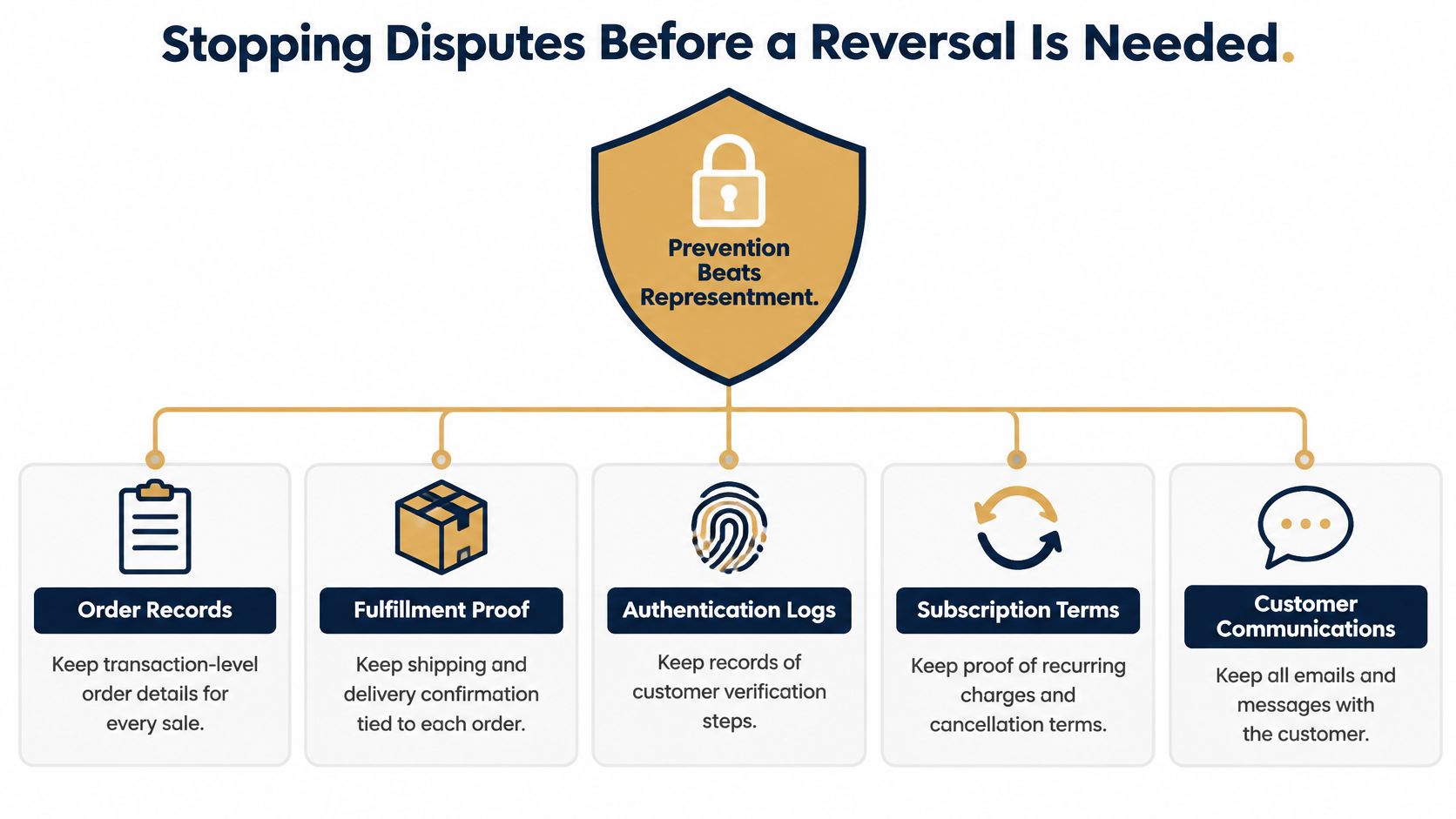
Strong prevention starts well before checkout closes. Clear billing descriptors, upfront renewal reminders, transparent return windows, and responsive tracking updates cut down the confusion that pushes buyers straight to their banks. Merchants building out those everyday store safeguards can pair operational workflows with the practical checklists in the AmaJova guide to dispute-proof selling from AmaJova, which focuses on removing friction points before customers ever question a charge.
Building a Four-Layer Prevention Sequence
Once basic checkout and fulfillment hygiene are in place, structure your dispute operations in four layers, moving from earliest intervention to last-resort recovery:
- Lock down immutable transaction records. Store order details, carrier tracking scans, IP and device authentication logs, subscription consent timestamps, and customer support threads at the transaction level. If a claim ever reaches representment, clean records let your team pull reason-code proof in minutes instead of hunting across four separate apps.
- Intercept disputes with pre-dispute alerts. Card-network alert programs including Visa RDR, Verifi CDRN, and Ethoca notify you the moment a cardholder challenges a transaction with their bank. That alert gives you a 24 to 72 hour window to issue a refund, closing the claim before a formal chargeback posts so your dispute ratio stays untouched. Understanding what are RDR alerts shows how automated rule-based resolution handles those requests in real time.
- Route alerts through clear refund rules. Don't treat every alert the same way. Set automated thresholds so low-value, clearly legitimate claims refund immediately, while ambiguous or high-ticket orders route to manual review. Disputely is one option for managing this alert layer: it connects directly to Stripe, PayPal, Shopify Payments, Authorize.net, and Square, matches incoming Visa RDR, Verifi CDRN, and Ethoca alerts to the underlying order, and issues refunds according to your configured rules so disputes never post or count against your ratio. Its dashboard also tracks every dispute, monitors your chargeback ratio, and shows how much revenue was saved.
- Automate representment only for what slips through. For disputes that bypass alerts and arrive as formal chargebacks, automate deadline tracking and evidence compilation so no valid case turns into a procedural forfeit.
Treat chargeback reversal as your final backstop, never your primary dispute strategy.
Check Your Reversal History This Week
Before changing a single processor setting, run one focused audit. Pull the last 90 days of dispute records from your payment processor and sort every case into four buckets:
- Reversed after representment: Cases where your evidence restored the funds.
- Lost or accepted: Cases where the debit stuck, either because you didn't contest or the issuer rejected your defense.
- Closed by refund before a chargeback: Claims caught early through support tickets or pre-dispute alerts.
- Still open: Active disputes waiting on evidence submission or an issuer ruling.
Next to each bucket, write down two numbers: the total dispute fees paid and how many cases had evidence submitted on time. That one spreadsheet gives you a clear fork in the road.
If most of your losses came from missed submission windows or evidence that didn't match the reason code, your core problem is operational, and fixing transaction-level record capture plus automated deadline monitoring will lift your recovery right away. If most of your losses were legitimate customer claims involving late shipments, missed cancellations, or unclear renewals, fighting harder won't save you; tighten your refund rules and cancellation flows instead.
Finally, plot your monthly dispute ratio right alongside your reversal count. Seeing money restored feels like a clean slate, yet those original cases still sit in your processor's risk reporting. If your ratio is creeping upward even when you win reversals, shift your effort upstream into pre-dispute alerts so fewer charges ever become formal chargebacks in the first place.
Protecting your merchant account means managing disputes across the entire lifecycle rather than scrambling only after funds leave your balance. Our platform covers all three stages: Resolve before a dispute opens, Alerts when a cardholder contacts their bank, and Recover when a formal chargeback needs reason-specific representment. Visit Disputely to connect your payment processor and stop avoidable chargebacks before you ever need a reversal.


