
What Is Straw Buyer: Fraud Red Flags and Prevention
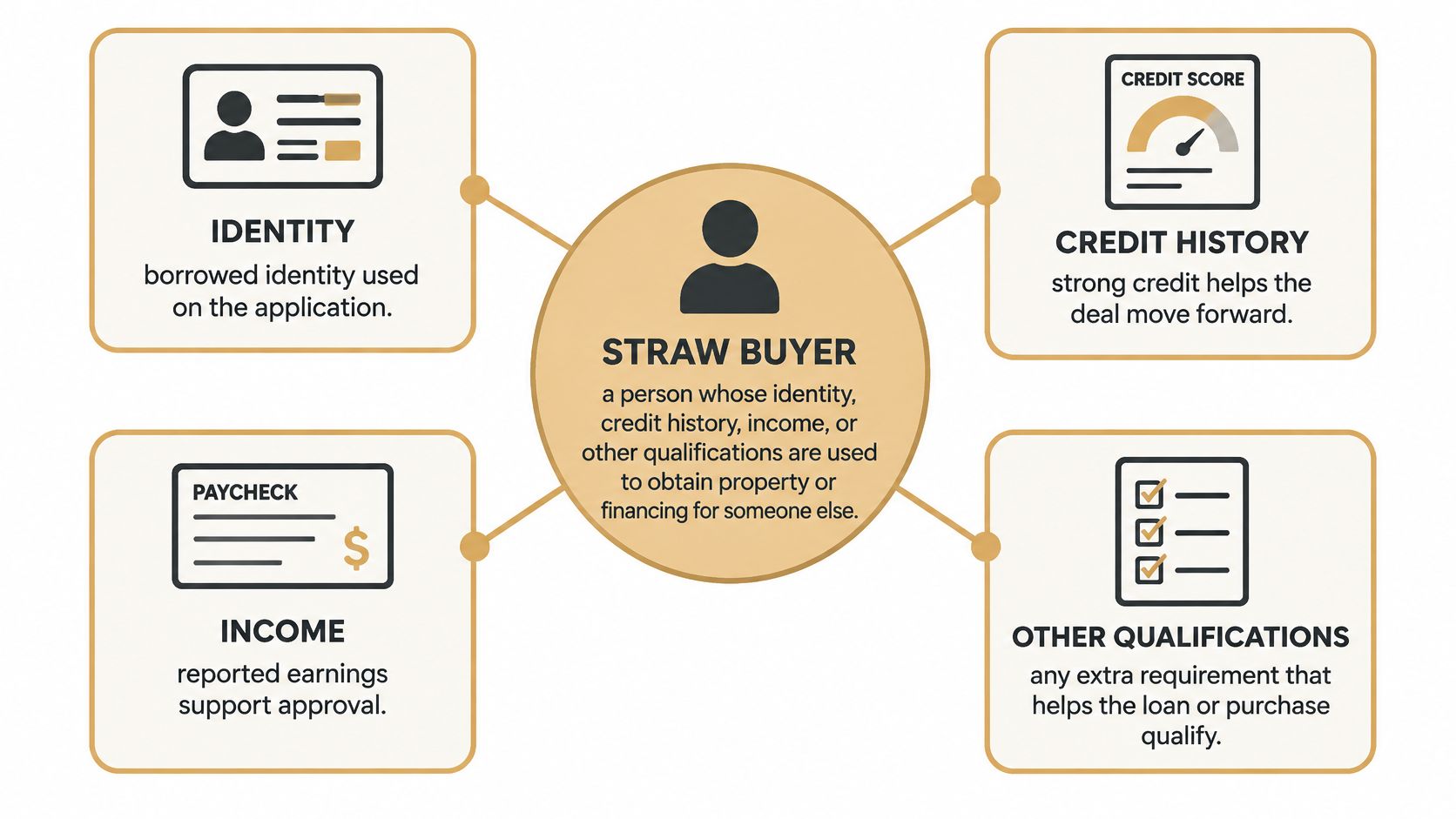
A straw buyer is a person whose identity, credit or qualifications are used to buy or finance property for someone else who is the true purchaser or controller. If you're reviewing a loan application, a vehicle purchase or a payment that doesn't quite fit the customer's profile, the key question is whether the person named on the paperwork is also the person who will control and benefit from the transaction.
That distinction matters because a third-party payer or a family member helping with a purchase isn't automatically committing fraud. The risk arises when someone hides who's really in control or gives a lender or merchant misleading information. For businesses, tracing who pays, who receives the asset and who directs what happens next can help separate a legitimate arrangement from concealed ownership.
What a Straw Buyer Is and Why Lenders Miss Them
A straw buyer is a person whose identity, credit history, income or other qualifications are used to obtain property or financing for someone else who is the true purchaser or controller. The straw buyer is the name on the door, while the controller holds the keys.
In a mortgage application, the named buyer might state that a home will be their primary residence despite having no intention of living there. The lender assesses the person it can see in the application, not the undisclosed party who intends to control the property or proceeds.
The FBI's account of mortgage fraud describes a scheme in which straw buyers were paid to lend their names to loan documents while organizers, brokers, agents and attorneys arranged the transactions. That kind of division of labor helps conceal who is directing the deal. In a Houston investigation covering 2005–2008, conspirators recruited people with good credit and sought loans of up to 100% of each property's sales price. The scheme generated about $16 million in loans based on false information and caused an actual loss of $5.4 million.
The term doesn't mean that a relative helped someone buy a home or that a co-signer is present. It describes a deal in which the named buyer's credentials help obtain financing while the actual beneficiary or controller is concealed. Similar arrangements can arise in vehicle finance, although the relevant rules and offenses differ by jurisdiction.
The practical test is concealment and misrepresentation, not whether another person helped with the purchase. A lender should ask whether the application accurately reflects who will use, control and benefit from the asset.
How the Straw Buyer Scheme Moves Money and Title
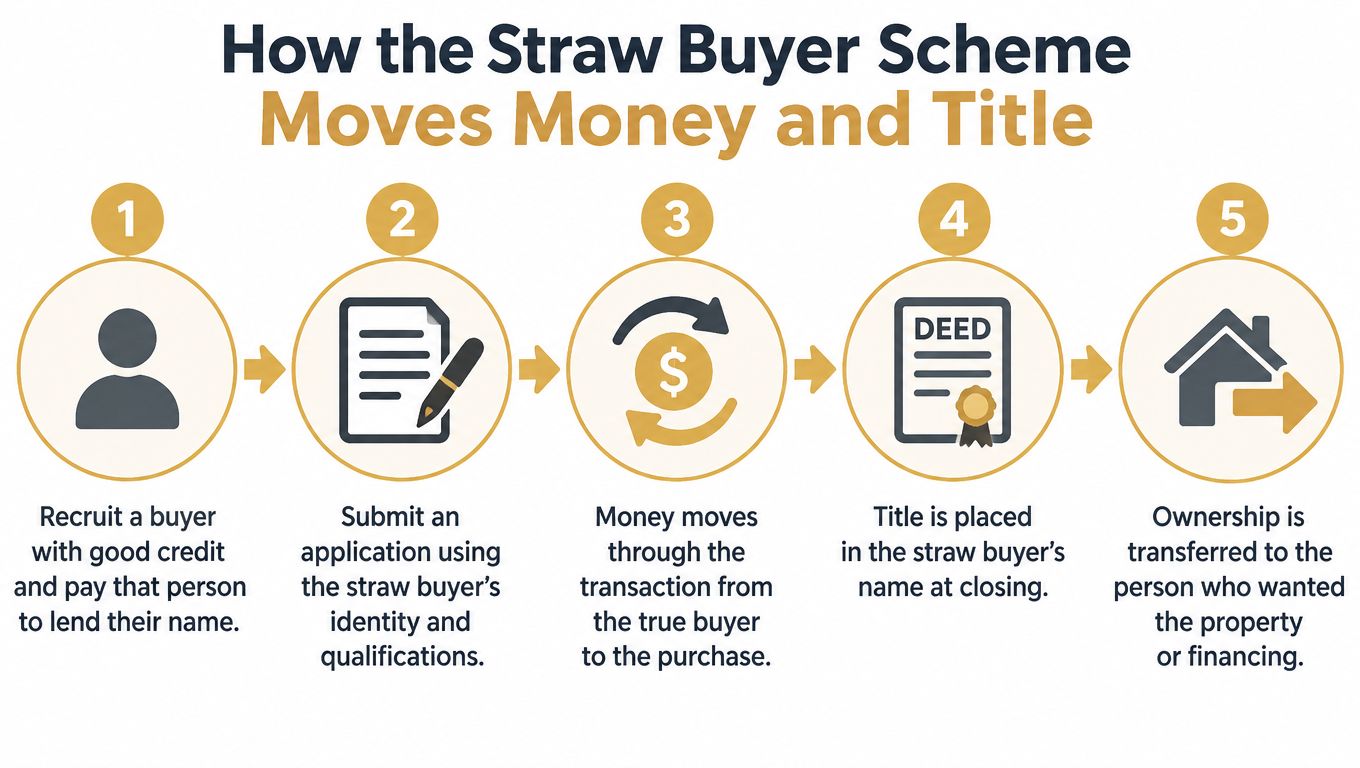
A mortgage file can satisfy every item on a checklist and still hide the person directing the deal. The scheme works like a relay: each participant hands a clean-looking piece of the transaction to the next, so no single checkpoint ever sees the full pattern. The concealment typically opens at five points.
Recruitment: An organizer finds someone with strong credit and pays them for the use of their name and borrowing history. To the lender, the file shows a qualified applicant and nothing about who found them. Worth flagging here: sometimes the named borrower agreed to the arrangement, and sometimes the credentials were used without that person's knowledge, which changes who counts as the perpetrator and who counts as the victim.
Application: The named buyer submits documents that may misstate occupancy, income, assets, employment or beneficial ownership. False W-2s, tax forms or appraisals make the file appear to support the stated qualifications.
Underwriting and funding: The lender assesses the person on the application and the paper in front of it. In the FBI-described property-flipping pattern, financing could cover the full sales price, so the lender funds the entire deal while the true controller stays outside the file.
Movement of proceeds: Excess loan money may pass through accounts linked to fictitious businesses. The lender can see the recorded transfers without knowing who ultimately controls those accounts.
Control after closing: The concealed party may keep or flip the property, or capture the gain, while the straw buyer remains the borrower of record. The title and loan documents identify one person, but economic control sits elsewhere.
The FinCEN overview of mortgage loan fraud describes the central mechanism as separating legal title from economic control, supported by false documents such as W-2s, tax forms and appraisals. FinCEN's analysis also identifies straw buyers as a recurring element in fraud-for-profit mortgage schemes, which fits the sequence above: the name on the file exists to monetize financing rather than to house anyone.
Merchants can borrow the same test for orders and payouts. Compare who places the order, who pays, who receives the goods or proceeds, and whether those are the same person. A successful payment authorization confirms the charge went through; it says nothing about who controls what was purchased. And when value gets spread across many smaller transfers, the concealment starts to resemble how smurfing distributes activity across transactions, a related pattern worth recognizing on its own terms.
Straw Buyer Cases From Mortgages to Cars
A mortgage case shows what disguising the person behind a purchase can cost. In a Houston investigation covering 2005–2008, conspirators recruited people with good credit and submitted false applications seeking loans of up to 100% of each property's sales price. The scheme produced about $16 million in loans and caused an actual loss of $5.4 million. One participant received a 14-year prison sentence and was ordered to pay $5.4 million in restitution, according to the FBI's account of the investigation.
Vehicles attract the same arrangement on a smaller scale. A person with good credit buys and finances a car for someone else who will drive it and make the payments, while the lender approves the loan believing the buyer is the actual user. One reported case involved about 16 recruited buyers and 90 vehicles allegedly redirected into a car-sharing operation, which shows how a single organizer can multiply the pattern across many loans.
The figures below distinguish individual case outcomes from an industry-wide estimate:
| Item | Figure | What it shows |
|---|---|---|
| Houston mortgage scheme, 2005–2008 | About $16 million in loans | Financing sought on false applications, often up to 100% of the property price |
| Houston actual loss and restitution | $5.4 million | Loss caused and restitution ordered |
| Houston sentence | 14 years | Prison term for one participant |
| 2025 auto-lending fraud exposure | $10.4 billion | Estimated fraud exposure across auto lending |
| Share attributed to straw purchases | 5.8 percent | Estimated portion of that exposure tied to straw buyers |
| Reported car-sharing case | About 16 buyers and 90 vehicles | Financed cars allegedly redirected to commercial use |
The auto-loan fraud analysis estimates $10.4 billion in 2025 auto-lending fraud exposure and attributes 5.8% of it to straw purchases.
Notice who participates in each case. The Houston recruits and the car buyers were knowing participants who lent their names and credit, usually for a fee. Other schemes run on stolen identities, leaving an unwitting victim whose name appears on a loan they never sought. The paperwork can look identical to a lender, but the exposure and the response differ: a recruited buyer faces prosecution and restitution, while an identity victim has to dispute the loan and clear their record.
Now compare a parent buying a car for a teenager who will drive it. That arrangement is not automatically a straw purchase, and a co-signer is not automatically a straw buyer. What matters is disclosure: whether the application tells the truth about who will use the asset and who will repay the loan.
Red Flags That Signal a Straw Buyer
Use this checklist when reviewing an order, lending application or payout. Each signal calls for a closer look, not an automatic fraud finding.
| Signal | What It May Indicate | Enhanced Review Step |
|---|---|---|
| Payment or refund sent to a third party | Payer and account holder differ | Request payer authorization and matching documents |
| Shipping address far from billing address, or changed after payment | Undisclosed true recipient | Hold fulfillment and verify the delivery address |
| Repeated orders from unrelated identities sharing one device or card | Identity or device reuse across accounts | Correlate device fingerprints and card data across accounts |
| Buyer profile inconsistent with order size or stated income | Inflated qualifications | Request authoritative income or asset documentation |
| Abrupt change in payout account before settlement | Concealed beneficiary taking control | Pause the payout and confirm account ownership |
| Buyer says someone else will make the payments | Undisclosed controller of the asset | Treat as a warning sign and escalate before approving |
One signal rarely proves that a buyer is concealing control. A family member may pay for a purchase, or someone may legitimately ship an item to another address. Several mismatches together, especially when the explanation changes or the recipient and payer remain unclear, may justify a fulfillment hold, authoritative documents or escalation.
Practical rule: Record the signal, the evidence you checked and the reason for your decision. That creates a review trail without treating every unusual purchase as fraud.
If a payment is declined during review, it also helps to understand the difference between a temporary and a permanent decline before deciding whether to retry or request another payment method. Spell's guide to comparing temporary and permanent card declines explains why those responses call for different handling. For ongoing oversight, transaction monitoring can help teams assess patterns across accounts rather than judging an order in isolation.
Legal and Chargeback Consequences for Each Party
Calling every person connected to a suspicious transaction a fraudster misses an important distinction: a person may knowingly lend their identity, or their information may have been used without consent. The FinCEN report on real estate industry suspicious activity distinguishes knowing straw buyers from people whose identities were used without permission or who were manipulated into signing documents.
| Party | Typical Exposure | First Action |
|---|---|---|
| Knowing straw buyer | Misrepresentation liability, the debt, damaged credit and possible criminal charges | Stop, don't sign further documents and consult counsel |
| Unwitting identity victim | Fraudulent debt appearing on the credit file | Preserve evidence, notify the creditor, remediate the credit report and report to police |
| Merchant or lender | Chargebacks, losses and disputes when the payer isn't the real beneficiary | Escalate the order, document the decision and tighten review for similar orders |
For an individual, ask four questions: Did they consent? Did they know who would occupy the property or make payments? Did they sign inaccurate statements about income, occupancy or assets? Who controlled the funds? Someone who knowingly accepts a fee or signs statements they know are false can face different risks from someone whose identity was stolen. A person who suspects identity theft should preserve records, contact the creditor, address inaccurate credit reporting and report the suspected misuse to law enforcement.
A merchant faces a different problem. If the person who authorized payment doesn't control the goods or proceeds, the transaction may later produce a dispute or chargeback. That dispute can be the first indication that the customer on the account wasn't the true beneficiary. Keep the transaction record and escalate the case rather than assuming that payment authorization proves legitimate ownership.
Don't sign financial documents you can't independently verify, especially if someone else promises to make every payment.
A people-search service, such as a people finder tool, may help locate publicly available identity information, but it can't establish consent or prove who controlled a transaction. Laws and remedies vary by jurisdiction, so this is general information, not legal advice. Anyone involved in a real case should consult a qualified lawyer.
How to Prevent Straw Buyer Fraud in Your Business
A verified account works like a checked ticket: it proves someone was allowed through the gate, not that they own what's in their bag. Prevention means testing who benefits from the transaction, not just who paid for it. FinCEN's assessment found straw buyers in 83% of reviewed fraud-for-profit mortgage cases and 15% of fraud-for-housing cases, as described in its overview of mortgage loan fraud. In one property-flipping pattern documented by the FBI, buyers with good credit submitted applications with inflated income and assets while excess loan proceeds moved through accounts linked to fictitious businesses.
Build controls around the link between the named customer and the transaction's economic purpose:
Collect beneficiary and authorized-payer details. Ask who's paying and who'll receive the asset or proceeds. A common gap is recording the account holder but not the intended beneficiary.
Compare identity, payment and delivery information. Match the account identity, funding instrument, delivery address and device. A successful authorization alone doesn't prove the named buyer owns or controls the goods.
Correlate activity across accounts. Look for unrelated identities sharing a device, payment card or other infrastructure. Reviewing each order separately can hide connections across accounts.
Review changes before settlement. Check abrupt payout or delivery changes, especially when the customer can't explain them. A late account update shouldn't bypass the usual review.
Hold and verify when signals combine. Request authoritative documents and pause fulfillment or payout while you assess the mismatch. An automatic refund can be as poorly grounded as an automatic approval.
Preserve evidence of purpose and delivery. Keep relevant communications, delivery confirmation and records showing how the named buyer relates to the transaction. That context may matter if a dispute follows.
Write down the decision. Record which signals appeared, what the reviewer checked and why the team released or held the transaction. Clear records make an escalation easier to explain to a processor or dispute reviewer.
The same signal can point at two very different people. A knowing straw buyer consented to the transaction and often answers verification questions smoothly, while someone whose identity was stolen may not recognize the purchase at all. Record which situation you appear to be facing, because the escalation path, the likely dispute and the exposed party differ for each.
A firm's know-your-customer requirements can guide how identity information is collected and reviewed at each step. For a complex case involving unclear identities or layered transaction parties, businesses may engage qualified investigators, such as PI's in London, where appropriate to their location and legal obligations.
Decide Whether Your Checks Catch Straw Buyers
A useful test is simple: run one ordinary order and one suspicious-looking order through the same steps, then see where the process breaks. Can checkout store the payer separately from the account holder? Does someone review a payout-account change before settlement? Does a delivery-address change after payment pause fulfillment? Do shared devices or cards across unrelated identities trigger review?
Mark each answer yes or no. If most answers are no, the weakness is a process gap across the workflow. Name one person to own holds and escalations, then write down the first three signals they will check, such as a mismatched payer, a changed delivery address and shared device details.
When those signals combine, separate likely intent before choosing the response. Consistent explanations may point to an ordinary third-party purchase, while rushed changes around identity, delivery or payout can point to deliberate concealment. If the named buyer seems unaware their identity was used, handle it as a possible fraud-victim case instead of a dispute with that buyer.
After the next month of disputes, compare those signals with what appeared and decide which checks to keep or adjust. Set the owner, the three signals and a review date one month out, then keep that appointment on the calendar.
Disputely analyzes order patterns to identify potential disputes and chargebacks, and customers pay only when chargebacks are successfully prevented. It does not guarantee prevention, fewer chargebacks or processor approval. If your team wants to add chargeback alerts to this workflow, visit Disputely to learn how the platform may fit.


